Why we love it:
- It’s a good looker
- Lots of kit
- Spacious and quiet
Where it could be better:
- Rear visibility could be better
- The name could be less confusing
- Even more driver engagement would be cool
Introduction
Omoda shouldn’t be mistaken for Jaecoo, even though the two brands share many similarities, writes our motoring journalist Tim Barnes-Clay.
Both are sub-brands of the esteemed Chinese manufacturer Chery, which also markets cars under its own name. Additionally, they offer similarly named, closely related models in Britain, which can lead to confusion.
Omoda and Jaecoo are also expanding their presence together, recently celebrating the opening of their 100th dealership in the UK, with ambitions to increase that number by approximately 30% in the near future.
What about their cars? The Omoda 5, the company's first model, was launched in Britain, achieving great success and even becoming the best-selling model in the Greater London area in 2025. Although this wasn't replicated across the nation, being the 'King of the Capital' in your first year of existence is not a bad achievement at all!
Following this, the larger Omoda 9 SUV was introduced last summer, and now, bridging the gap between the two is the new mid-sized Omoda 7.
On The Road
Handling & Performance
The petrol-powered Omoda 7 can sprint from 0-62mph in 10.4 seconds, which is comparable with its competitors. However, we're driving the brand's more powerful plug-in Super Hybrid System (SHS) model, comprising an 18.3 kWh battery and a 1.5-litre engine, which cuts that time down by an impressive two seconds.
The electric motor primarily handles acceleration from a standstill, though you can prioritise the engine's involvement by adjusting the driving modes. In Eco mode, it's feasible to undertake a medium-distance journey solely on electric power.
Indeed, the 7 showcases good responsiveness when drawing solely on the electric motor. This characteristic makes it suitable for urban driving, where it accelerates swiftly enough for navigating ring roads while remaining smooth and untroublesome in stop-and-go traffic.
Therefore, it's very easy to attain a respectable speed before the engine kicks in, and when it does, it continues to push you to whatever speed you need to get on to a motorway. If you choose Sport mode, it increases the accelerator's sensitivity, which is perfect for a swift burst of speed on open roads, though it's a bit jerky at slower speeds.
The SHS's engine operates quietly, only becoming apparent when pushed hard. Ride comfort is generally a strong point – the suspension does a commendable job of smoothing out potholes and bumps, ensuring stability throughout.
When cornering, the Omoda 7 lacks the engaging driving experience of sportier models like the Ford Kuga. Nonetheless, for a mid-sized SUV, it provides ample grip when tackling faster bends and makes a good fist of resisting body roll.
A notable positive about Omoda, along with its parent company, Chery, and sister brand, Jaecoo, is their willingness to heed feedback. Jaecoo's initial models faced criticism for overly intrusive driver assistance systems and braking issues. Fortunately, improvements have been made to the Omoda 7, including a smoother brake pedal progression. The driver assistance still intervenes more readily than in rivals, but far less intrusively than in earlier Omoda/Jacoo/Chery vehicles.
As briefly alluded to earlier, the Omoda 7 in SHS guise offers a quiet ride, thanks to acoustically treated glass and active noise cancellation. However, there's still more tyre noise at higher speeds than some competitors.
Styling
Omoda presents its design philosophy as 'art in motion'. The recent reveal at London Fashion Week, rather than a typical motor show, effectively highlights this sentiment.
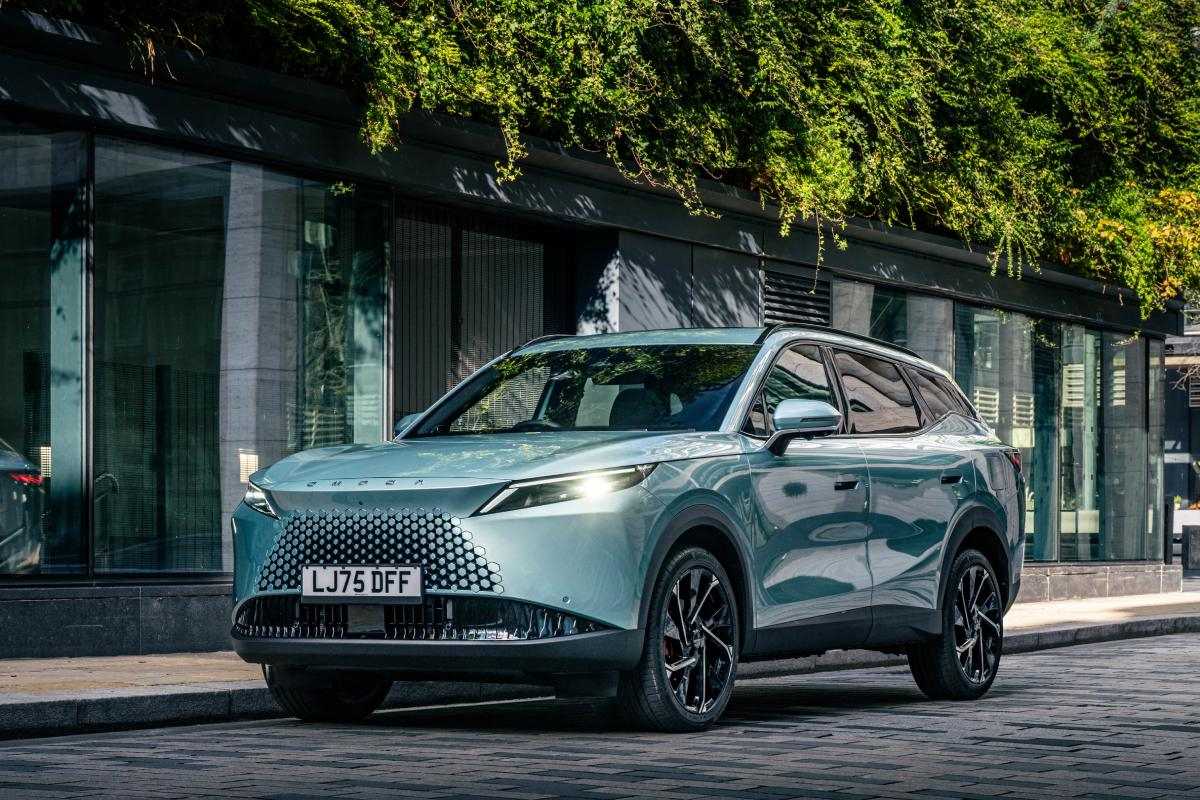
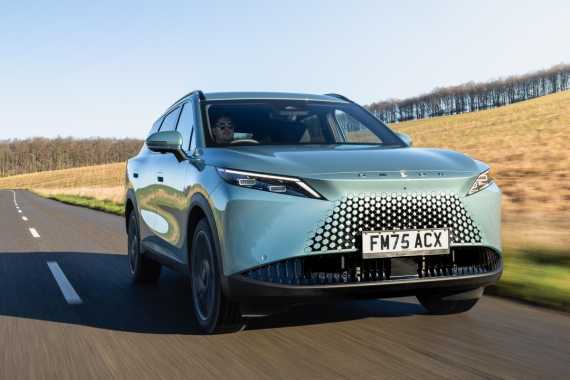
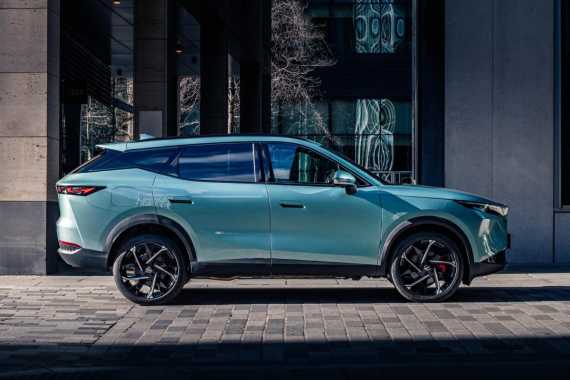
The Omoda 7’s design first catches your eye with its seamless grille that merges smoothly with the bodywork, complemented by sleek triangular headlights that impart a distinctly modern feel.
At the front, the 7 boasts a sharp silhouette with a pronounced nose that leads to a very upright grille, set above a lower grille featuring vertical spokes, which sits just beneath the front registration plate.
The SUV character is emphasised by cladding along the lower sides, including around the wheel arches, with a slight thickening at the vehicle's midsection.
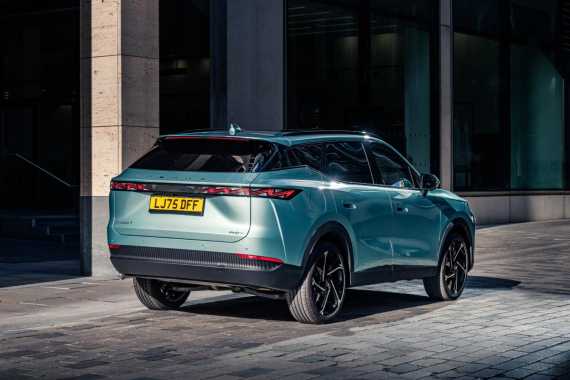
Going to the back, the tailgate has a diagonal section that meets a vertical drop, highlighted by a light bar running across its width, with the Omoda logo at the top and the registration plate at the bottom. Although not identical, there appears to be a familiar similarity to the Range Rover Evoque in the tail section.
Visually, it stands out brilliantly, so it's no surprise the SUV is being showcased on a fashion platform.
The Omoda 7 is available in two trim levels, both well-equipped and packed with tech.
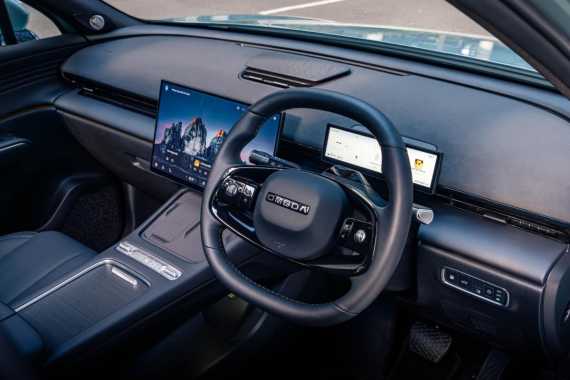
The entry-level Knight variant includes 19-inch alloy wheels, a sizable 15.6-inch infotainment touchscreen with Apple CarPlay and Android Auto, built-in satellite navigation, and voice control. An 8.88-inch digital instrument cluster adds to the modern look, alongside a six-speaker premium Sony sound system.
Additional features include dual-zone climate control with air purification, a wireless phone charging pad, a rear-view camera, a six-way adjustable driver's seat, and a heated eco-leather steering wheel.
The top-spec Noble version enhances the experience with 20-inch rollers, a 540-degree panoramic camera, four-way electric adjustments for the front passenger seat, plus a powered panoramic sunroof and a powered tailgate. While retaining the same Sony sound unit, this model upgrades to twelve speakers and includes ventilated front seats.
Additionally, the premium edition features a fragrance system and an enhanced two-zone voice control for the air conditioning, capable of identifying the speaker's location to adjust the temperature in either the front or rear intelligently.
Space & Practicality
Achieving a comfortable driving position is straightforward thanks to the Omoda’s six-way electric seat adjustment, available as standard across all models.
The upgraded Noble trim we’re reviewing further enhances comfort, as mentioned earlier, with a four-way power adjustment for the front passenger seat, offering ample range for both the seats and the steering wheel.
The Omoda 7 provides an excellent, elevated perspective of the road ahead, with relatively slender front pillars that mean you have an unobstructed view at intersections. However, rear visibility is not as impressive, as the sloping roofline compromises it.
On the plus side, front and rear parking sensors come as standard on all models, with the entry-level Knight trim equipped with a rear-view camera, while our higher-spec model features a "540-degree" panoramic view camera. This innovative feature offers a combined view from various angles, allowing you to see through the vehicle as if it were transparent via the screen.
Inside, there's ample headroom and legroom, while the broad centre console effectively maintains personal space in the front. The rear seating area also impresses with significant legroom compared with most competitors, and even the panoramic sunroof in our Noble test vehicle doesn’t encroach on rear headroom, despite the roof's slope.
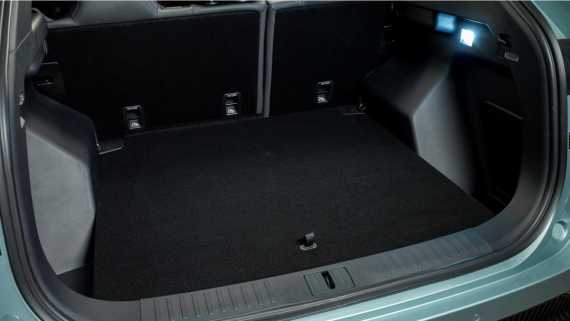
In terms of luggage capacity, the petrol variant offers 639 litres, though in our SHS model, it’s cut to 590 litres due to the underfloor compartment accommodating the 18.4 kWh battery. Nonetheless, even that surpasses the capability of many peers.
The rear seats can be folded in a 60/40 split, which is standard for this category, though a few challengers offer a more flexible 40/20/40 split. With the rear seats down, volume expands to 1,417 litres.
The cabin also features numerous storage options, including a substantial lidded compartment in the centre console. This is located between the wireless phone charger pad and the central armrests, under which another cubby is nestled. Additionally, there’s a spacious glovebox and well-sized door bins to accommodate personal items.
Ownership
Running Costs
The Omoda 7 SHS is equipped with an 18.4 kWh battery, providing an all-electric range of 56 miles on a complete charge.
According to Omoda, with its 60-litre fuel tank brimmed, the vehicle's total range extends to an impressive 745 miles. Expect up to 403mpg and CO2 emissions as low as 23g/km.
The charging capability of the Omoda 7 SHS is capped at 40kW DC. Although this may be slower than a fully electric vehicle, as a plug-in hybrid electric vehicle (PHEV), it has a significantly smaller battery, allowing it to reach a full charge relatively quickly.
Additionally, many PHEVs lack the capability for DC fast charging altogether and are limited to around 7kW AC charging. A top-up from 30% to 80% via DC takes roughly 20 minutes.
Omoda hasn’t disclosed charging durations for a 7kW AC home wallbox, but it’s likely to take around three to four hours for a complete charge from 0% to 100%.
For those considering the Omoda 7 SHS as a company car, it falls into the 9% Benefit-In-Kind (BIK) tax band. However, some rival PHEVs might qualify for a lower band thanks to their extended electric ranges.
It is worth noting that no PHEV can match the BIK tax benefits of a fully electric vehicle.
As for reliability, Omoda provides peace of mind with a seven-year, 100,000-mile warranty, aligning with the industry leader, Kia.
However, this is outdone by Geely, another Chinese newcomer, which offers an eight-year warranty, while Toyota, Suzuki, and Lexus promise ten years if you opt for main dealer servicing.
Verdict
The Omoda 7 boasts several advantages, including a respectable electric-only range, an impressive array of standard features, and a stylish, spacious cabin that surpasses many of its opponents – all at a competitive price for a PHEV.
However, the 7 falls a little short in terms of driver engagement - but that shouldn't be a dealbreaker - as this will in all likelihood be bought as a family car, not a vehicle for hooning around in.
Given that Omoda is a relative newcomer, it's hard to gauge its reliability, but the generous seven-year warranty provides oodles of reassurance.
Our higher-end Noble model is impressive, but the entry-level Knight model holds its own, offering a specification list that outshines many competitors'.
So, if your priorities include value for money, efficiency, practicality, and a pleasing interior, the Omoda 7 is certainly a commendable car.