Why we love it:
- Stand-out design and plenty of tech
- Very capable on and off road
- Refined with hushed cabin
Where it could be better:
- Limited driving range
- Lower payload capacity than diesel version
- Not being classified as a commercial vehicle has cost implications
Introduction
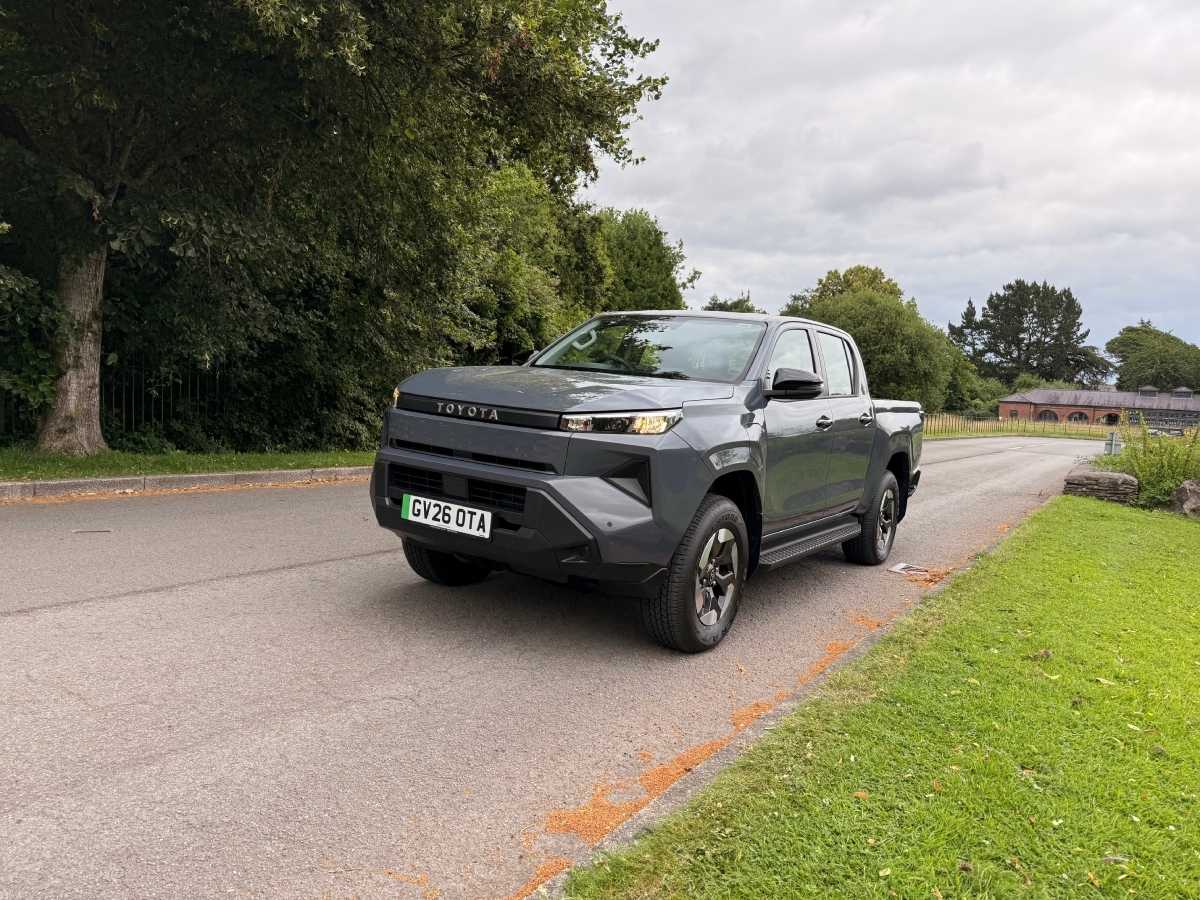
The Toyota Hilux has long-been a popular pick-up choice for farmers, gardeners and adventurers looking for a hardy expedition vehicle that can tackle any terrain with a confident spring in its step. But now Toyota has introduced a fully electrified version that brings a fabulous mix of old and new to the table.
It still features the renowned ladder-frame chassis, which is just ideal for housing the battery pack, yet it delivers silent running with a 59.2kWh battery and two electric motors for all-wheel drive.
With a limited driving range of just 159 miles, it’s not designed for anyone who clocks up heavy motorway mileage, but could be the ideal model for the fleet manager who needs vehicles to cover depot-based daily journeys with zero emissions. That could be anything from airports to forestry, councils and holiday resorts.
There are trims called Icon and Invincible to choose from and while they are all Double Cab, both versions are offered with just two seat options which is beneficial for taxation purposes.
We opted for the Icon Double Cab four-seater for our test drive with a retail on-the-road price of £57,845, before the government electric grant of £5k was deducted.
On The Road
Handling & Performance
The Hilux BEV features a 59.2kWh battery with two electric motors – one on each axle – delivering permanent all-wheel drive. The combined power output is 193bhp with 205.5Nm of torque on the front axle and 268.6Nm at the rear. The 0-62mph time is just over nine seconds and the pick-up maxes out at 87mph. That’s not too shabby for a vehicle that can wade through water up to a depth of 700mm (identical to the diesel-powered model) as well as scramble across the roughest terrain with ease.
Admittedly the driving range is a modest 159 miles between charges, but that should be perfectly adequate for the type of customer that purchases the vehicle.
When it comes to performance, the Hilux BEV is pleasantly engaging with sharp acceleration via the single-speed transmission and plenty of power on tap to overtake at short notice. And the first thing you will notice by its absence is the noise of a grumbling diesel engine. Instead, the Hilux BEV goes about its business without any fuss in blissful silence.
The elevated driving position results in excellent all-round visibility and although there are no steering wheel paddles to adjust the strength of the regenerative braking, there is a B mode which recoups extra energy as the vehicle slows down.
On twisting B roads, it’s agile and easy to throw around, but it feels quite wide at times as the lanes get narrower. There are drive modes called Eco, Normal and Sport that alter the driving dynamics accordingly as well as a Multi-Terrain Select (MTS) set-up that offers five more modes for challenging terrain. These are Rock, Sand, Mud, Dirt and, for the first time, Mogul for bumpy surfaces. There is also an automatic MTS mode whereby the system adopts the most suitable set-up for the driving conditions.
Styling
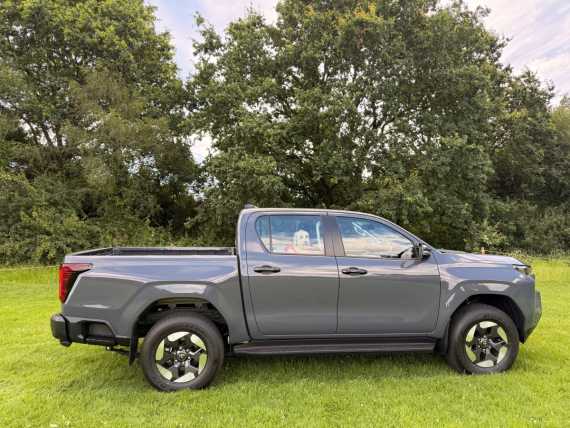
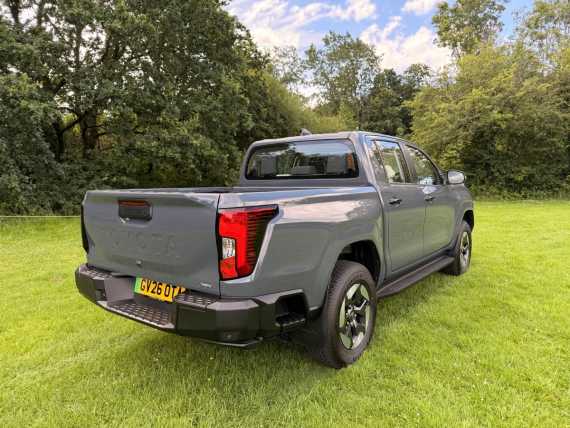
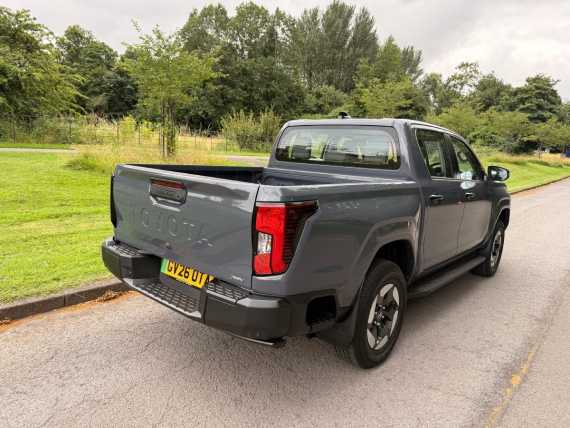
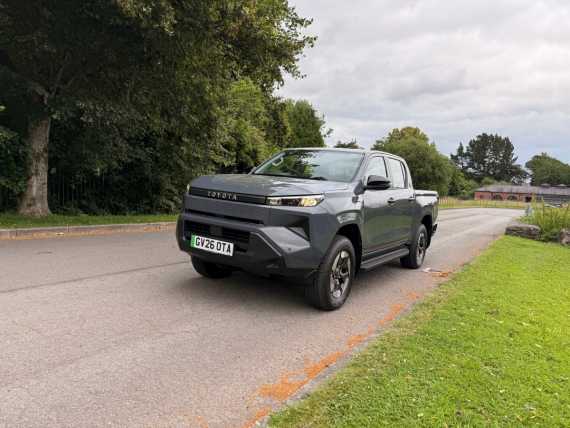
With its bold and commanding design, the all-electric Hilux sports a strong road presence with slim new headlights linked by a central bar bearing the TOYOTA name. The grille has a modern look with a hexagonal mesh pattern and there are stand-out wheel arch mouldings, side steps, rear privacy glass, a rear bumper step plus 17-inch alloy wheels.
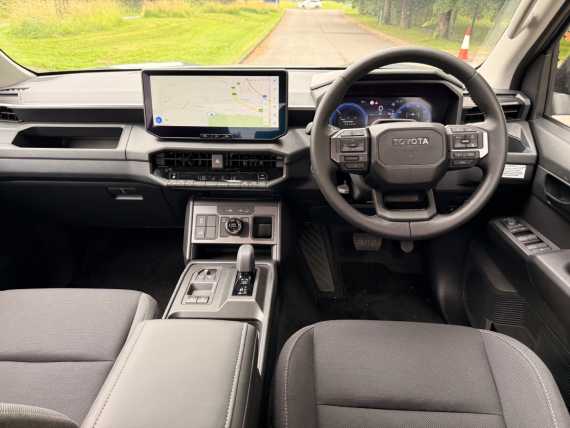
The interior is completely new and Toyota claims it’s the most significant upgrade in the Hilux’s history. The main focal point is a 12.3-inch multimedia system offering access to the on-board tech which includes an eight-speaker sound system, smartphone integration via Apple CarPlay and Android Auto, sat nav, DAB radio, Bluetooth, a rear-view camera with guidelines and plenty more besides.
Behind the steering wheel is a seven-inch driver display highlighting important data such as speed, battery charge levels and existing driving range. There is a separate panel for the climate control settings, along with plenty of proper physical buttons, dials and switches – something we always appreciate.
The supportive cloth-covered seats are manually adjusted but, along with the steering wheel, can be heated against the winter chill.
Everything inside this Hilux BEV has been designed for ease of use from the readouts to the responsive multimedia set-up.
Space & Practicality
The battery-powered Toyota Hilux certainly has plenty of kerb appeal stretching 5,320mm in length, 1,855mm across, 1,865mm tall and with a 3,085mm wheelbase. These dimensions are identical across both diesel and BEV powertrains.
But when it comes to carrying and pulling, electric pick-ups almost need to be separated completely from their diesel or petrol-powered siblings as they are quite different. They generally have a lower payload and a lesser towing capacity and that’s true of the Toyota Hilux BEV.
While the diesel-powered version can carry more than a tonne of goods in the back, the BEV version is set at 715kg for the Icon model, as tested, and 710kg for Invincible specification. Additionally, the diesel Hilux can pull a braked trailer or caravan weighing up to 3.5 tonnes, but the limit drops to 1.6 tonnes for the EV version.
But, the Hilux BEV is anything but a soft-roader – it can cross almost any terrain imaginable, with 212mm of ground clearance (309mm on the diesel unit) and has approach and departure angles of 29 and 24 degrees respectively.
There are side steps and grab handles to help get in and out of the high cabin, along with a handy rear step for leaning into the payload area. Storage options throughout the cabin are comprehensive too with a lockable glovebox, a deep central cubby, door bins with space for a bottle, seat back pockets, front and rear cup holders, lots of trays, a wireless charging pad and four USB ports.
Charging the 59.2kWh battery from 10 to 80 per cent takes approximately 30 minutes using a DC 150kW fast charger. If using a home or work-based wallbox, a 10 to 100 per cent boost will take around 6 hours, 30 minutes.
Ownership
Running Costs
The cheapest Toyota Hilux model in 2026 is the Single Cab version with a 2.8-litre diesel powertrain and this costs £36,295 (£30,315 excluding VAT). The most expensive version available is the Invincible X Double Cab, also featuring the same diesel powertrain, and this is priced at £76,195 or £63,565 excluding VAT.
The fully electrified line-up ranges from £57,845 (£48,273 excl. VAT) for the Icon Double Cab, as tested, to £61,995 (£51,731 excl. VAT) for the Invincible Double Cab two-seater. Our test car featured upgraded Storm Grey metallic paint that bumped up the final price-tag by an extra £730.
However, the vehicle is eligible for the government’s plug-in van grant of £5,000, which sees the asking price drop accordingly.
The government recently changed the taxation regulations for pick-ups and as the Hilux BEV has a double cab with rear seats, along with a sub-one-tonne payload capacity, it’s not regarded as a commercial vehicle for Benefit in Kind purposes. That means it is judged the same as a car mainly on CO2 figures, so resulting in a BiK rating of four per cent.
The vehicle does qualify as a Light Commercial Vehicle when it comes to road tax though, so owners will pay a flat-rate annual charge of £360.
And, buyers will need to look carefully at the VAT criteria because the Hilux has that sub-one-tonne payload. It really is as clear as mud!
Verdict
With global sales topping more than 27 million across seven decades, the exceptional toughness and go-anywhere ability of the Toyota Hilux has never been in doubt.
But now it is moving with the times offering an electric version to the line-up. While it looks like a Hilux and has plenty of ability both on and off-riad, this vehicle has a different target audience. Instead of heavy duty load-lugging and brutal mileage, it will be suited to fleets that need zero-emission vehicles, but still need plenty of capability such as the forestry commissions, airports, ferry terminals and the likes.
And that’s exactly where the Hilux BEV comes into its own – it is easy to drive, packed with tech and if the day-to-day mileage is not too demanding, the limited driving range should be just fine too.
However, Toyota is not stopping there – it is already developing a hydrogen fuel-cell Hilux which should be launched in 2028. We look forward to testing that one.