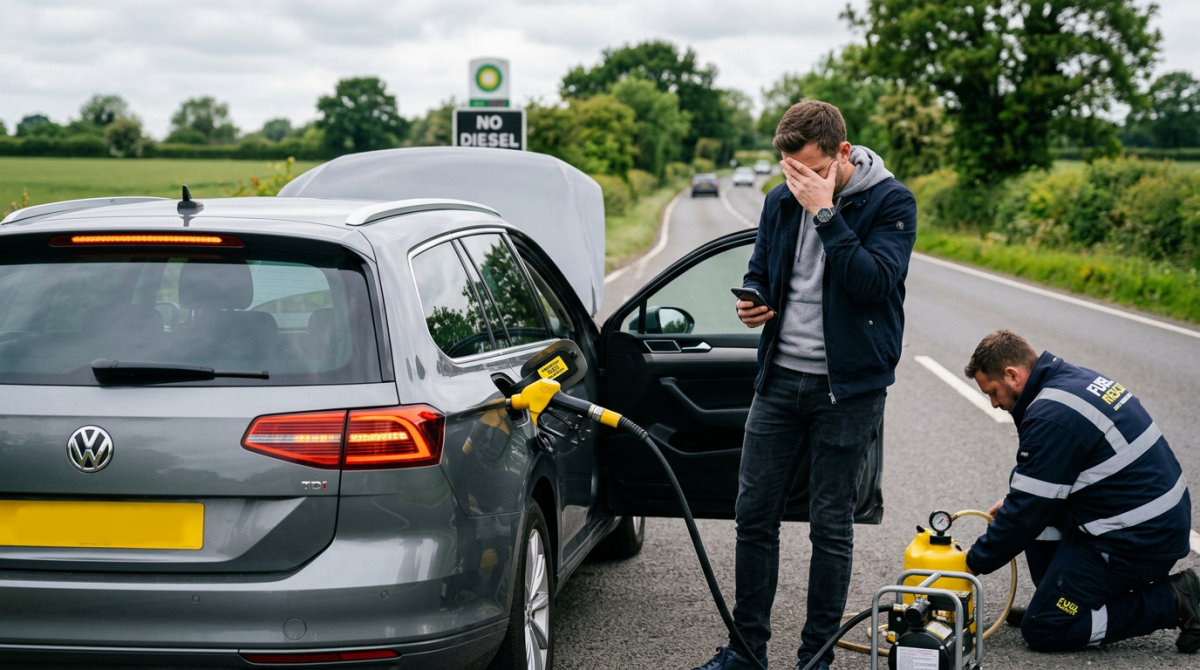
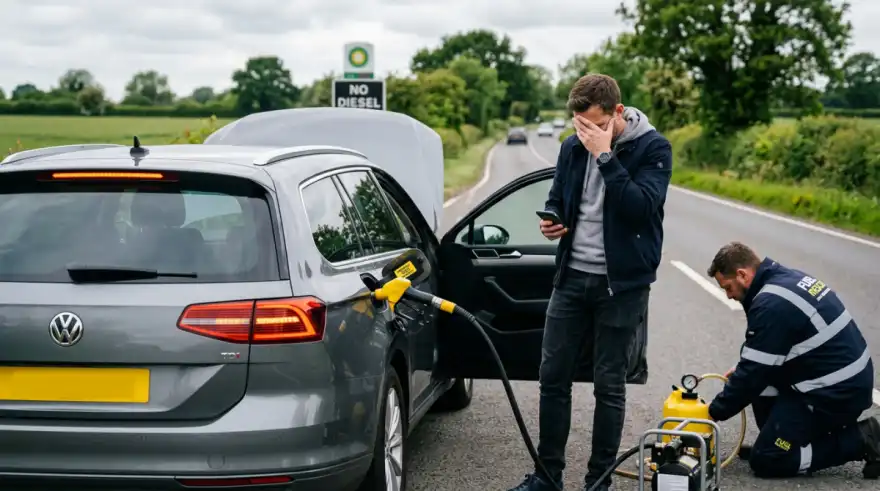
TL;DR: Putting the wrong fuel in your car is a common mistake that can be fixed easily if you act fast. The absolute key is to NOT start the engine. A professional fuel drain costs around £200, which is a small price to pay to avoid a potential £5,000+ bill for engine damage from wrong fuel.
UK drivers warned: The £5,000 'wrong fuel' mistake and how to fix it for £200
It’s a moment of dread that happens far more often than you might imagine. You’re distracted at the pump; maybe you're driving a new car or a hire vehicle, and your hand instinctively grabs the green petrol nozzle instead of the black diesel one. The latest data from GoCompare recently revealed a staggering statistic: 1 in 5 UK drivers, or 20% of the driving population, admit to having made this exact mistake at least once.
Key Facts
- 20% of UK drivers have admitted to misfuelling their car at least once, according to GoCompare data.
- £200 to £300 is the typical wrong fuel recovery cost for a professional mobile service in the UK.
- £5,000+ is the potential repair bill for a modern diesel engine if you drive it with petrol in the tank.
- Petrol in a diesel car is the most frequent and most destructive type of misfuelling error.
- RAC and the AA both confirm that not starting the engine is the single most important step to prevent serious damage.
Here at Regit, we know the panic of putting the wrong fuel in your car, but there's genuinely good news for both petrol and diesel car owners. If you realise the error quickly and follow a few simple steps, your vehicle, and just as importantly, your bank balance, will almost certainly be fine. This guide draws on first-hand expertise and data from the RAC, the AA, and leading automotive engineers to explain what this means for drivers and how to handle a misfuelling incident correctly.
The golden rule: Do not turn the key
If you catch your mistake while you’re still at the forecourt with the nozzle in your hand, stop filling immediately. The single most critical piece of advice from every expert in the industry is this: do not, under any circumstances, start the engine.
In fact, don't even put the key in the ignition or, in a modern car, press the 'Start/Stop' button. Why? Because the moment you turn the ignition to its first position, it often triggers the low-pressure electric fuel pump. This begins the damaging process of pulling the contaminated fuel from the tank and circulating it into the vehicle's sensitive fuel lines, filters, and high-pressure injection system.
As automotive insurance experts at Lifesure have noted, preventing this circulation is the crucial difference between a simple £200 fuel drain and a catastrophic £5,000 engine rebuild. It’s that serious.
What to do if you are still at the petrol station:
- Leave the engine completely off. Keep the keys out of the ignition.
- Let the petrol station staff know what's happened. They deal with this situation regularly and can help secure the area.
- Put the car into neutral. For an automatic, select 'N'. You'll then need to push the vehicle to a safe parking bay, out of the way of other customers.
- Call for roadside assistance. Your breakdown provider or a specialist wrong fuel recovery service is your next call.
Petrol in a diesel car: The high-risk scenario
Putting petrol into a diesel car is by far the most common type of misfuelling. This is mainly a design issue – the narrower unleaded petrol nozzle fits easily into the wider filler neck of a modern diesel vehicle. Unfortunately, it's also the most damaging scenario for your engine.
So, why is it so dangerous?
It all comes down to lubrication. Diesel fuel is oily and acts as a vital lubricant for the components of the high-pressure fuel injection system. Petrol, on the other hand, is a solvent. When petrol is introduced into a diesel system, it strips away that protective lubricating film. This causes metal-on-metal contact between incredibly fine-tolerance parts, like those inside the high-pressure fuel pump.
This friction creates tiny metal particles, or 'swarf', which then travel through the entire fuel system. These shards can completely destroy the high-pressure pump and clog the microscopic holes in your fuel injectors.
Diesel in a petrol car: Less common, still costly
It's physically harder to put diesel into a petrol car. The nozzle on a diesel pump is typically larger than the filler neck on a petrol car, acting as a built-in preventative measure. However, it’s not impossible, and it does still happen.
What happens to the engine?
The fundamental difference here is how the fuel ignites. A petrol engine uses a spark plug to ignite the fuel-air mixture. A diesel engine uses high compression. If you introduce diesel into a petrol engine, the heavy, oily fuel won't ignite properly from the spark. Instead, it will quickly coat the spark plugs in a thick, sooty residue, preventing them from creating a spark at all.
This leads to the engine misfiring badly, producing huge amounts of smoke, and eventually stalling completely. While it's generally considered less immediately destructive than petrol in a diesel, it's not without its own risks. If you attempt to keep driving, you can cause lasting damage to your catalytic converter and oxygen (O2) sensors, which are expensive components to replace.
Wrong fuel recovery cost compared to engine repair bills
What this all means for drivers is a clear choice: you can opt for a relatively inexpensive, proactive fix, or risk an eye-watering reactive repair bill.
- Professional Fuel Drain: A dedicated mobile service, like the RAC’s Wrong Fuel Recovery or the AA’s Fuel Assist, will typically charge between £150 and £300. This is an all-inclusive service where a technician comes to you, drains the contaminated fuel, flushes the system, and provides a small amount of the correct fuel to get you on your way. This is the smart choice.
- The 'Drive and Hope' Cost: If you start the engine and drive away, ignoring the misfuelling symptoms, you are gambling with a total fuel system failure. A new high-pressure fuel pump for a modern Euro 6 diesel engine can cost over £1,200 for the part alone. A full set of injectors can add another £1,500. When you factor in labour at a main dealer, you could easily be facing a bill that exceeds £4,000 or even £5,000.
Misfuelling symptoms: The red flags to watch for
Didn't realise your mistake at the pump? If your car starts acting up a few miles down the road, these are the tell-tale misfuelling symptoms you need to look for immediately:
For diesel engines with petrol:
- A loud, metallic knocking or rattling sound from the engine, especially under acceleration.
- A noticeable loss of power and very sluggish acceleration.
- The engine management light (EML) or glow plug light flashing on your dashboard.
- The engine may cut out and refuse to restart.
For petrol engines with diesel:
- Excessive smoke coming from the exhaust, often blue, grey or black.
- A severe engine misfire, making the car feel jerky and rough.
- The engine stalling frequently, particularly when you come to a stop or are idling.
Will your insurance or warranty cover misfuelling?
This is a question we get all the time. The answer is, it depends entirely on your policy. Some fully comprehensive insurance policies will include 'misfuelling cover' as a standard benefit, but many do not. Others may offer it as an optional add-on for a small extra fee.
However, it's crucial to know that many standard policies classify misfuelling as a 'preventable error' on the driver's part. In this case, they may not cover the cost of the fuel drain itself, though they would likely still cover the cost of recovering your vehicle to a garage if needed.
Regarding your car's warranty, you need to be very careful. Most vehicle manufacturers, including major brands like Ford, Volkswagen, and BMW, explicitly state in their warranty terms that any damage caused by using incorrect fuel is not covered. This makes the 'don't start the engine' rule more critical than ever to protect yourself from a huge, uninsured bill.
The professional fuel drain process explained
When a qualified technician from a service like the RAC or a specialist wrong fuel recovery firm arrives, they follow a strict, safe protocol to get you back on the road:
- Suction and Draining: They will connect a certified, explosion-proof vacuum pump to your car’s fuel tank to safely remove every drop of the contaminated mixture.
- System Flushing: Once the tank is empty, a small amount of fresh, correct fuel is put in. They then use this to flush the fuel lines, filter housing, and fuel rail to remove any lingering contaminants.
- Diagnostic Checks: The technician will often plug a diagnostic tool into your car’s OBD-II port to check for any fault codes that may have been triggered and to ensure the fuel pump is priming correctly.
- Refuel and Restart: Finally, they will add around 5-10 litres of the correct fuel to your tank. This is enough to get you safely to the nearest petrol station to fill the tank completely, which further dilutes any microscopic residue that might remain.
A note on E10 and premium fuels for UK drivers
Since the UK's standard grade of petrol switched to E10, there has been some confusion. If you own a classic or older car (generally pre-2011), it may not be compatible with E10's higher ethanol content. Accidentally putting E10 in a car that requires E5 isn't as catastrophic as a diesel/petrol mix-up, but it can cause long-term corrosion of rubber seals and fuel lines.
If you do this by mistake, the fix is simple. Don't panic. Just make sure you top up the tank with E5 'Super Unleaded' premium fuel at your next opportunity. The sooner you do this, the more you will dilute the ethanol content, minimising any potential harm.
What about putting standard 95 octane fuel in a high-performance car that recommends 98 octane premium? For a one-off mistake, it's generally safe. Modern Engine Control Units (ECUs) have knock sensors that will detect the lower octane rating and automatically adjust ('retard') the ignition timing to prevent engine knock or 'pinking'. You might notice a slight drop in performance, but it won't cause damage.
Final verdict: Your options just got better
A decade ago, putting the wrong fuel in your car was often a disaster that could lead to a vehicle being written off. Today, thanks to a network of 24/7 mobile fuel drain services, it's a manageable, albeit frustrating, inconvenience.
Our advice remains simple: Stay calm. Do not turn the key. Call the experts. By making the decision to spend around £200 now on a professional fuel drain, you are directly saving yourself from a potential £5,000 repair bill and preserving the life of your vehicle. Misfuelling is a common human error; don't let a moment of panic turn it into a permanent and costly mechanical one.
If you find yourself stuck at a forecourt, specialist brands like Misfuelled Car Fixer and all major breakdown providers offer rapid response times, often getting a technician to you in under 60 minutes. It's worth storing one of their numbers in your phone, it’s far better to be safe than sorry.