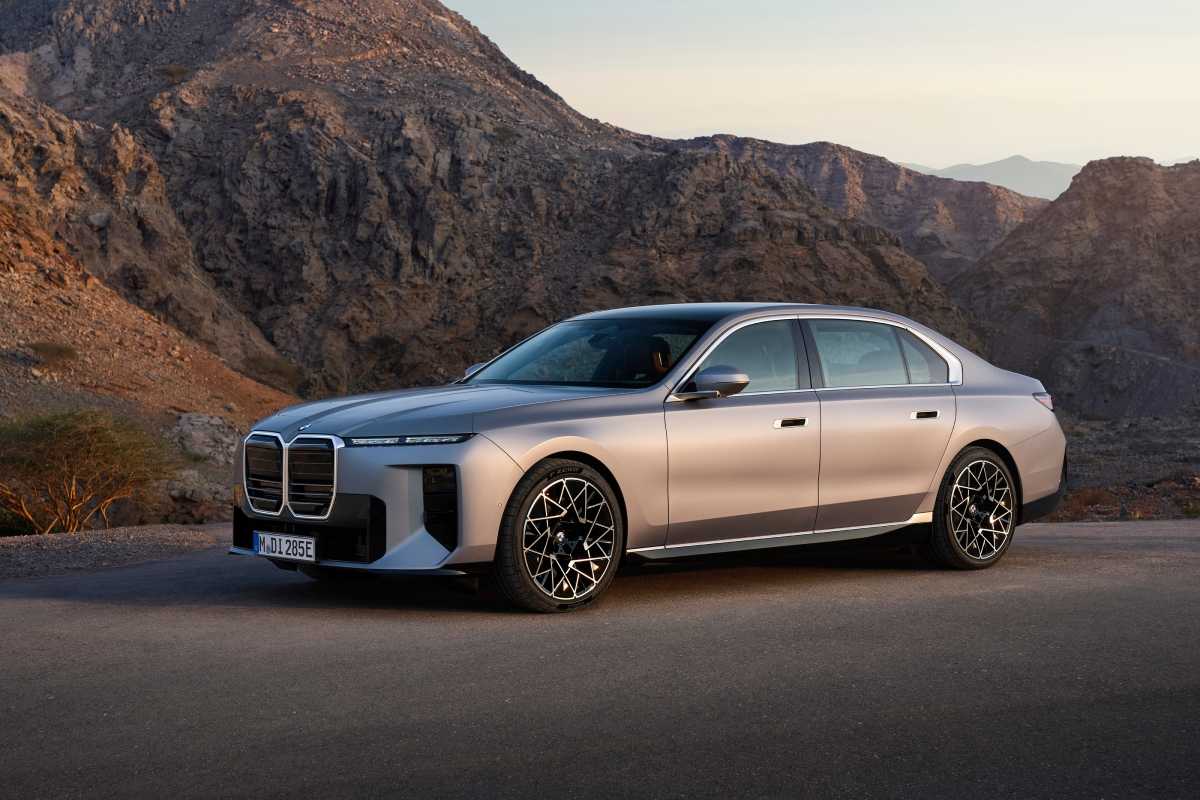
The BMW i7 is the electric version of BMW's 7 Series limousine, and the 2026 facelift gives it a bigger battery, faster charging and up to 452 miles of claimed range, with prices starting at £104,230. Regit's motoring reporter Tim Barnes-Clay drove the i7 50 xDrive M Sport, and he found it a superb car to travel in, but its strongest argument is as a company car, where the 4% benefit-in-kind rate means a higher-rate taxpayer pays about £1,670 this tax year. That bill climbs every year to 2030, though, so it's worth doing the sums for the whole length of your deal before you sign.
Tim will happily admit to a soft spot for BMWs, and he reckons the i7 does what a big BMW should, which is make you feel rather special every time you get behind the wheel. For him that makes it a heart-over-head choice, but the head gets plenty to like too, provided somebody else's accounts department is involved.
What does a BMW i7 cost as a company car?
Because it produces no tailpipe CO2, the i7 sits in the lowest benefit-in-kind band, which is 4% for 2026/27. On the £104,230 list price of the i7 50 xDrive before options, that's a taxable benefit of about £4,170, so a basic-rate taxpayer pays around £834 a year and a higher-rate taxpayer around £1,670 (LINK: Regit guide to electric company car tax).
The rate is already set to rise each year, so here's what the same car would cost you over a typical four-year deal, assuming the list price and your tax band stay the same.
| Tax year | BIK rate | Basic-rate taxpayer (20%) | Higher-rate taxpayer (40%) |
|---|---|---|---|
| 2026/27 | 4% | £834 | £1,668 |
| 2027/28 | 5% | £1,042 | £2,085 |
| 2028/29 | 7% | £1,459 | £2,918 |
| 2029/30 | 9% | £1,876 | £3,752 |
Regit calculation on the £104,230 list price of the i7 50 xDrive. Any options you add increase the taxable value. The Autumn Budget has also set the rate at 10% for 2030/31.
So by the fourth year a higher-rate taxpayer is paying more than twice what they started on, which is still a fraction of what a petrol limousine at this price would cost, but it's worth knowing before you pick a long lease. The fairer comparison is BMW's own 750e plug-in hybrid, and the outgoing version was taxed at 8%, according to Fleet News, which is double the i7's rate today. The new 750e arrives in November, with its price and tax band still to be confirmed.
That said, a BMW is a driver's car, and Tim argues there's little point having one as your company car if you only ever sit in the back, which would be like buying a mansion and never living in it, and anyone chauffeured around in an i7 would soon want the wheel for themselves.
BMW i7 price and specs
Prices start at £104,230 for the i7 50 xDrive, with the M Sport version Tim drove above it, and the i7 60 xDrive (from £120,335) and the 680hp M70 xDrive (£164,420) at the top of the range for buyers who want a lot more performance.
Even the entry car comes generously equipped, with a 17.9-inch central touchscreen, a 14.6-inch screen for the front passenger, Apple CarPlay and Android Auto, sat nav, heated seats, adaptive air suspension and four-zone climate control. M Sport adds a sportier body kit, darker exterior trim, an M steering wheel, upgraded brakes and 20-inch alloys.
The options list can get expensive very quickly, and the 31.3-inch theatre screen that folds down from the roof for rear passengers comes as part of a £6,350 Executive Lounge Pack, which also adds a lounge-style rear seat with a footrest. Tim's test car had no options fitted, and while we can see the temptation once you've spent more than £100,000, he thinks less is more here and wouldn't add anything.
BMW i7 design and interior
The i7 is enormous, and it looks it. The facelift brings a reshaped kidney grille, new headlights, a reworked bonnet and longer tail-lights, and Tim thinks it's an improvement on the old car, with a presence that will certainly get noticed in the company car park.
Inside, the materials and build quality are what you'd hope for at this price, the seats are properly comfortable, and there's plenty of adjustment in the driving position, so long journeys feel a lot less tiring. BMW's new Panoramic Vision display runs along the base of the windscreen from pillar to pillar, alongside a 3D head-up display, so you don't have to rely on the central touchscreen for everything.
We're sorry to see the iDrive rotary controller go, though, because a physical dial is easier to use than a screen when you're concentrating on the road. Tim's hand went looking for it out of habit a couple of times, but he'd adapted within five minutes.
There's loads of room in the front, and rear passengers get generous legroom and headroom, with reclining seats and a footrest available depending on the spec. The boot holds 500 litres, with extra space under the floor and a ski hatch, but the rear seats don't fold, so it's not the car for regular trips to the tip. The thick rear pillars restrict the view behind, and although parking sensors and a 360-degree camera help, the i7's sheer size still needs care in multi-storey car parks and narrow streets.
BMW i7 performance and driving
The i7 50 xDrive has 455hp and goes from 0 to 62mph in 5.5 seconds, which makes a car weighing the best part of three tonnes feel surprisingly effortless, and the i7 60 xDrive (544hp, 4.8 seconds) and M70 xDrive (680hp, 3.8 seconds) are quicker still. It gathers speed smoothly and without any fuss, which suits a car like this far better than a lot of noise would.
It will never feel like a small sports saloon through tight corners, but there's plenty of grip, the body stays well controlled and the steering gains useful weight as the road gets more demanding. Optional active roll stabilisation tightens things up further, and at this price we think it should be standard.
The ride is the best thing about it. The air suspension lets the i7 glide over bad surfaces, and the cabin stays quiet at motorway speeds. Tim drove it around Epsom Downs and the racecourse in Surrey, where it looked perfectly at home, and it wafted along beautifully, though like the horses up the road it could break into a gallop whenever he asked.
BMW has also smoothed out the switch from regenerative braking to coming to a stop, which matters more than you'd think for passengers in a big electric car. Driving Assistant Plus is standard, and Tim liked the way it keeps the car centred in its lane, which could make a real difference if your concentration dips for a second on a long motorway run.
BMW i7 range and charging
The new i7 has a 112.5kWh battery built from BMW's latest Gen6 round cells, and BMW quotes up to 452 miles of range for the i7 50 xDrive, 451 miles for the i7 60 xDrive and 426 miles for the M70, which is around 73 miles more than the old entry-level i7, according to BMW.
Tim's drive was on a warm day on A and B roads, and although he didn't go far, he averaged 3.3 miles per kWh, which points to a real-world range of about 370 miles. That's still enough to get from London to Newcastle or Manchester to Glasgow without stopping to charge.
DC rapid charging now runs at up to 250kW, and BMW quotes 28 minutes for a 10 to 80% charge on a fast enough charger. At home, a typical 7kW wallbox takes around 16 to 17 hours to fill the battery from empty, so overnight top-ups are easy but a full charge from flat isn't, and the i7 can take up to 22kW on AC, which helps at faster workplace chargers.
What does a BMW i7 cost private buyers?
Private buyers have a different sum to do. Electric cars now pay vehicle tax, at £10 in the first year and £200 after that, and because the i7 costs more than £50,000 it also pays the £440 Expensive Car Supplement from its second year to its sixth, which makes £640 a year. From April 2028 electric cars will also pay a new pay-per-mile charge of 3p a mile, which adds £300 a year if you cover 10,000 miles, or £600 at 20,000.
BMW's warranty runs for three years with unlimited mileage, and the battery is covered separately for eight years or 100,000 miles.
What we like
- Superb ride and a very quiet cabin
- Up to 452 miles of claimed range, and around 370 in the real world
- 4% company car tax this year
What worries us
- More than £100,000 before options
- The iDrive rotary controller has gone
- Company car tax more than doubles by 2029/30
The i7 pays the £440 Expensive Car Supplement for five years, so if you'd like to know what your own car costs to tax, Regit's free car tax checker will tell you in seconds.
Verdict
For a company car driver who wants a limousine but still wants to drive it, the i7 is hard to beat, because it rides beautifully, goes well over 350 miles between charges in the real world and costs a higher-rate taxpayer about £1,670 in tax this year. Go in knowing that bill will be nearer £3,750 by 2029/30, choose the i7 50 xDrive M Sport, which is quick enough that you'll never miss the £164,420 M70, and leave the options list alone. If you're paying for it yourself, £104,000 plus £640 a year in tax and pay-per-mile charges from 2028 is a much harder sum to justify.