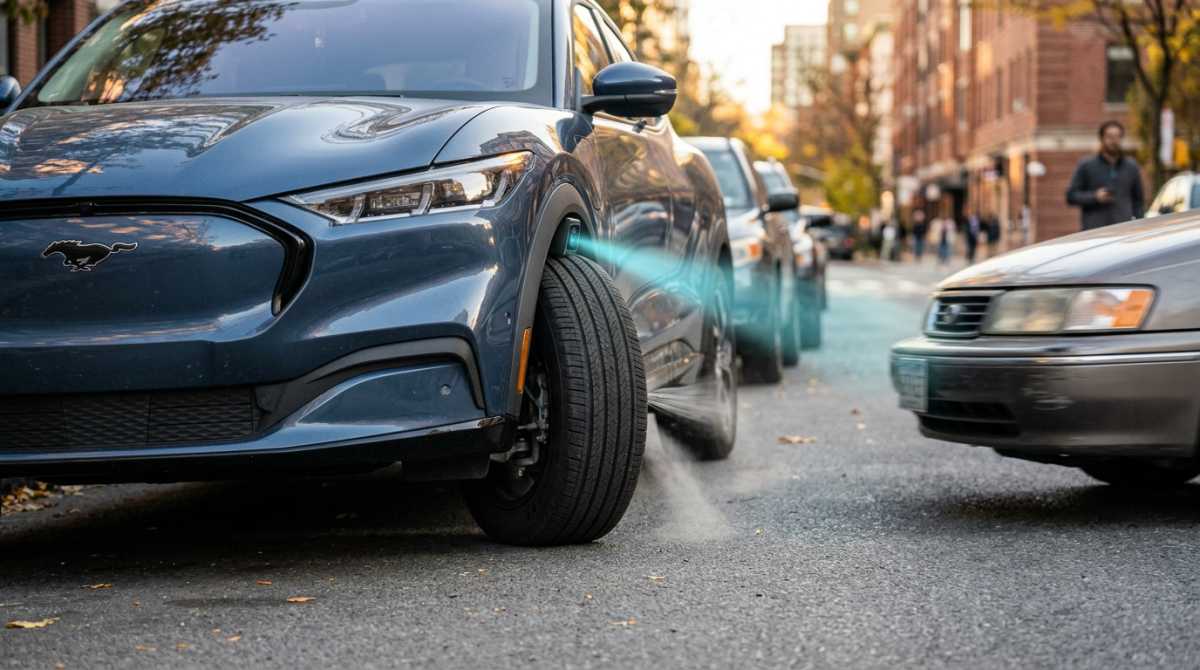
TL;DR: Ever come back to your car in a supermarket car park to find a rogue trolley has put a dent in your pride and joy? Ford has patented a new “System for Detecting Moving Objects” that could let your parked car spot trouble, warn what’s coming, and even move itself out of the way to avoid a bump.
Ford’s new way to stop your parked car getting clobbered
We’ve all been there. You park up neatly, nip into the shops, and return to find a fresh dent courtesy of a runaway shopping trolley or a careless driver. It’s frustrating, expensive and usually impossible to prove who was at fault.
Ford reckons it might have an answer, with a newly published patent that effectively teaches your parked car to watch its surroundings and dodge danger all by itself.
What has Ford actually patented?
The technology is described in US patent application US12617393B2 and is called “System for Detecting Moving Objects”. In simple terms, it uses the kind of cameras, radar and ultrasonic sensors many modern cars already have to constantly keep an eye on what’s happening around the vehicle when it’s parked.
Software then tracks moving objects, works out their speed and direction, and calculates how likely they are to hit your car. If the risk starts to rise, the system automatically escalates its response rather than just sitting there waiting to be smacked.
Four smart “states”: idle, aware, warning, evade
Ford’s system puts the car into one of four states depending on the probability of a collision.
- Idle – If nothing looks threatening, the car stays in a low‑power idle state, simply monitoring the surroundings for any change in trajectory.
- Aware – If the system thinks the chance of an impact is between 0 and 10 per cent, it moves into an aware state, waking up the powertrain, brakes and steering so the car is ready to react if things get worse.
- Warning – Once the risk climbs above 10 per cent, the car enters warning mode, flashing its lights and sounding the horn to get the attention of whatever is heading its way – whether that’s another vehicle or a rogue trolley.
- Evade – If a collision looks almost certain – over 90 per cent probability – the system activates evade mode, manoeuvring the car at low speed to somewhere safer, as long as there’s space to move without hitting another vehicle, pillar or barrier.
The clever bit is that the car isn’t just focused on the moving object; it also maps out the stationary obstacles around it so it only moves if it can do so safely.
What if the car can’t move?
There will be plenty of situations where the car is boxed in and simply has nowhere to go – for example, tightly packed multi-storey bays or a nose‑to‑tail street. In those cases, the system won’t try to wriggle out of trouble just for the sake of it.
Instead, the onboard cameras and sensors will kick in to record the incident, capturing video and data that could prove invaluable for insurance claims or any legal disputes later on.
Talking to other cars: V2V And V2X
Ford’s patent also looks beyond just your own car’s movements. If the approaching vehicle is equipped with vehicle‑to‑vehicle (V2V) or vehicle‑to‑everything (V2X) connectivity, Ford’s system could send a signal telling that vehicle to brake or adjust course to avoid the impact entirely.
In effect, your parked car becomes part of a wider safety network, trying to prevent a crash before metal meets metal, even when you’re nowhere near it.
Will this actually reach your driveway?
As with many patents, there’s no guarantee this technology will appear on a production Ford any time soon. Automakers regularly patent ideas that never make it past the drawing board, and there are still big questions around regulations that would allow a car to move itself without anyone inside.
Ford has already stressed that what appears in a patent shouldn’t be taken as a direct roadmap for future products, and that customer needs will still drive what actually gets developed and sold. That said, the concept shows just how far car makers are now thinking about protecting your vehicle, not just while you’re driving, but long after you’ve locked it and walked away.