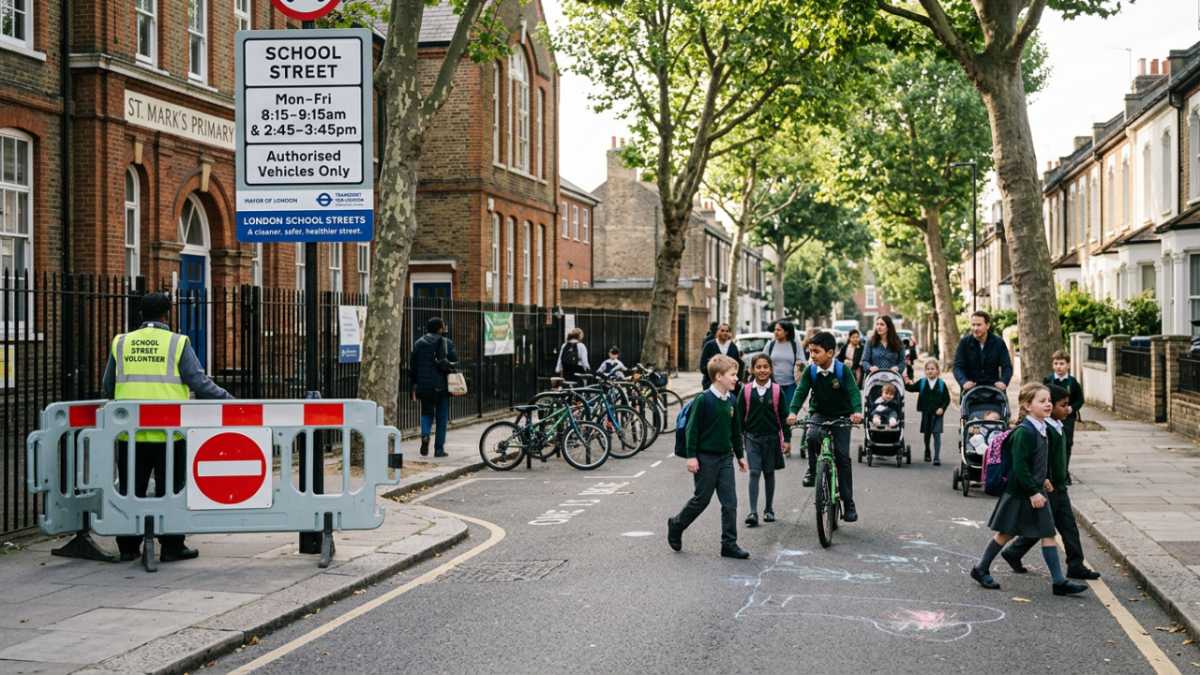
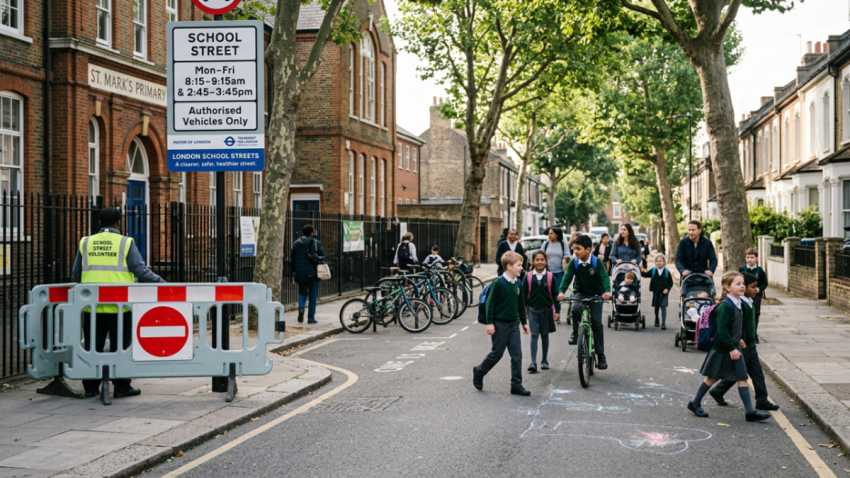
TL;DR: TfL and London's Mayor have confirmed a major expansion of the London School Streets scheme, aiming to close over 1,000 roads to cars during school run hours by 2030. This means around 200 more streets will soon face vehicle restrictions as part of a wider strategy to reduce car journeys across the capital.
Key Facts
- 1,000+: The total number of London School Street zones Sadiq Khan and TfL plan to have in place by 2030.
- 200: The approximate number of new roads set to be converted into School Streets in the near future.
- 80%: TfL's target for all London journeys to be made by walking, cycling, or public transport by the year 2041.
- 35 miles: The additional length of roads in London that will be converted to 20mph speed limit zones by 2030.
- 2017: The year the London Borough of Camden introduced the capital's first School Street scheme.
Sadiq Khan's plan to close 200 more London roads confirmed
London drivers are facing a significant shift in the city's road network, as recently confirmed plans reveal a massive expansion of the London School Streets scheme. The initiative, championed by Mayor Sadiq Khan and Transport for London (TfL), is set to grow from its current size to over 1,000 zones by 2030.
What this means for drivers is that approximately 200 more roads are slated to become off-limits to most vehicles during the crucial morning drop-off and afternoon pick-up times. This latest development is a core part of TfL's wider walking and cycling strategy, which continues to spark debate among motorists across the capital.
What is a London School Street?
For drivers who haven't yet encountered one, a School Street is a road outside a school that is temporarily closed to most motor traffic. These restrictions are typically enforced for an hour at the beginning of the school day and an hour at the end.
While the scheme has seen rapid growth recently, the concept is not new. The first 'school exclusion zones' were introduced in Italy as far back as 1989. In the UK, the London Borough of Camden was the first to pilot the idea in 2017, paving the way for the city-wide rollout we see today.
These zones are designed to be highly visible to prevent accidental entry. Many boroughs, including Richmond upon Thames, use distinctive 'pencil bollards'- large, brightly coloured posts resembling crayons - to block access and prevent pavement parking. Drivers will also notice painted 'dragon’s teeth' markings on the road surface and sections of deep red tarmac, all signalling a restricted area.
The 2030 target: A major shift away from cars
This expansion is not an isolated policy. It represents a crucial piece of a much larger, and some argue aggressive, strategy to fundamentally change how Londoners travel. The official TfL target is for 80% of all journeys within London to be made by walking, cycling, or public transport by the year 2041.
Achieving this ambitious goal requires a multi-faceted approach that goes far beyond school roads. The latest data from TfL shows several other major changes are being implemented to support this vision:
- Lower Speed Limits: An additional 35 miles of London's road network are scheduled to have their speed limits reduced to 20mph by 2030, expanding on the current 20mph zones.
- Safer Pedestrian Crossings: TfL has committed to installing around 1,000 new pedestrian crossings by 2031 to make walking safer and more appealing.
- Instant Green Men: A significant number of new traffic light installations will be configured with 'pedestrian priority'. This means traffic will be programmed to stop almost immediately after a pedestrian presses the button to cross.
Why drivers call the scheme 'anti-motorist'
The rapid rollout of these schemes has not been without controversy. Many drivers, including commercial vehicle operators and tradespeople, have labelled the policies as 'anti-motorist', and it is easy to understand their perspective.
For those who rely on their vehicle for work or for essential journeys, these closures can feel like another obstacle in an already congested city. A common complaint is that the restrictions simply displace traffic and congestion onto adjacent residential streets, creating new problems while solving old ones. For parents who need to use a car for the school run due to distance or other commitments, the scheme can turn a simple journey into a logistical nightmare.
However, TfL officials defend the strategy. Christina Calderato, TfL's Director of Transport Strategy and Policy, argues that the changes are necessary to make walking the 'natural choice' for short trips. The objective is to create an environment where people feel safe enough to leave their car at home for a quick journey to local shops or a station. Similarly, London's Walking and Cycling Commissioner, Will Norman, has stated that such measures are the only viable way to tackle the city's persistent air quality issues and reduce transport-related emissions.
Which London roads will be closed next?
As of now, a definitive list of the next 200 streets to be included in the School Streets scheme has not been made public. TfL has provided the relevant data and framework to individual London councils, who will be responsible for identifying suitable locations and implementing the closures in their boroughs.
This means that if you live near a school in London, your local road could be under consideration. Whether you view the London School Streets scheme as a welcome safety measure or a daily inconvenience, one thing is clear: London's urban landscape is being systematically redesigned to prioritise pedestrians and cyclists over private cars. For many drivers, this bold vision feels like a frustrating reality in the making.