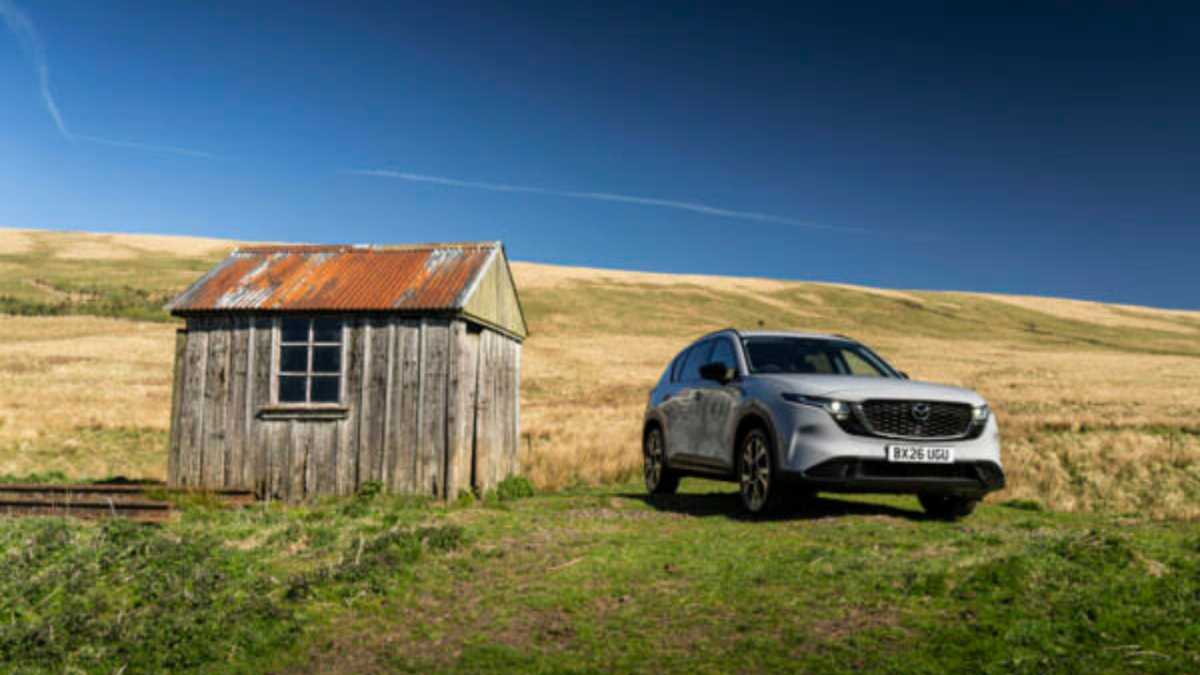
Since launching in the UK in 2012, the CX-5 has become the Japanese marque’s best-selling model globally.
Now, against a backdrop of sweeping change in the automotive industry, the all-new CX-5 arrives with plenty riding on its shoulders. Electrification is accelerating, Chinese manufacturers are reshaping the market, and consumer expectations are evolving faster than ever. Yet Mazda believes there’s still strong demand for a well-engineered, stylish petrol-powered family SUV that prioritises connection behind the wheel.
Our motoring journalist Tim Barnes-Clay joined Mazda in Scotland for the UK media launch of the new CX-5, where twisting country roads offered the perfect opportunity to sample the SUV’s latest evolution.
Between drives, Tim sat down with Mazda UK Managing Director Jeremy Thomson to talk about the model and why he believes cars should still “bring a smile to your face”.
Tim Barnes-Clay: Jeremy, we're here for the launch of the all-new CX-5. Tell me about the model.
Jeremy Thomson: It's a fascinating car for me personally because I was involved in the original launch back in 2012. This iteration continues the story of our best-selling model.
There's been a lot of anticipation around it because we effectively ran out of the old model earlier this year. Dealers and customers have really been waiting for this moment.
What's impressive is that, in almost every single way, this new car builds on everything people liked about the previous CX-5 - but makes it all a little bit better. The overall feel of the car has moved on significantly, and I'm absolutely convinced it's going to be our next best-seller.
Tim Barnes-Clay: We've had a lovely day driving around Scotland in it. Tell me a bit about the powertrain.
Jeremy Thomson: There's effectively one engine choice - a 2.5-litre petrol automatic with Mazda's mild-hybrid technology.
That might sound slightly counterintuitive at a time when everybody's talking about EVs - and indeed, our next two model launches later this year will be electric vehicles.
But the reality is that, especially among private retail buyers, four out of five customers are still choosing conventional combustion-engine cars. So, in many ways, this CX-5 is the perfect car for the perfect time. And as electrification gathers pace, we've got other cars in our product lineup to suit, too.
Tim Barnes-Clay: I was going to ask you that - Mazda has a lot coming up over the next few months. Can you tell me more?
Jeremy Thomson: We have three new models, two of which are all new to Mazda - the Mazda6e and the CX-6e - and then the replacement for the CX-5 - the model you've seen today.
It’s unprecedented for Mazda to launch three cars in six months. It’s a lovely problem to have, you know, to have all that excitement and that communication to dealers and customers and media, but it’s going to be quite a stretch for our business to deliver that, you know, as well as I want us to do it.
Tim Barnes-Clay: How do you view the way the automotive industry is changing - especially with the influx of Chinese brands entering the market?
Jeremy Thomson: It's dramatic. I think of this period we're in now, five years post-pandemic, as a sort of once-in-a-hundred-years moment for the industry.
We're in the middle of the storm now of change on every dimension. Consumer behaviour’s changed, legislation’s changing, electrification, new entrants into the market – more players for a limited total industry. But, in the end, that's what keeps us going, that's what gives you that kind of mental stimulation - and the interest in the job comes from really those challenges.
Tim Barnes-Clay: Mazda has always had a cool image for me, largely thanks to the MX-5. How would you describe the Mazda brand today?
Jeremy Thomson: The brand has evolved massively. I joined Mazda in 2001, so nearly 25 years ago, and back then, we were probably positioned more as a value brand.
Today, we sit in a much more premium space. People choose Mazda consciously because they want something a little different - something thoughtful.
We're not mass-market, but we absolutely compete head-on with the mainstream brands. What we offer is a more premium feel and a stronger connection between car and driver.
That philosophy runs deeply through the brand DNA. You mentioned the MX-5 - that connection you feel in that car should also come through in the CX-5.
It should bring a smile to your face. It’s not just a car for a car’s sake – it should be an experience, and that’s one of the things that’s kept me here.
Tim Barnes-Clay: You clearly feel passionately about Mazda. That must say something about the company culture.
Jeremy Thomson: Absolutely. It's a very interesting company to work for.
The longevity within the business is remarkable. As I said, I'm approaching 25 years with Mazda, and the average manager has been with the company for around 16 years. That's very unusual in the automotive industry, where people often move between brands regularly.
We've built a really strong internal culture, and there's a genuine sense of protection and passion for what we do in the UK. I think that consistency also comes across to dealers and customers.
Tim Barnes-Clay: Finally - the new CX-5. When can people buy one, and how much will it cost?
Jeremy Thomson: Cars arrive in UK showrooms from June, with prices ranging from around £30,000 to £40,000 depending on specification.
What's important is that pricing remains broadly in line with the outgoing model, despite significant improvements across the board.
And the early signs are incredibly positive. In Europe, we've already seen around 12,000 pre-orders before the car's come to market, left-hand drive. That is the highest number of pre-orders Mazda has ever had on any model.
So, there's a lot of pent-up demand for this car, and a lot of customers are waiting to buy it. So, even though the UK has less of a pre-order mentality, I'm convinced this car is going to do well in the run-up to when it comes into showrooms.