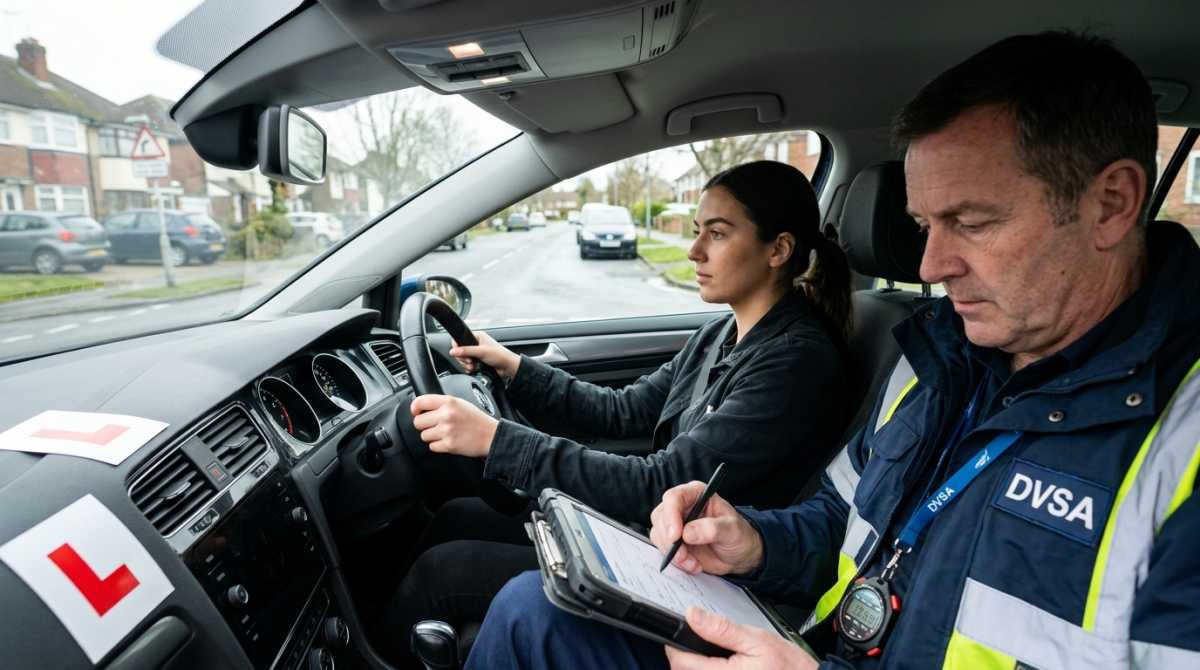
Key Points: A standard car driving test in Great Britain involves around 35 minutes of driving, with the full test process typically taking 38–40 minutes. You will complete an eyesight check, answer two vehicle safety questions, demonstrate your general driving ability and perform one reversing manoeuvre. Independent driving takes 20–35 minutes of the test.
Key Facts
- Standard driving test: Around 35 minutes of driving, with the overall process typically lasting 38–40 minutes.
- Independent driving: Between 20 and 35 minutes, following a sat nav, road signs or a combination of both.
- Extended driving test: Around 65 minutes of driving for drivers who have been banned and must take an extended test.
- Test components: An eyesight check, two vehicle safety questions, general driving and one reversing manoeuvre.
- Retaking the test: If you fail, you must book a new test for a date at least 10 working days away.
- Waiting times: Half of learners who took their test in September 2026 waited no more than 11.6 weeks, according to the latest GOV.UK figures.
How Long Does a Driving Test Take?
A standard practical driving test in Great Britain takes around 35 minutes of driving. Including the other elements of the assessment, the full test process typically lasts between 38 and 40 minutes.
The test is designed to assess whether you can drive safely and independently in different road and traffic conditions. It follows the same format whether you take your test in a manual or automatic car.
However, the driving test duration is not the same as the time you should allow for your appointment. Arrive with enough time to check in, confirm your identity and prepare for the assessment. You should also allow extra time for your result and feedback after the drive.
The Driver and Vehicle Standards Agency (DVSA) sets the requirements for car driving tests in England, Scotland and Wales. Northern Ireland has a separate driving test system administered by the Driver and Vehicle Agency (DVA).
What Happens During a Driving Test?
Your practical driving test consists of four main parts: an eyesight check, vehicle safety questions, general driving ability and a reversing manoeuvre. The examiner assesses your driving throughout the appointment rather than allocating a fixed number of minutes to each individual section.
1. Eyesight Check
Before you start driving, your examiner will ask you to read a vehicle registration plate from the required distance.
You must be able to read a new-style number plate from 20 metres away, or an older-style plate from 20.5 metres away. You can wear glasses or contact lenses if you need them to meet the eyesight requirement.
If you fail the eyesight check, you will fail the driving test and the assessment will end.
2. Show Me, Tell Me Questions
You will be asked two vehicle safety questions during your practical driving test.
The first is a 'tell me' question, which you answer before you start driving. It tests your knowledge of basic vehicle safety, such as checking tyre pressures or explaining how you would check the engine oil level.
The second is a 'show me' question. Your examiner will ask you to demonstrate a safety-related task while driving, such as washing the windscreen or operating the rear demister when it is safe to do so.
You should practise these questions before test day so you can answer confidently without becoming distracted from the road.
3. General Driving and Independent Driving
The main part of your practical driving test assesses how safely you drive in different road and traffic conditions.
You will be asked to pull over and move away from the kerb, pull out from behind a parked vehicle and demonstrate a hill start. Your route may include roundabouts, junctions, pedestrian crossings, different speed limits and other everyday driving situations.
You will also complete independent driving for between 20 and 35 minutes. Depending on the instructions given by your examiner, you may follow a sat nav, directional road signs or a combination of both.
The examiner will set up the sat nav if one is used. You cannot use your own sat nav for this part of the test.
If you take a wrong turn, do not panic. You will not receive a fault simply for going the wrong way, provided you continue to drive safely. Your examiner will help you get back on route if necessary.
You may also be asked to perform an emergency stop during the test. This is not guaranteed to happen on every test.
4. Reversing Manoeuvre
Your examiner will ask you to complete one reversing exercise to assess your control of the vehicle and awareness of your surroundings.
The possible manoeuvres are:
- Parallel parking: Reverse into a space alongside a parked vehicle.
- Bay parking: Drive into a parking bay and reverse out, or reverse into a bay and drive out, as instructed.
- Pulling up on the right: Stop on the right-hand side of the road, reverse for around two car lengths and rejoin traffic safely.
The examiner will be looking for good observation, accurate positioning and effective control. Take your time, check your surroundings carefully and respond safely to other road users.
How Long Is an Extended Driving Test?
An extended driving test involves around 65 minutes of driving, compared with around 35 minutes for a standard practical test.
It is generally required when a court has disqualified someone from driving and ordered them to take an extended test before regaining their licence.
The longer assessment gives the examiner more time to assess driving ability. It is not simply an optional, longer version of the standard test for learners who want additional practice.
Does the Length of Your Driving Test Affect Whether You Pass?
No. Finishing your driving test earlier than expected does not automatically mean you have passed or failed.
Your test may end early if the examiner believes your driving presents a danger to other road users. However, the duration can also be affected by route conditions and how the assessment progresses.
Similarly, taking close to the full allotted time is not a sign that you have made mistakes.
The examiner assesses your driving against the required standard, including your observation, control, positioning, response to hazards and ability to follow the rules of the road.
You can make mistakes and still pass. What matters is the type and number of faults recorded during the assessment.
How Long Do You Have to Wait to Retake a Driving Test?
If you fail your practical driving test, you must book another test. GOV.UK states that your new test date must be at least 10 working days away.
This is different from the time it may take to find an available appointment. Actual waiting times depend on demand, your chosen test centre and the appointments available when you book.
In 2026, the DVSA also introduced changes to car driving test bookings in England, Scotland and Wales. These include limits on how many times you can change a booking and rules requiring learners to manage their own appointments.
There is no general 28-working-day retest rule in the current GOV.UK rebooking guidance.
Before booking another test, review the feedback from your examiner and work with your driving instructor to improve any areas that need attention.
How Long Are Driving Test Waiting Times in 2026?
The time spent taking a driving test is relatively short, but finding an appointment can take considerably longer.
According to GOV.UK, half of the learners who took a practical driving test in September 2026 waited no more than 11.6 weeks. This is a median figure based on completed tests, not a guarantee that a new booking will be available within that time.
Waiting times vary between test centres and can change from month to month. The date you can book depends on local availability, cancellations and the number of examiners available.
If you already have a test booked and want an earlier date, you can check the official booking service for available appointments. Earlier slots may appear when another learner cancels or changes their booking.
How Can You Prepare for Your Driving Test?
Although the practical test lasts around 35 minutes of driving, preparation should focus on becoming a safe and independent driver rather than simply getting through the time.
Here are some ways to prepare:
- Take online driving quizzes: Test your motoring knowledge with Regit’s range of fun, interactive driving quizzes, covering road signs, the Highway Code and general motoring knowledge.
- Take mock driving tests: Ask your instructor to conduct practice tests under realistic conditions, including following directions independently.
- Practise different road types: Build experience on residential roads, busy junctions, roundabouts and faster roads where appropriate.
- Revise the safety questions: Practise the official 'show me, tell me' questions so you can answer without hesitation.
- Work on reversing manoeuvres: Practise all three possible exercises and focus on observation, positioning and control.
- Learn from mistakes: Use feedback from your instructor to address recurring problems before your test.
- Stay calm if you go the wrong way: Focus on driving safely rather than worrying about following a route perfectly.
You should take your test when your instructor believes you can drive safely without regular guidance. There is no minimum number of lessons you must complete before taking the practical test.
Final Thoughts: How Long Is a Driving Test?
A standard car driving test in Great Britain involves around 35 minutes of driving, with the full assessment typically lasting 38–40 minutes. Independent driving takes between 20 and 35 minutes, and you will also complete an eyesight check, two vehicle safety questions and a reversing manoeuvre.
The best way to prepare is to understand what the examiner expects and practise until you can drive safely and independently. Rather than worrying about how quickly the test finishes, concentrate on making safe decisions throughout the assessment.