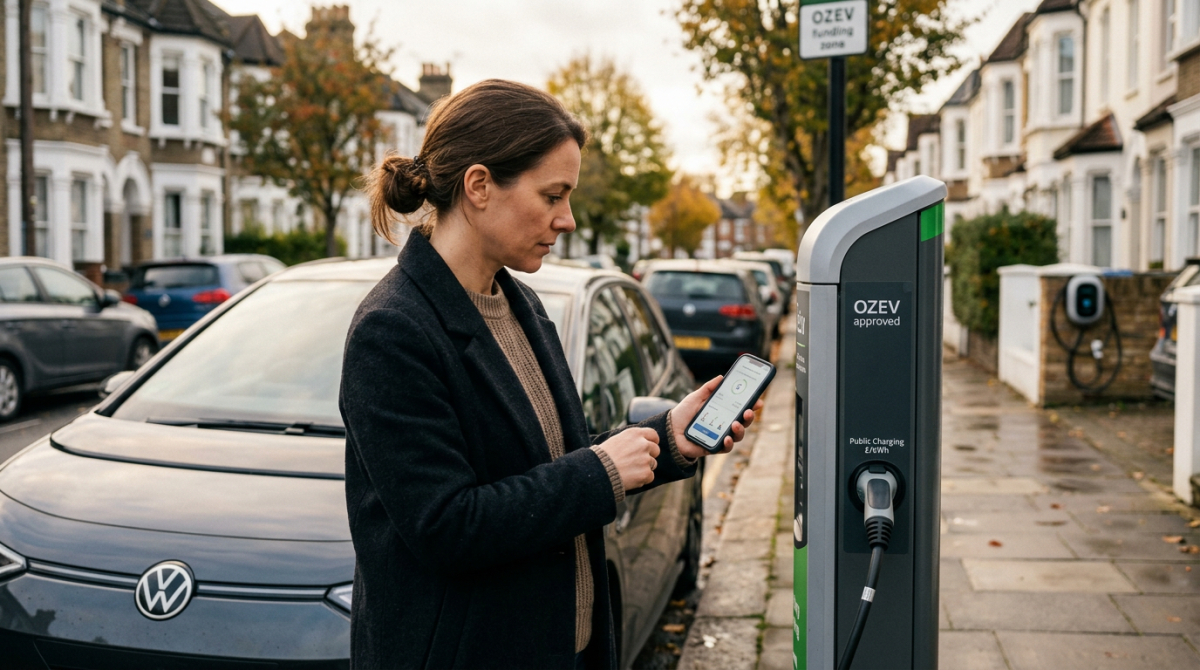
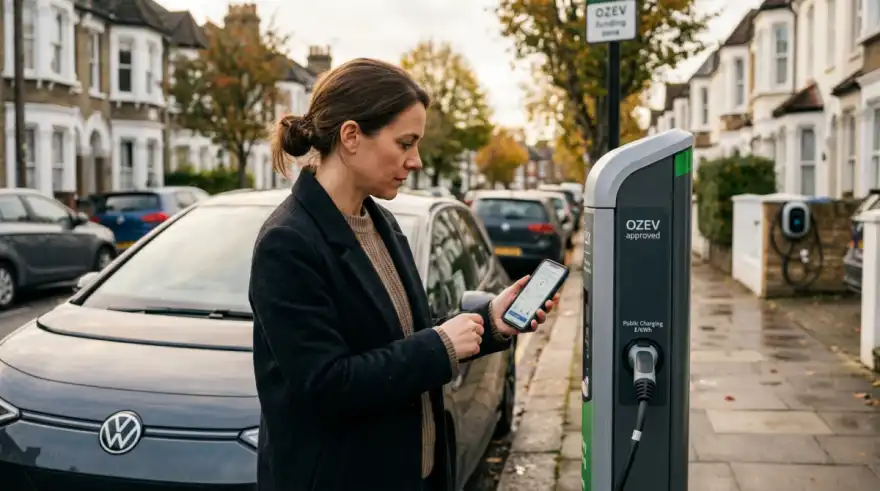
TL;DR: The UK government has launched an official review into public electric vehicle (EV) charging prices, aiming to address the 38% cost increase since 2021 and the significant price gap between home and public charging. This initiative seeks solutions to make EV ownership more accessible for drivers without home charging options, with recommendations expected by autumn 2026.
Key Facts:
- Since 2021, public EV charging costs have increased by 38%, impacting UK drivers.
- UK drivers relying on public charging pay an average of £1,760 annually, £1,080 more than home chargers (approx. £680).
- The review, led by independent chair Philip New, will deliver recommendations by autumn 2026.
- Public rapid chargers average 79p/kWh, starkly contrasting with home off-peak rates as low as 8.8p/kWh.
- The 20% VAT on public charging, compared to 5% for home charging, remains outside the scope of this review.
UK Government scraps 'driveway divide' for EV drivers: Public charging price review launched
As of recent announcements, the UK government has finally triggered an official EV public charging price review, a move set to tackle the growing disparity between home and public charging costs. This review comes as a direct response to public charging prices soaring by 38% since 2021, a trend that has created a significant hurdle for many UK motorists considering an electric vehicle.
For millions of UK drivers without off-street parking, the cost of plugging in an electric car has become a major concern. This review aims to understand why costs have escalated and what can be done to alleviate the financial burden on those who rely solely on the public network. It’s about ensuring that choosing an EV isn’t a penalty for not having a driveway.
The latest data paints a stark picture for UK EV drivers. If you’re fortunate enough to charge your electric car at home, your annual expenditure is likely around £680. However, for those who depend on public charging points, this figure balloons to a staggering £1,760 per year. That’s a massive £1,080 difference, effectively creating a two-tier system in car ownership.
Consider this: for many, relying exclusively on the public network currently makes EV ownership about £100 more expensive per year than simply filling up a standard petrol car, assuming petrol costs 159p per litre. This financial disadvantage is a tough reality for anyone trying to embrace greener transport options.
This new EV public charging price review is being led by independent chair Philip New, tasked with unravelling this complex issue. The investigation will delve into various factors, including energy prices and the often-overlooked costs associated with infrastructure development. The goal is to identify areas where pressure can be relieved and costs reduced, making EV ownership more equitable across the country.
The disparities are quite striking. We’ve seen public rapid chargers hit average prices of 79p/kWh, while some home off-peak rates can be as low as 8.8p/kWh. This review will scrutinise these massive price gaps to find sustainable solutions. We anticipate the final recommendations by autumn 2026, which will hopefully provide a clear roadmap to help the UK meet its 2030 targets for electric vehicle adoption.
However, there’s one significant snag. Despite persistent pressure from the industry to reduce the 20% VAT on public charging to match the 5% rate applied to home charging, the Treasury has kept tax policy off the table for this specific study. This decision is a source of considerable frustration for campaigners who argue that the current tax system unfairly penalises those living in flats or terraced houses without private charging access.
Ultimately, the objective of this EV public charging price review is straightforward: to make electric vehicle ownership a viable and affordable option for every UK driver, regardless of their living situation. If the government fails to effectively bridge this 'driveway divide', the UK's transition to electric power could very well slow down before it ever reaches full speed. It’s a critical moment for the future of electric transport in the UK.