
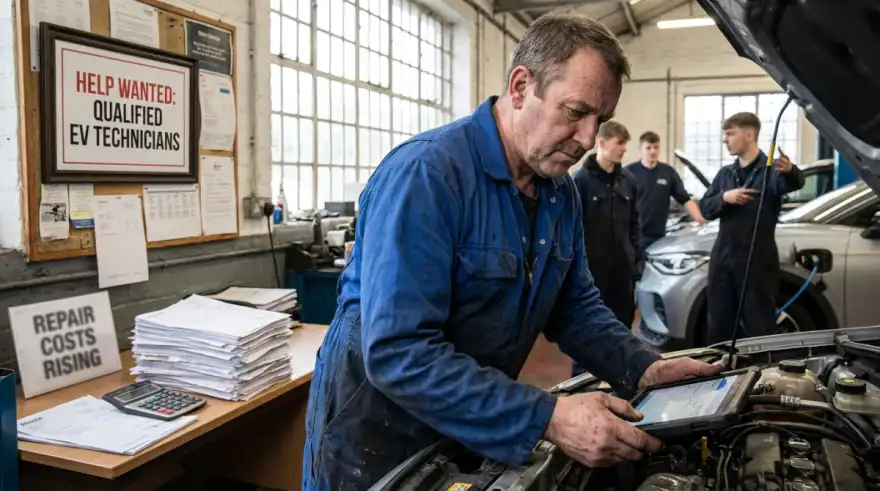
TL;DR: A critical shortage of mechanics across the UK is now hitting drivers’ wallets, driving up car repair costs by 8% in just a year. The industry’s growing skills gap is leading to longer garage wait times and poses a major threat to the UK’s switch to electric vehicles, with a 44,000 EV technician shortfall forecast by 2035.
Key Facts:
- 8% – The annual rise in car repair costs, far above the UK’s general inflation rate.
- 44,000 – The projected shortfall of qualified EV technicians by 2035 (Institute of the Motor Industry).
- 70% – UK workshops struggling to recruit younger mechanics.
- 1 in 5 – Garages currently training an apprentice, revealing a major skills gap.
- 23% – Price increase for ADAS (advanced driver assistance systems) parts, fuelling higher repair bills.
A mechanic crisis hitting drivers hard
Across the UK, drivers are paying the price for a worsening mechanic shortage. Garage wait times are stretching longer, repair bills are rising faster than inflation, and local workshops are struggling to find qualified staff.
If your garage feels busier than usual, you’re not imagining it. Around 70% of garages say they’re finding it extremely difficult to hire new, skilled technicians. It’s a visible symptom of a skills pipeline under intense strain.
Repair costs are climbing fast
For drivers, the impact is immediate and financial. Industry data shows an 8% jump in repair costs over the past year, a steep rise that’s putting real pressure on household budgets.
To make matters worse, parts for key safety systems have spiked too. Components for ADAS features such as lane-keep assist and automatic emergency braking are up 23%, meaning even small parking knocks are now much more expensive to fix.
Electric vehicle transition at serious risk
This mechanic shortage isn’t just inconvenient; it’s threatening the UK’s EV future. The Institute of the Motor Industry warns of a potential 44,000 shortfall of qualified EV technicians by 2035. Without enough trained experts, maintaining and repairing electric vehicles could soon become a major problem.
For EV owners today, the shortage already means longer waits for repairs. In some areas, finding a certified technician has become a postcode lottery and delays can stretch for weeks.
Why are mechanics in such short supply?
Modern cars are complex, high-tech machines, closer to computers on wheels than traditional engines. That means today’s technicians need advanced diagnostics training, constant software updates, and thousands of pounds worth of equipment.
Yet despite this evolution, only one in five garages is currently investing in apprenticeships, a worrying sign for the industry’s future. Combine that with a lack of diversity (over 90% of technicians are male), and the talent pool shrinks even further.
Barriers to entry are holding young talent back
For young people, joining the industry can feel out of reach. The cost of professional tools and certifications adds up quickly, often before an apprentice earns a wage that makes those investments worthwhile. On top of that, outdated stereotypes about mechanics being “greasy” or blue-collar dissuade new recruits, even as the trade becomes increasingly digital and data-driven.
If this shortage continues, the knock-on effects could be dramatic. More vehicles might be written off after minor accidents simply because recalibrating their sensors costs more than the car’s value. To avoid this, Britain must urgently invest in automotive apprenticeships and rebrand the trade as the high-tech, rewarding career it truly is.