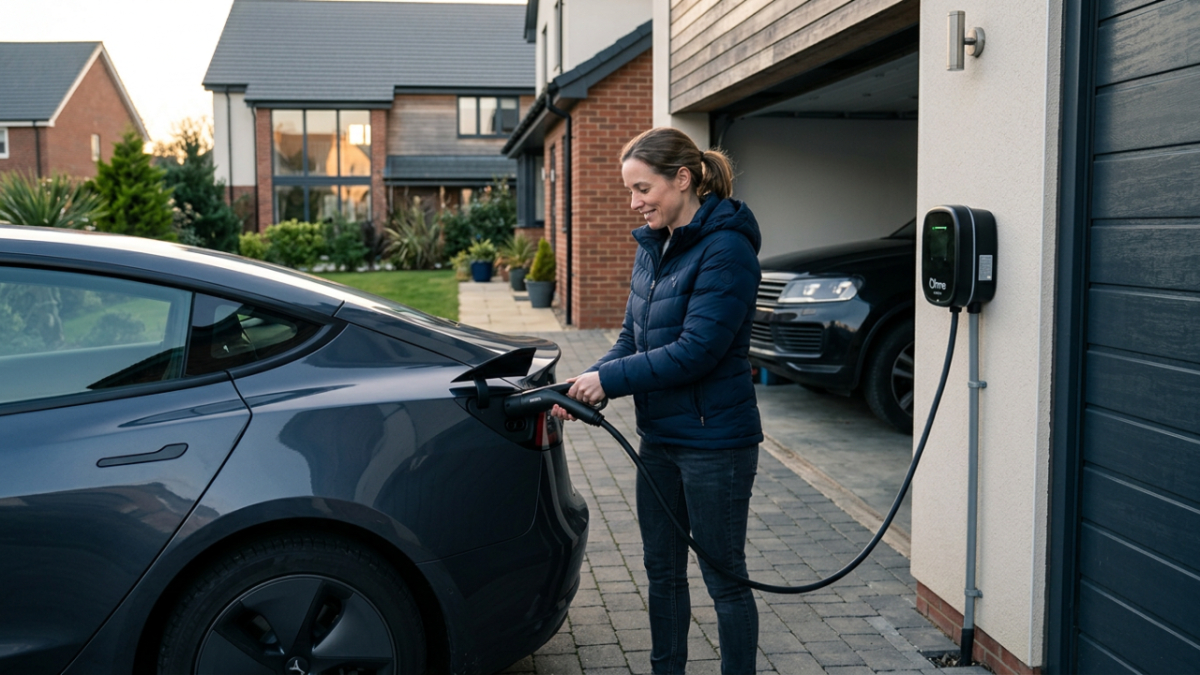
TL;DR: Charging an EV from home is the most cost-effective and convenient way to power your electric car in the UK, with dedicated wallboxes and off-peak tariffs slashing charging costs from £10-£18 to just £3-£6 per full charge.
Key Facts:
- Home charging remains the primary method for UK EV owners, with around 70–80% of charging taking place at home (source: Department for Transport, Ofgem, Zapmap).
- A standard 3-pin plug delivers ~2.3kW and can take 24–30 hours to fully charge a 60kWh battery (RAC, Energy Saving Trust).
- A 7kW home wallbox typically adds 25–30 miles of range per hour and can fully charge most EVs in 6–10 hours (Energy Saving Trust, Pod Point).
- Off-peak EV tariffs can reduce charging costs to roughly 7p–10p per kWh, meaning a full charge can cost as little as £4–£7 depending on battery size (Octopus Energy, British Gas, Ofgem typical tariffs).
- The EV Chargepoint Grant offers up to £350 or 75% of installation costs for eligible renters, flat owners and landlords (GOV.UK, OZEV).
Why home charging still wins
Even with rapid growth in public charging, home charging is still where EV ownership becomes genuinely cost-effective.
The UK now has over 120,000 public charge points as of early 2026, yet home charging still dominates day-to-day use for most drivers.
For most drivers, plugging in overnight replaces the need for weekly petrol station visits — and costs significantly less than both petrol and public rapid charging.
Your home charging options
1. 3‑Pin Plug (Emergency use)
You can charge from a standard domestic socket, but it’s slow and not ideal for regular use.
A typical 3‑pin plug delivers about 2.3kW, so a modern EV with a 60kWh battery would need 24–30 hours for a full charge. The RAC and Energy Saving Trust advise using this only as a backup, as prolonged loads on household wiring can generate heat and pose a safety risk over time.
If you’re away from home or in a rental without a wallbox, “granny charging” can keep you moving, but it’s not a long‑term solution.
2. 7kW Home Wallbox (Recommended)
A dedicated home wallbox is the standard for UK households and the gold standard for convenience.
Most dedicated EV chargers deliver 7kW on a single‑phase supply, which is roughly three times faster than a 3‑pin socket. In real‑world testing, a 7kW charger can replenish a typical EV battery from empty to full in about 6–10 hours, which fits neatly into an overnight window.
Popular brands such as Pod Point, Ohme and Zappi offer smart features that sync with your energy tariff and automatically charge during cheaper off‑peak hours. This means you wake up with a “full tank” of electricity ready for the day, without having to think about timing.
3. Tethered vs Untethered Chargers
When choosing your wallbox, you’ll come across two main design types.
- Tethered chargers have the cable permanently attached to the unit. This is the most convenient option: you simply pull up, plug in and walk away, with no need to retrieve a cable from your boot. The cable is always there, ready to go.
- Untethered chargers have a socket on the unit, and you use the cable supplied with your car. This is often considered more aesthetically pleasing, as there’s no cable hanging when not in use. It also gives you flexibility if you ever switch between vehicles with different port types, or if you have multiple cars.
In terms of charging speed, tethered and untethered units perform identically when they’re both 7kW.
How to plug in your EV to charge at home: Step-by-step
Charging your EV at home is simple once you know the basics. Follow these steps to get started safely and efficiently.
Step 1: Check your parking position
Pull up so your car’s charging port is close to the wallbox or socket. Make sure you have enough room to move around the cable comfortably without stretching it across walkways or blocking doors.
Step 2: Unlock your car and charger (if needed)
Many smart chargers and EVs require the car to be unlocked before charging will start. Some wallboxes also have a lock or app requirement - check that your charger is ready to use.
Step 3: Connect the cable to the wallbox (if untethered)
If you’re using an untethered charger, plug one end of the cable firmly into the wallbox socket. Ensure it clicks or locks into place.
Step 4: Plug the cable into your car
Take the other end of the cable and insert it into your vehicle’s charging port until you hear or feel a click. Most EVs will automatically detect the connection and begin charging. If your car has a charging port cover, make sure it’s fully open before plugging in.
Step 5: Confirm charging has started
Check the car’s dashboard, infotainment screen, or charging app to confirm that charging is active. Many wallboxes also have LED indicators that change colour (e.g., from orange to green) when charging begins.
Step 6: Set up smart charging (optional but recommended)
If your charger supports smart features, use the app to schedule charging during off-peak hours (typically midnight–5am). This ensures you get the cheapest electricity rate without having to manually start and stop charging each night.
Step 7: Unplug when done
When charging is complete or you need to leave, unlock your car, press the cable release button (if fitted), and gently remove the cable. Store it neatly on the wallbox holder or in your boot, and close the charging port cover.
Following these steps will help you charge safely, avoid cable damage, and make the most of your off-peak tariff.
How much does it cost to charge at home?
Costs depend almost entirely on your electricity tariff and battery size.
On a standard domestic tariff, electricity is typically around 22p–30p per kWh under the Ofgem price cap range in 2026. For a 60kWh battery, that means a full charge costs roughly £13–£18.
Switching to an off‑peak EV tariff changes the picture dramatically. Leading UK EV tariffs in 2026 offer off‑peak rates from around 7p per kWh, compared with 24p–29p per kWh on standard variable tariffs (Electric Cars Scheme).
Major providers include:
- Octopus Intelligent Go at around 7p/kWh between 11:30pm–5:30am
- British Gas EV Power+ at around 7.9p/kWh between 12am–5am
- E.ON Next Drive Smart at 8p/kWh between 12am–6am
On these tariffs, a full charge on a 60kWh battery drops to roughly £4–£7, depending on the exact rate and any fees.
Smart chargers can be programmed to draw power only during these off‑peak windows when grid demand is low and prices are significantly cheaper. This strategy dramatically reduces your running costs compared to petrol or even public rapid charging.
Installation: What you need to know in 2026
Off‑street parking is usually required
To install a home charger, you generally need off‑street parking, such as a driveway or a garage. Running a cable across a public pavement is not permitted under current safety rules unless you have specific local authority approval.
If you don’t have a driveway, don’t panic. Around 24% of UK households without driveways are now within a five‑minute walk of a public charging device, so your options have improved even without home charging (Zapmap).
Smart chargers are mandatory by law
All new home chargers in the UK must comply with smart charging regulations, which have been in place since 2022. This means your charger must be able to communicate with the grid and your energy provider, and charge at the most efficient times.
Smart charging is crucial for taking advantage of cheaper EV tariffs, as it allows automatic scheduling during off‑peak hours without you having to manually start and stop charging.
Use an OZEV‑approved installer
EV charger installation requires a dedicated circuit and often a Residual Current Device (RCD) to manage the high electrical load safely. This is not a job for DIY.
Ensure your chosen installer is OZEV‑approved (Office for Zero Emission Vehicles). This is a prerequisite for claiming any government grants and ensures your installation meets all safety standards and building regulations.
EV Government Grant
The EV Chargepoint Grant now offers up to £350 or 75% of costs for purchasing and installing a chargepoint. Following changes introduced in April 2024 and confirmed in 2026 guidance, the grant is primarily aimed at:
- Renters in rented accommodation with landlord permission and off‑street parking
- Flat owners (leaseholders and owner‑occupiers) with dedicated parking
- Landlords installing chargers for tenants
Standard homeowners in detached or semi‑detached houses are no longer eligible, having been removed from the scheme in 2022 .
Always check the official GOV.UK guidance to see if your specific property qualifies, as rules can change.
What this means for drivers: Real‑world convenience and value
Having driven various EVs over long‑term tests, we can confidently say that the “range anxiety” often cited by skeptics virtually disappears when you have home charging. You start every day with a “full tank” of electricity.
For the average UK driver who travels 20–30 miles a day, a home charger means you only actually need to plug in once or twice a week, but the convenience of daily topping up remains a major win. This peace of mind is invaluable.
Installing a charger could also boost your home’s appeal to future buyers. While there’s no universal data confirming a fixed value increase, estate agents increasingly market EV charging as a premium feature, and demand for EV‑ready homes is rising. Treat it as a future‑proofing benefit that adds convenience and may help your property stand out.
Regit Verdict
Charging your EV from home is still the foundation of a successful electric vehicle experience in the UK. It drastically slashes your running costs compared to petrol or public rapid charging and adds a level of convenience that traditional internal combustion engine vehicles simply can’t match.
If you’re considering the switch to an EV, our advice is clear:
- Check your eligibility for the £350 OZEV grant if you rent or live in a flat
- Choose a smart 7kW charger that integrates with an off‑peak tariff
- Book a home survey with an OZEV‑authorised installer to get started
The initial investment of approximately £800–£1,000 for a smart wallbox and installation is usually paid back in fuel savings within the first 12–18 months of driving, making it a smart financial decision for most UK drivers.
Common Questions
Can you charge in the rain?
Absolutely. EV chargers and cables are specifically designed to be weather‑resistant, typically rated IP65 or higher. You can safely plug and unplug your car in a downpour without any risk of electric shock. They are built for the unpredictable British weather.
Do you need a ground loop or earth rod?
Most modern best EV home chargers in the UK, such as the Ohme ePod or Zappi, have built‑in PEN fault protection. This means they don’t require a physical earth rod to be driven into your driveway, making the installation cleaner, quicker and less disruptive to your property.
In some cases, an old fuse box may need an upgrade to handle the additional 32‑amp load required by an EV charger. A qualified electrician will check your consumer unit during the site survey and advise if changes are needed.