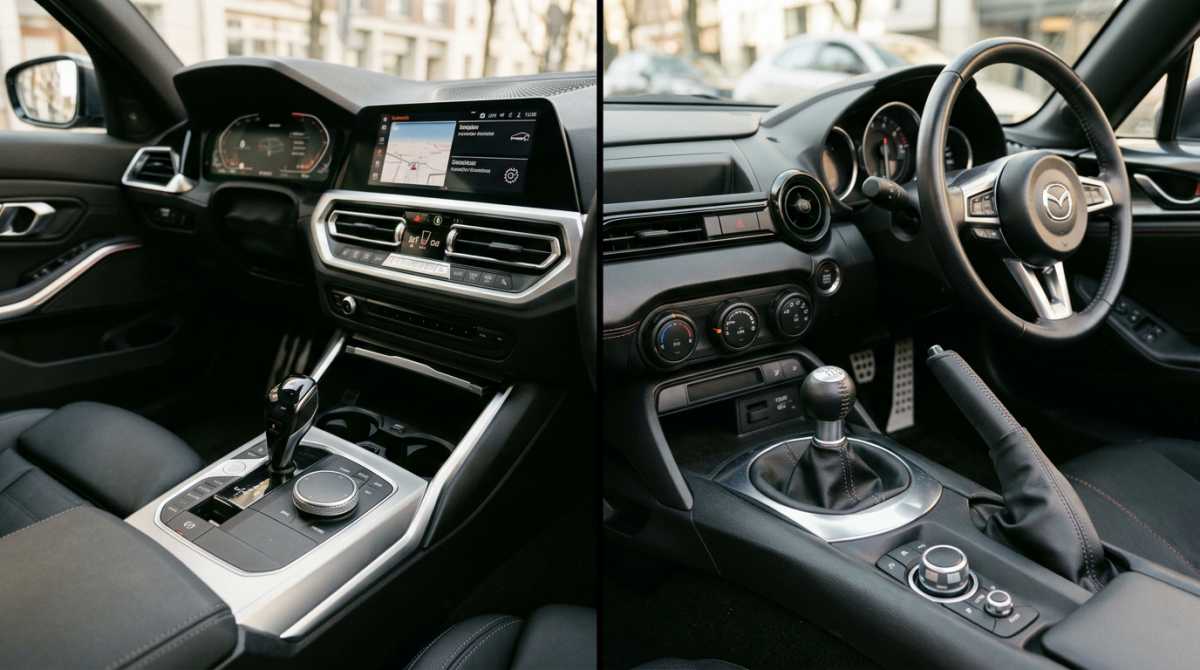
TL;DR: The battle of manual vs automatic cars in the UK is now a choice between upfront savings and future-proofing. While a used manual can be over £1,500 cheaper to buy and insure, the latest automatic cars now offer better fuel economy and are becoming the standard, especially with the rise of all-electric vehicles.
Manual vs automatic cars UK: The £1,500 price gap drivers need to know
The long-held belief that manual cars are the default, superior choice for UK drivers is being seriously challenged, as the latest data reveals a significant shift in the market. As of 2026, while manual cars still offer substantial upfront savings for budget-conscious buyers, the sheer practicality and evolving efficiency of modern automatics are changing the game for learners and seasoned motorists alike.
Manual cars win the upfront cost battle
For drivers where every pound counts, the manual gearbox remains the undisputed champion of the wallet. If your primary goal is to slash your motoring costs, the traditional three-pedal car is still the most direct route to savings. Our research confirms that this financial advantage is visible across the entire ownership experience.
When looking at the purchase price on the bustling UK used car market, the difference is stark. A manual version of a popular hatchback like the Ford Fiesta or Volkswagen Golf can be anywhere between £500 and £1,500 cheaper than its automatic counterpart of the same age and condition. This is a significant upfront saving that can make a real difference to your budget.
Now, let's talk about the automatic vs manual insurance cost. From our experience analysing quotes, insurers in the UK still tend to view automatic gearboxes, particularly older torque converter units, as more complex and therefore more expensive to repair or replace. This risk is often reflected in an annual premium that can be 5% to 15% higher for the automatic model, a recurring cost that adds up over time.
Maintenance is another area where the manual shows its financial strength. A manual clutch replacement is a common and predictable expense for most garages, typically costing a few hundred pounds. In stark contrast, a major failure in an automatic gearbox can be a financial catastrophe, with repair bills sometimes costing more than the entire value of an older used car. This makes manual gearbox vs automatic reliability a key factor for those buying cars over five years old.
Why automatics are the clear winner for city and commuter driving
If your daily drive involves the infamous M25 at rush hour or the stop-start crawl through city centres like Manchester, Birmingham, or London, an automatic car is nothing short of a revelation. The constant clutch work and gear changing in traffic is a major source of driver fatigue.
The RAC have noted that an automatic car makes it significantly easier to focus on the important tasks of road positioning, hazard perception, and speed management. The car's computer handles the mechanical task of gear selection, freeing up your mental capacity.
Having driven both transmission types extensively in congested UK cities, our editors agree: the 'fatigue factor' is very real. In a manual car, you might depress the clutch pedal over 100 times in a single mile of heavy traffic. In an automatic, you simply manage the brake and accelerator. This isn't just about luxury; it's a genuine benefit for safety and reducing driver stress on Britain's busy roads.
The automatic driving test: Not the easy pass you think
A common myth persists that taking your driving test in an automatic is a 'shortcut' to getting your licence. While it's true that you don't have to master the delicate art of 'clutch control' or worry about the embarrassment of stalling at a busy roundabout, the official data tells a more complex story.
Recent statistics from organisations like the New Driver Programme suggest that the pass rate for automatic-only driving tests often remains lower than the combined UK average. So, why is this? Driving examiners have told us that learners who struggle with spatial awareness, road rules, or hazard perception sometimes opt for an automatic test thinking it will be 'easy'. However, they still fail on these core driving competencies, as the transmission type doesn't fix fundamental observation flaws.
Here's the most important point for learners: if you pass your test in a manual car, your Category B licence legally qualifies you to drive both manual and automatic cars. If you pass in an automatic, you are restricted to only driving automatics.
Fuel economy u-turn: Modern automatics finally beat manuals
For decades, it was a simple fact: manuals were more fuel-efficient. That has completely changed. This is one of the biggest U-turns in modern motoring. The latest generation of 'dual-clutch' transmissions, like Volkswagen’s famous DSG or Porsche's PDK, can shift gears faster and more precisely than any human driver ever could.
What does this mean for drivers at the pump? In 2026, many new or nearly-new automatic cars actually offer better MPG (miles per gallon) than their manual siblings. The car's computer keeps the engine in its most efficient rev range at all times.
But wait, there's a catch for used car buyers. If you're looking at older used cars (typically those made before 2015), the simpler, lighter manual gearbox usually still wins on manual car fuel economy. If you're buying a 10-year-old runaround, go manual for better fuel savings. If you're buying a 3-year-old car, the automatic might actually save you money on fuel.
The future is automatic: How electric cars are killing the manual gearbox
We have to address the elephant in the room: the UK government's 2035 deadline for the ban on new petrol and diesel car sales. This single policy is fundamentally reshaping the industry. Electric cars, which are the designated successors, do not have gearboxes in the traditional sense; they are all effectively single-speed automatics.
If you are looking for a car that is future-proof, leaning towards an automatic now makes perfect sense. It prepares you for the inevitable switch to an EV. Car manufacturers are already voting with their factories; they are rapidly phasing out manual options. Premium brands like BMW, Mercedes, and Audi have already significantly reduced or completely eliminated manual gearboxes from their new model line-ups. Your options for a brand-new, high-spec manual car are shrinking every single year.
A split in the used car market: What's happening to prices?
As of mid-2026, we are seeing a fascinating 'divergence' in the used car market, creating two distinct trends for manual vehicles.
On one hand, high-performance 'enthusiast' manual cars are seeing their prices hold firm or even spike. Models like the Honda Civic Type R, older manual BMW M3s, or the Ford Focus ST are becoming modern classics. 'Driving purists' want to own the last of the breed, and this demand is keeping residual values strong for these specific models.
On the other hand, for everyday cars, the opposite is happening. Standard family SUVs or hatchbacks in manual are becoming harder to sell on the second-hand market. The vast majority of families now demand the convenience and ease of an automatic for the school run and daily commutes. This is depressing the value of used manual family cars, making them a bargain for some, but a potential liability for others when it comes time to sell.
Manual vs automatic costs: The numbers compared
When we break down the figures, the financial differences become even clearer. Looking at automatic driving lessons cost, you can expect to pay anywhere from £38 to £45 per hour. This is consistently higher than the £34 to £37 per hour typically charged for manual lessons, a difference that adds up over the 40-50 hours of tuition many learners need.
The initial purchase price for a good, fair-condition entry-level used car also shows a clear manual advantage. You could find a reliable manual runaround for around £2,500, whereas a comparable automatic would likely start closer to £3,800.
The story is similar for insurance. A car's insurance group is often higher for the automatic version (e.g., Group 12E vs 10E for the manual). This is due to the higher potential repair costs, directly impacting your annual premium.
However, the automatic claws back a significant win in efficiency, particularly in the stop-start traffic that defines modern urban driving. Its ability to keep the engine optimised and reduce driver strain is a major plus. This also leads to better residual values, as demand for used automatics is rising steadily, meaning you'll likely get more of your money back when you sell.
The verdict: Who should buy a manual?
You should choose a manual car if you are on a strict budget and want the absolute lowest purchase price, insurance premiums, and potential maintenance costs. It's the savvy choice for the present-day bargain hunter. It's also the right car for you if you genuinely enjoy the mechanical connection and 'feel' of driving, finding the process of changing gears engaging and fun. Finally, a manual licence offers ultimate flexibility, allowing you to drive any van, hire car, or older vehicle you might encounter.
The verdict: Who should buy an automatic?
You should choose an automatic car if you do most of your driving in congested cities or on traffic-clogged motorways. The reduction in stress and fatigue is a massive quality-of-life improvement. An automatic is also the logical choice if you are planning to transition to a hybrid or fully electric vehicle in the next few years, as it makes the switch seamless. Lastly, if you find gear changes and clutch control a distraction from observing the road, an automatic allows you to focus 100% on safety and hazard perception. Your options just got better.
Your next steps as a driver
Check your licence
Before you do anything, look at the back of your pink photocard licence to confirm which 'Category B' codes you have, which will tell you if you are restricted to automatics.
Test drive both
The best way to decide is to experience it first-hand. Book back-to-back test drives of the same car model in both manual and automatic forms.
Compare insurance quotes
Don't just assume the auto will be more expensive for your specific profile. Get real quotes for cars you're interested in, as the difference can sometimes be surprisingly small.