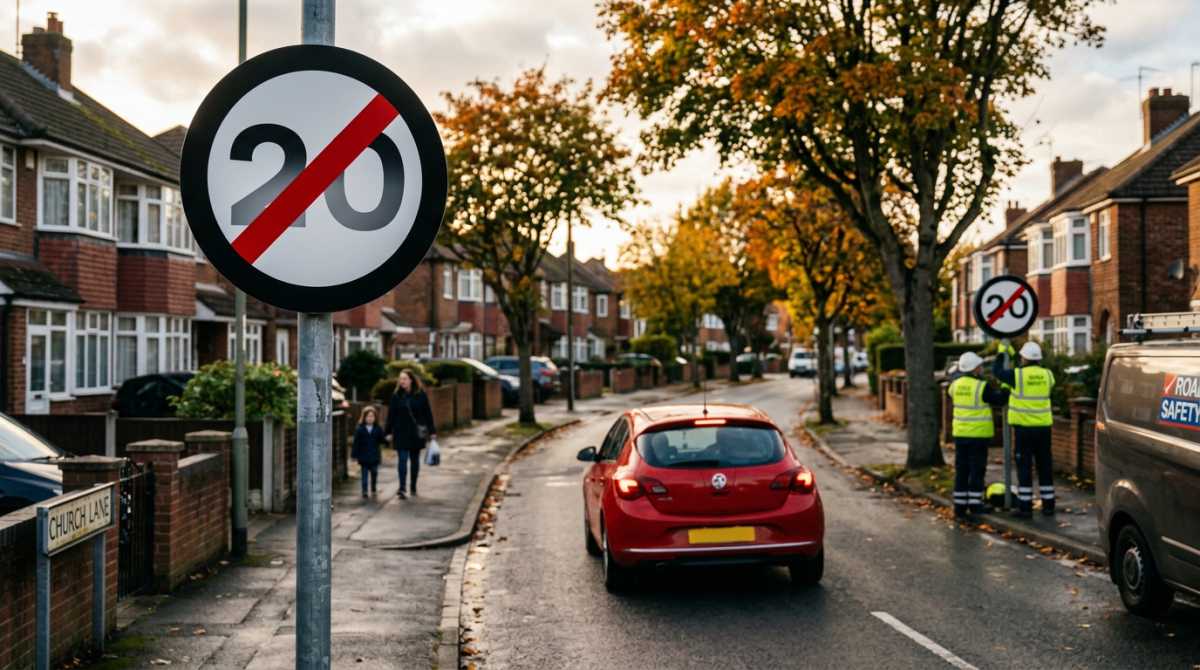
TL;DR:
Government advisers are pushing for a national default 20mph speed limit across UK built-up areas, primarily to reduce administrative burdens and signage costs for local councils. This move could significantly impact UK drivers, following a record 5.6 million penalty points issued last year, largely due to the expansion of existing slower zones.
Key Facts:
1. 20mph is being proposed as the new default speed limit for built-up areas across the UK.
2. 5.6 million penalty points were issued to UK drivers last year, a record high.
3. 40% of English local authorities are already implementing 20mph schemes.
4. Wales has already adopted a default 20mph limit, with Scotland set to follow.
A National 20mph Limit Could Be Coming
UK drivers could soon face a significant change to their daily commutes as government advisers advocate for blanket 20mph speed limits UK-wide in built-up areas. This proposal aims to establish a national default, moving away from the current 30mph standard. The shift is not solely driven by safety concerns but also by a desire to alleviate the financial and administrative strain on local councils.
Recently, the data has revealed a startling trend. Last year alone, UK drivers accumulated a record 5.6 million penalty points. Industry experts widely attribute this surge to the rapid expansion of existing slower speed zones, catching many motorists unaware. This has sparked a debate among various organisations.
The Parliamentary Advisory Council for Transport Safety (Pacts) supports a national approach to speed limits, believing it offers the most coherent and effective solution. Conversely, motoring groups have voiced strong objections. Their primary concerns revolve around a potential 20mph penalty points increase and the added wear and tear on vehicles from constant low-gear driving.
Why Councils Support Blanket 20mph Zones
So, why are local authorities increasingly considering these blanket 20mph zones? The answer largely boils down to economics. Under the current UK local authority road safety policy, implementing a reduced speed limit on even a single street is a complex and costly endeavour. It requires extensive legal orders, the installation of numerous physical signs, and a substantial amount of administrative work. The 20mph zones cost of signage alone is a significant drain on already stretched council budgets.
By designating 20mph as the default speed limit, the financial burden would effectively reverse. Councils would only need to invest in signage if they wished to 'opt-out' a specific road, maintaining a 30mph or 40mph limit. This change would dramatically reduce the initial outlay for implementation.
What It Means for UK Drivers
Jamie Hassall from Pacts recently confirmed this point to Members of Parliament, stating that the current system is simply unsustainable due to its prohibitive cost. We've already seen Wales successfully implement a default 20mph limit across its built-up areas, and Scotland is poised to follow suit. In England, roughly 40% of local authorities are already progressing with similar schemes.
For the remaining drivers across the country, this potential policy shift means commutes could become slightly longer, and more attention will be required to monitor speedometers. Whether this initiative is viewed as a crucial step for road safety or merely another financial imposition on motorists, the momentum towards blanket 20mph speed limits UK-wide appears to be gathering unstoppable pace.