

Most of us have been stuck in a motorway queue that didn’t move for hours, and the government wants drivers ready for something worse. Its new Be Ready campaign, launched by the Cabinet Office last week, includes advice for anyone whose journey is held up by severe weather, a serious incident or a failure in the road network.
The idea is simple. If you’re properly kitted out, you’re less likely to need help, and Security Minister Dan Jarvis has said that simple steps like these can take pressure off the emergency services during events such as severe storms.
What should you keep in your car?
These are the items on the government’s list for drivers.
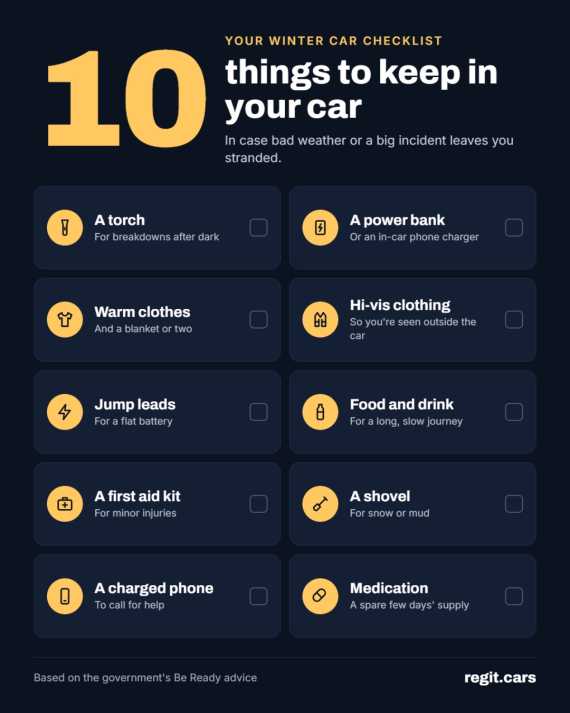
- A torch, so you can see what you’re doing if you break down in the dark.
- A power bank or in-car charger, so a long wait doesn’t leave your phone flat.
- Warm clothes and blankets, in case you’re stuck for hours or your car can’t run its heater.
- Hi-vis clothing, so other drivers can see you if you have to get out.
- Jump leads, because a flat battery is one of the most common causes of winter breakdowns.
- Food and drink, for a journey that turns out far longer than planned.
- A first aid kit, for small injuries while you wait for help.
- A shovel, for digging out of snow or freeing a wheel stuck in mud.
- A charged phone, so you can call for help and keep up with traffic updates.
- Any essential medication, in case you’re away from home longer than expected.
How much will a car emergency kit cost?
Not much, because you probably own most of it already. Blankets, a torch, an old coat, a few snacks and a bottle of water can come straight from home, and your medication only needs a spare few days’ worth kept in the glovebox.
The items you might need to buy are jump leads, a hi-vis vest, a fold-up shovel and a first aid kit, and all of them are widely sold at car accessory shops and supermarkets. Keep the food and drink fresh by swapping it out every few months, and check the torch batteries when the clocks change.
How to stop it happening in the first place
The best emergency kit is the one you never need. Before a long winter journey, check the forecast and traffic, set off with plenty of fuel or charge, and make sure your tyres, lights and wipers are in good shape. A battery that’s struggling to start the car on a cold morning is worth getting tested before it lets you down somewhere remote.
The Be Ready campaign goes beyond the car, too. It asks households to have enough supplies to cope for three days of disruption, including water, food and a battery or wind-up radio.
Our verdict
The government’s list is sensible, cheap and easy to follow, and every driver should have the basics in the boot before winter sets in. If you only do three things this week, put a warm coat, a torch and a phone power bank in the car, then add the rest over the next few weekends.