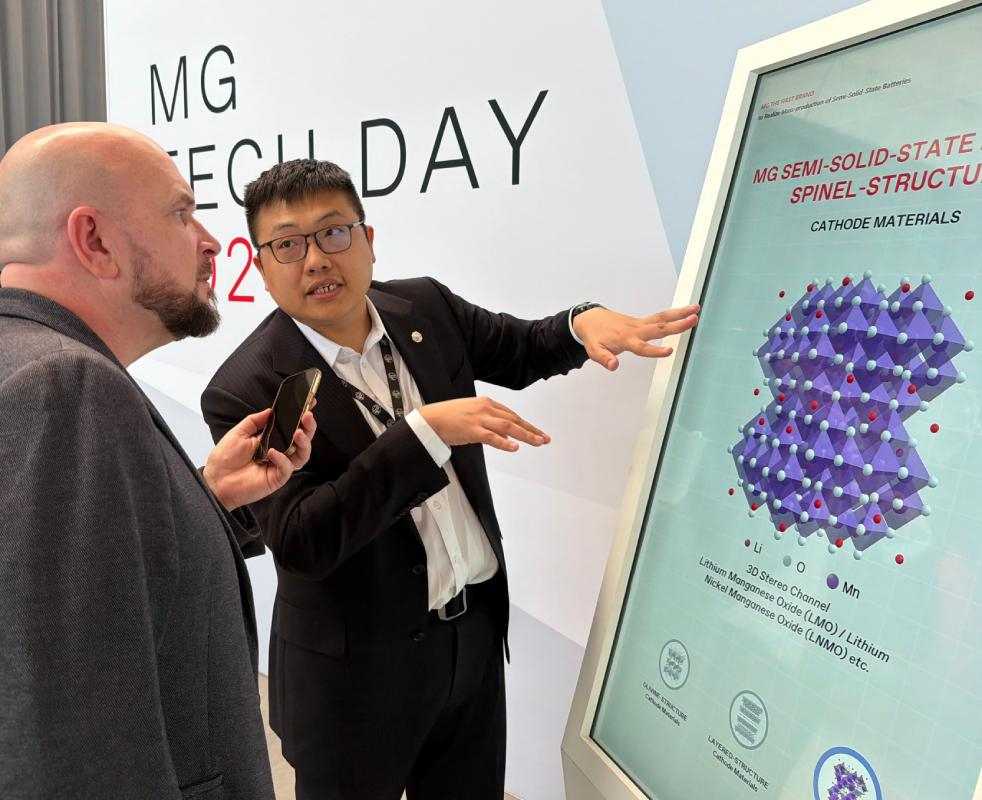
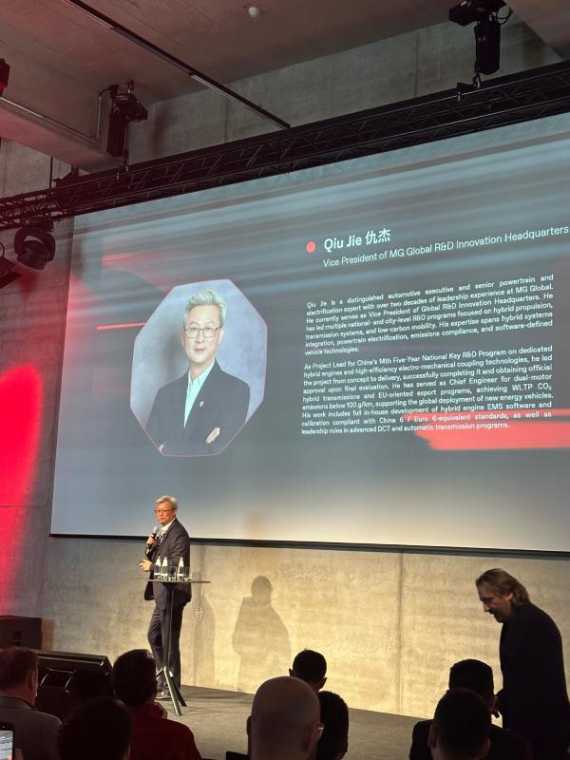
In two separate conversations, our motoring journalist Tim Barnes-Clay spoke with Dr Li Zheng, MG Global Chief Battery Scientist, and Dr Qiu Jie, Vice President of MG Global R&D Innovation Headquarters. Each offered a distinct perspective on the company's future - one focused on breakthrough battery technology, the other on the evolution of hybrid systems and real-world usability.
Interview One: Dr Li Zheng on Next-Generation Batteries
Tim Barnes-Clay: Can you tell me about MG's new battery technology?
Dr Li Zheng: Certainly. What we are developing is different from current battery technologies such as LFP and NCM. We are introducing entirely new materials designed to improve both safety and performance. In electric vehicles, safety is essential, but customers also expect strong acceleration and reliable performance in low temperatures. That's why we've had to rethink the material structure.
Tim Barnes-Clay: What makes this new structure unique?
Dr Li Zheng: Traditional batteries allow lithium ions to move in one or two directions. Our material enables movement in three directions, which improves performance significantly. However, this structure isn't stable in conventional liquid batteries, so we use semi-solid-state technology. This ensures better durability and a longer lifecycle.
Tim Barnes-Clay: Why bring this technology to Europe?
Dr Li Zheng: Europe wants to develop its own battery supply chain. If it continues to rely only on existing technologies, it may struggle to compete. New materials create new opportunities - new supply chains and new expertise. That's why we see Europe as a key region for this innovation.
Tim Barnes-Clay: Is MG leading in this field?
Dr Li Zheng: Yes, we believe so. We are among the first to bring this type of technology into mass production. It's not just about innovation - it's also about scaling it effectively, which is not easy to copy.
Tim Barnes-Clay: And what about competition?
Dr Li Zheng: Competition is intense, especially in China, but our approach is different. It's based on new materials and new systems. We're also working to establish local supply chains in Europe, which benefits both MG and the wider industry.
Tim Barnes-Clay: How do you balance MG's heritage with innovation?
Dr Li Zheng: MG is a European brand at its core. Our strength is combining advanced Chinese technology with European expectations. That creates a strong foundation for the future.
Interview Two: Dr Qiu Jie on Electrification and Everyday Efficiency
Tim Barnes-Clay: How do you see the future of MG in terms of hybrid and electric vehicles?
Dr Qiu Jie: To understand the future, we look at today. Our current products are gaining strong acceptance, with more customers embracing electrification. European drivers value efficiency, performance, and energy-saving technologies, and that drives our development.
Tim Barnes-Clay: In the UK, with congestion and high living costs, do hybrids make sense?
Dr Qiu Jie: Yes, they are very well suited. We focus on three areas: performance, efficiency, and battery capability. Modern electric motors provide high torque and fast response - smooth, quiet, and quick acceleration, which drivers really appreciate.
Tim Barnes-Clay: How do you improve efficiency?
Dr Qiu Jie: We've developed dedicated hybrid engines that are highly fuel-efficient. While engines alone may respond more slowly, the electric system supports them, creating a balanced and efficient driving experience.
Tim Barnes-Clay: And the battery?
Dr Qiu Jie: Our hybrid batteries are larger than before - around 1.8 kWh. This allows rapid charging and discharging, so energy can be efficiently exchanged between the engine and battery in all driving conditions.
Tim Barnes-Clay: What does that mean on the road?
Dr Qiu Jie: It means strong low-speed performance. Our system includes an electric motor of around 100 kW and 250 Nm of torque, delivering instant acceleration - ideal for city driving - while maintaining excellent fuel economy.
Tim Barnes-Clay: Are hybrids a good option for those not ready for EVs?
Dr Qiu Jie: It depends on usage. EVs are ideal for short daily journeys, but hybrids offer flexibility for longer distances. Our goal is to make hybrids feel as close as possible to EVs in performance and refinement.
Tim Barnes-Clay: MG is known for value. How do you keep costs down?
Dr Qiu Jie: Large-scale electrification, particularly in China, has reduced the cost of key components like batteries and engines. By integrating these efficiently, we can offer high-value vehicles at competitive prices.