TL;DR The UK’s net zero strategy is accelerating the shift from petrol and diesel cars to electric vehicles, but the transition is creating financial and practical challenges. Car manufacturers face high costs to meet EV sales targets, while drivers deal with higher purchase prices, insurance, and limited charging infrastructure. Public confidence is essential for adoption, and critics argue that the burden on motorists is heavier than on other high-emission sectors like aviation or shipping. A balanced approach with realistic targets, infrastructure investment, and affordability measures is key to ensuring the success of net zero transport goals.
Net zero now sits at the heart of UK transport policy, with a clear intention to phase out petrol and diesel cars and replace them with electric vehicles at pace. While the direction is widely accepted, there is growing debate over whether the speed being demanded reflects the realities of the market and consumer readiness.
Pressure on manufacturers
Car manufacturers are operating under increasing pressure from the Zero Emission Vehicle mandate, which sets annual EV sales targets and applies financial penalties if those targets are missed. To remain compliant, brands are investing billions in electric platforms, retooling factories, restructuring supply chains and discounting vehicles to stimulate demand, often at the expense of profitability. Several major manufacturers have already acknowledged that some EV models are being sold at a loss, a strategy driven less by market demand than by regulatory necessity.
Mike Hawes, chief executive of the Society of Motor Manufacturers and Traders, has repeatedly warned that regulation alone cannot generate consumer confidence, pointing instead to affordability, charging availability and infrastructure reliability as unresolved barriers.
Consumer confidence lags behind policy
These concerns are reflected on forecourts, where interest in electric vehicles has increased but not at the pace assumed by policy. Private buyers, particularly outside major cities, remain cautious, with worries around public charging costs, network reliability and long-term battery performance continuing to influence purchasing decisions.
As a result, manufacturers are being assessed against targets that depend heavily on infrastructure provision, energy pricing and consumer behaviour that sit largely beyond their control.
Political ambition meets practical reality
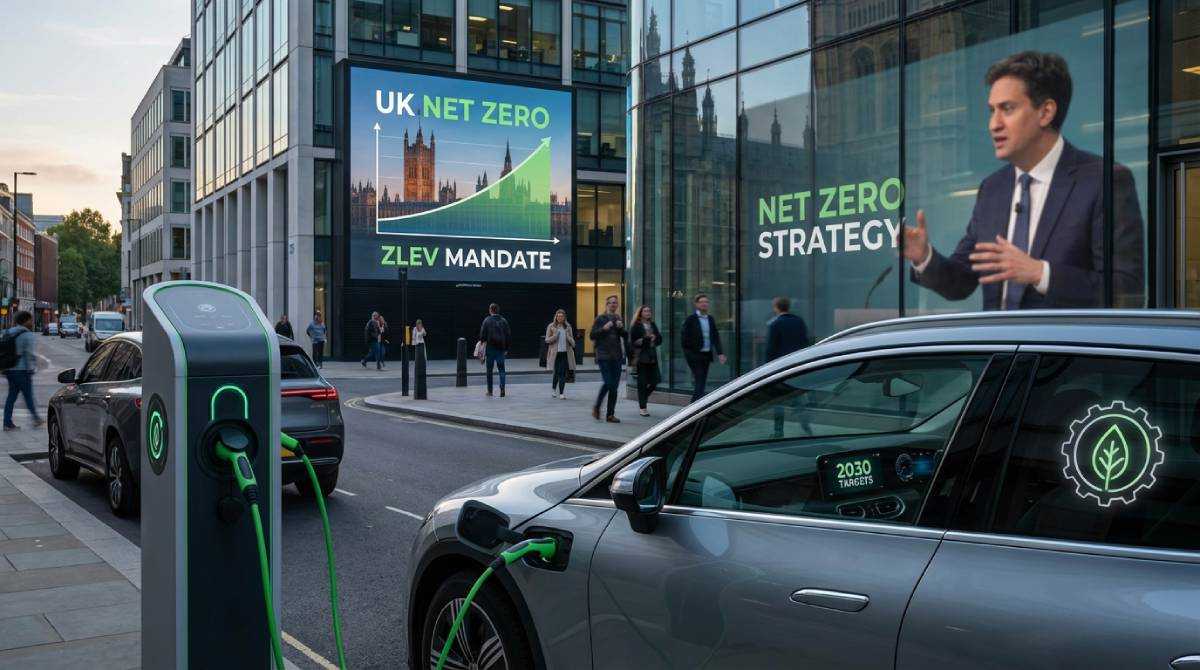
Ed Miliband has positioned net zero as a defining political priority, arguing that urgency and ambition are essential if the UK is to meet its climate commitments. Supporters view this approach as necessary leadership, while critics argue that deadlines are being prioritised ahead of the practical conditions required to support widespread adoption.
While policy can shape markets, it cannot force trust, and most drivers will only make the switch when electric vehicles feel practical, affordable and reliable without requiring lifestyle compromises.
Costs are most visible to drivers
For many motorists, the transition to electric feels increasingly one sided. EVs continue to carry higher upfront prices, insurance premiums are often higher than for equivalent petrol or diesel models, and public charging, particularly on rapid networks, can be expensive compared with home charging or traditional fuel.
At the same time, ongoing discussions around future road pricing schemes suggest that the overall tax burden on driving is unlikely to reduce, reinforcing the perception that motorists are being asked to adapt quickly while absorbing higher costs.
Other sectors face less scrutiny
Road transport is a major contributor to UK emissions, but it is not the only one. Aviation and global shipping generate substantial CO₂ output while operating under looser international regulation, where enforcement is slower and public scrutiny is far less visible.
This imbalance raises questions about fairness, particularly when private motorists experience the most immediate disruption while progress in other high-emission sectors appears slower.
Public support matters
Reducing emissions depends not just on regulation but on sustained public support. When policies are perceived as expensive, restrictive or unevenly applied, confidence weakens and resistance grows.
A more durable approach would better align ambition with market readiness by setting realistic EV targets, accelerating investment in charging infrastructure, addressing affordability and ensuring stronger action across all high-emitting industries.
Fairness will determine success
The transition to net zero does not need to slow, but it does need to feel fair and credible. Manufacturers are absorbing financial strain, motorists are facing higher costs and policymakers remain focused on deadlines. Without a clearer balance between ambition and practicality, the risk is not delay but a loss of public trust, which would ultimately undermine the UK’s path to cleaner transport.