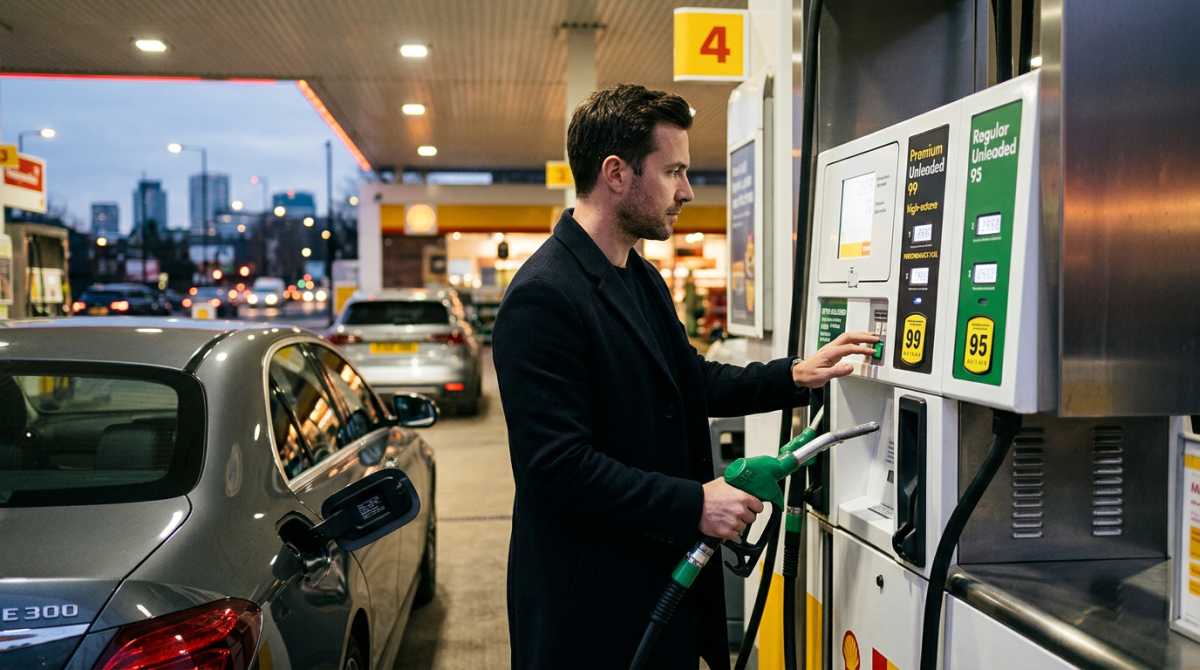
TL;DR: For most UK drivers, premium fuel is not worth the extra cost, potentially saving average motorists £650 per year by sticking to standard E10 petrol. While premium E5 offers a marginal 2.7% fuel economy boost, the significantly higher price rarely justifies the switch unless you own a high-performance or classic car.
Key Facts:
- In 2026, the average UK driver could pay an additional £650 per year by regularly using premium petrol.
- Standard E10 unleaded fuel has a Research Octane Number (RON) of 95, while premium fuels typically range from 97 to 99 RON.
- Official testing suggests premium fuels offer an average 2.7% improvement in fuel economy and a 1.4% increase in horsepower.
- Classic cars and vehicles manufactured before 2011 should always use premium E5 fuel due to its lower ethanol content.
- The price gap between standard and premium fuel can be around 15p per litre, adding £7.50 to a typical 50-litre tank fill-up.
Is premium fuel worth it? The UK driver's guide to superunleaded
In 2026, UK petrol stations present drivers with an increasingly complex and expensive choice at the pump. With the price gap between standard E10 unleaded and premium E5 super-unleaded widening, a crucial question keeps emerging: Is premium fuel worth it?
At Regit, we’ve meticulously analysed the latest data and consulted with industry specialists to help you decide if that extra spend is a savvy maintenance move or simply money down the drain for your average UK motorist.
In our experience, the answer isn't a simple 'yes' or 'no'. It's a nuanced calculation involving your car's engine requirements, your annual mileage, and the specific age of your vehicle. According to data provided by BookMyGarage, regularly filling a vehicle with premium petrol could cost the average driver an additional £650 per year in 2026. For many, that's a significant price to pay for what might be more of a psychological boost than a tangible mechanical one.
Understanding the technical difference: Premium petrol vs regular unleaded
To truly understand if super unleaded 99 octane is better for your engine, we first need to define the terms. In the UK, standard unleaded (E10) has a Research Octane Number (RON) of 95. Premium fuels, often marketed as 'Super Unleaded', 'V-Power', or 'Ultimate', typically offer a 97 to 99 RON. This higher number is crucial for certain engines.
The octane rating isn't a measure of the power contained within the fuel but rather its resistance to 'knocking' or pre-ignition. This occurs when the air-fuel mixture in the cylinder ignites prematurely due to high pressure and heat before the spark plug fires. High-performance engines, such as those found in BMW M-Series or Porsche models, operate at higher compression ratios. For these drivers, high-octane fuel is essential to prevent engine damage and ensure optimal performance. Higher octane fuel is specifically for engines prone to pre-ignition, such as those with high boosts from turbochargers or high compression ratios. So, for some, the high octane fuel benefits are undeniable.
Does E5 vs E10 fuel economy justify the cost?
Does the extra cost of premium petrol vs regular translate to more miles per gallon for the everyday driver? Official testing indicates a marginal benefit.
A study cited by several automotive researchers found that while results vary, test vehicles averaged a 2.7% improvement in fuel economy and a 1.4% increase in horsepower when using premium fuels. What this means for drivers is that if your car is an 'everyday' hatchback (like a Ford Fiesta or a Volkswagen Polo) carrying out a weekly shop, you are unlikely to feel that 1.4% power increase.
However, some drivers do report small improvements in MPG. Because premium petrol (E5) contains less ethanol than standard E10, the energy density is slightly higher, which can lead to a slight range extension. But is super unleaded better for engine longevity and overall running costs for the average car? The numbers often tell a different story.
Why classic car owners MUST choose premium E5 fuel
If you drive a classic car, the 'is premium fuel worth it' debate ends immediately with a resounding 'yes'. Following the UK's transition to E10 as the standard grade of petrol, many older vehicles are at significant risk of mechanical damage. Why? Engineering Explained has highlighted that ethanol can be corrosive to older rubber seals and fuel lines. Therefore, if you are driving a classic car, you should always select a premium grade of fuel. Not only does the higher octane protect against knocking in older engines without modern knock sensors, but the lower ethanol content (5% in premium E5 vs up to 10% in standard E10) actively prevents long-term degradation of the fuel system. This is a critical high octane fuel benefit for vintage vehicles.
Comparing the costs: How much you could save by avoiding premium
Let's look at the numbers for premium petrol vs regular. If we assume a price gap of 15p per litre between standard and premium fuel – a common scenario across UK forecourts:
- Typical 50-litre tank fill-up: This means an extra £7.50 per tank.
- Fortnightly fill-up: Over a year, this adds up to an extra £195.
- Weekly fill-up: For those filling up more often, that's an additional £390 per year.
The BookMyGarage data suggesting a £650 impact reflects high-mileage users or those driving SUVs with larger fuel tanks. When compared to the potential 2.7% fuel economy gain, the maths often doesn't stack up for the budget-conscious driver. If standard fuel costs £1.45/L, a 2.7% gain saves you roughly 4p per litre. Yet, you're paying 15p more to get it. That's a net loss of 11p per litre. Your options just got better for saving money by sticking to standard.
The role of detergents and engine cleaning in high octane fuel
Beyond octane ratings, premium fuels are also marketed as 'cleaning' products. Brands like Shell and BP claim their premium fuels contain higher concentrations of detergents and friction modifiers. These are designed to:
- 1. Remove carbon deposits from intake valves, improving engine breathing.
- 2. Clean fuel injectors for a more efficient spray pattern, optimising combustion.
- 3. Reduce friction in the upper cylinder area, potentially extending engine life.
While Swansway Motor Group notes that these fuels are marketed as superior choices promising lower emissions, the reality is that all UK fuels must meet British Standards (BS EN 228). Even standard 95 RON fuel contains cleaning additives.
However, if you have a modern direct-injection engine, using a tank of premium fuel every few months may help prevent carbon build-up, a common issue in modern GDI (Gasoline Direct Injection) powerplants. So, for some, is super unleaded better for engine cleanliness? Possibly, but not necessarily for every tank.
Verdict: Should UK drivers make the switch to premium fuel?
Good news for petrol car owners: unless your manufacturer specifically states 'Super Unleaded Only' on the fuel filler cap, your car will run perfectly well on standard 95 RON petrol. The modern Engine Control Unit (ECU) is designed to adjust timing to suit the fuel provided, meaning it can compensate for lower octane without issue. This means your options just got better for saving money without compromising performance for most vehicles.
In our experience, you should choose premium fuel IF:
- You drive a high-performance car (Turbocharged or high compression), where super unleaded 99 octane is often a requirement.
- You drive a classic car or a vehicle manufactured before 2011, making E5 vs E10 fuel economy and engine protection critical.
- You are towing heavy loads and want maximum engine protection and efficiency under strain.
- You notice your engine 'hunting' or idling roughly on standard fuel, which could indicate a need for higher octane.
For everyone else: Stick to regular 95 RON. The performance gap is simply too narrow to justify the £650 annual premium for the average UK commute. This is a clear win for petrol car owners looking to save money.
Conclusion: Is premium fuel worth it for your car?
The 'premium' tag is often more about marketing than major mechanical gains for the average motorist. While the 2.7% MPG increase is a factual data point, the financial reality remains that for a standard car, the cost of premium fuel far outweighs the savings. Check your owner's manual, if it doesn't demand 97+ octane, keep that £650 in your pocket this year. This approach offers significant relief for petrol car owners navigating rising costs.
Next steps for UK drivers:
- 1. Check your fuel filler cap for the manufacturer's RON recommendation to understand your car's specific needs.
- 2. If you want engine cleaning benefits without the daily cost, consider using a high-quality fuel system cleaner additive once a year instead.
- 3. Use a fuel price tracker app to find the cheapest 95 RON in your area to maximise your savings and make your options just got better for budgeting.