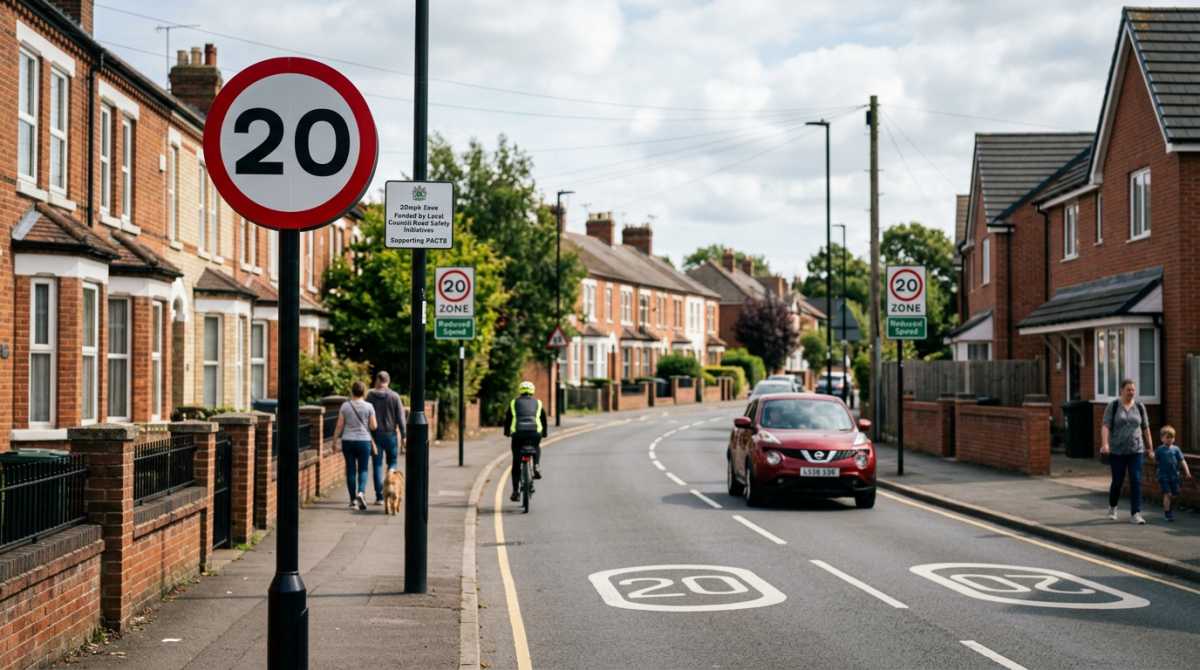
TL;DR: Government transport advisers are pushing for a blanket 20mph speed limit across all UK built-up areas as a cost-cutting measure for councils. Motoring groups have slammed the proposal, warning it's a "cash grab" against drivers, especially as speeding penalties recently hit a record high.
Key Facts
- 5.6 million: The record number of speeding penalty points issued to UK motorists in the last year.
- Pacts: The Parliamentary Advisory Council for Transport Safety is the key advisory body proposing the nationwide 20mph default.
- 62: The number of English councils that have already introduced their own 20mph schemes, going against central government guidance.
- Wales: Has already implemented a default 20mph speed limit for most residential roads, setting a precedent for the rest of the UK.
- FairFuelUK: The prominent motoring campaign group has labelled the proposal a "blatant cash grab" against UK drivers.
UK drivers warned as blanket 20mph speed limit pushed for all built-up areas
The debate over speed on our urban roads has intensified, with government transport advisers recently recommending a radical change: blanket 20mph speed limits for all built-up areas across the UK.
The proposal, presented to the Commons transport committee, argues that making 20mph the national default would save local councils significant sums of money. This cost-saving comes from eliminating the need for expensive, bespoke signage and complex administrative processes currently required to lower the limit on a street-by-street basis.
What is being proposed for UK speed limits?
Jamie Hassall, who leads the influential Parliamentary Advisory Council for Transport Safety (Pacts), is spearheading the proposal. He told the committee that the current system is simply too clunky and expensive for councils to manage effectively.
Under his proposed model, 20mph would become the standard speed limit for built-up areas in England, mirroring changes already seen elsewhere. If a local authority believes a specific road is safe enough for a 30mph limit, they would need to formally 'opt-out' and justify the higher speed. This effectively flips the current system on its head, placing the burden of proof, and the associated costs, onto those arguing for faster speeds.
What this means for UK drivers
While officials are framing this as a smart way to manage public funds, the implications for the everyday driver are raising serious concerns. For many, the practicalities of navigating a network of blanket 20mph zones could turn the daily commute or school run into a frustrating crawl.
There's also the significant safety concern that drivers will spend more time watching their speedometers than the road ahead, trying to avoid a fine. This constant monitoring and the stop-start driving style it encourages is not just irritating; some argue it's counter-productive to road safety.
This comes at a time when drivers are already under pressure. UK motorists received a staggering 5.6 million penalty points for speeding last year alone, a record number that has left many feeling unfairly targeted.
The strong reaction from motoring groups
Motoring organisations have been quick to condemn the plan. Howard Cox from the FairFuelUK motoring campaign didn't hold back, describing the proposal as a "blatant cash grab" aimed at some of the most heavily taxed individuals in the country.
His argument is that these new, lower limits are less about genuine safety improvements and more about creating new opportunities to issue fines and penalties. With car insurance premiums already soaring, often due to minor infractions, another measure that increases the risk of penalty points could be the final straw for many households struggling with the cost of living.
How does the UK compare to Wales?
The UK is currently a patchwork of different rules. Wales has already made 20mph the default speed limit for most residential streets, a move that has been both praised by safety campaigners and criticised by drivers for increasing journey times. Scotland is also actively considering a similar nationwide policy.
Meanwhile, in England, at least 62 councils have forged ahead with their own 20mph schemes, despite a promise from the central government to curb the rollout of blanket 20mph speed limits UK-wide. This has created a confusing and inconsistent experience for drivers navigating different parts of the country.
The core of the issue, it seems, boils down to the cost of road signs. By changing the law at a national level, the need for thousands of individual '20' signs would disappear. Proponents claim this would free up UK council road safety funding for more important projects, like better pedestrian crossings. However, for the driver behind the wheel, the reality may just be a slower journey, increased stress, and the ever-present threat of another fine.