TL;DR: Recent vehicle crime UK statistics reveal a significant rise in incidents, with 1 in 4 drivers affected annually. Research from RAC Insurance shows urban areas are high-risk, with 45% of city centre drivers targeted compared to 15% in rural locations. Organised car theft gangs using advanced technology and a decrease of 1,300 police officers across England and Wales are contributing to rising car insurance premiums and security concerns.
The latest vehicle crime UK statistics have revealed a stark reality for British motorists, with new research showing a one in four chance of being targeted by criminals over the next 12 months.
A recent report based on the RAC motor crime research, which surveyed 2,400 drivers, indicates that 26% of car owners have been victims of motor crime in the last year alone. This wave of crime isn't limited to outright theft; it covers a broad spectrum of offences, from smashed windows and stolen catalytic converters to the sophisticated fraud of vehicle cloning.
These figures serve as a sobering wake-up call, suggesting that basic vigilance is no longer enough. For anyone driving or parking in the UK, especially in built-up areas, taking extra security precautions has become an absolute necessity.
Stark Divide in Vehicle Theft: Urban vs Rural Areas
Where you park your car appears to be the single biggest factor determining your risk level. The RAC's data paints a dramatic picture of the disparity between city centres and the countryside, exposing major car crime hotspots in UK urban zones.
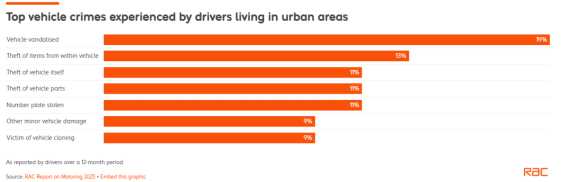
The findings are clear: drivers in city centres face a staggering 45% chance of being targeted by criminals, with nearly half of all motorists in these areas affected last year. This risk drops significantly on the outskirts of towns, where around 20% of drivers were affected. In contrast, rural villages reported the lowest rates, with just 15% of motorists experiencing any vehicle-related crime.
Car Vandalism Trends in England and Wales Soar in Cities
The threat goes far beyond theft. City dwellers are disproportionately affected by a troubling rise in car vandalism trends in England and Wales. The data shows that nearly one in five urban drivers (19%) have had their cars deliberately keyed or dented.
This is a sharp contrast to more remote locations, where the figure for vandalism drops to just 7%. The risk of opportunistic theft from a vehicle is also hugely inflated in cities. Leaving personal belongings like a bag on a seat makes a driver six times more likely to suffer a break-in compared to someone parked in a quiet, rural spot.
What Are the Real Odds of Becoming a Victim?
So, what does this mean for the average person? While the national average risk sits at 26%, this figure skyrockets to almost 50% for those who live or work in major city hubs. It’s a coin-toss every time they park their car.
But here's the catch: the perception of risk doesn't always match the reality. Interestingly, the RAC research found that rural drivers are often more anxious about their cars being damaged than their city-dwelling counterparts. A full 40% of rural motorists reported constantly worrying about vandalism, despite the statistics showing they are at a much lower risk.
London's West End Named a Top Crime Blackspot
Certain areas are demonstrably worse than others. Separate data analysis from This is Money identified London’s West End, particularly the area around Regent Street, as a major black hole for vehicle security. In a single year, this small patch of the capital recorded an astonishing 564 incidents.
That breaks down to an average of 1.5 vehicle crimes every single day, cementing its status as one of the most prominent car crime hotspots in the UK.
Simon Williams, a spokesperson for RAC Insurance, highlighted the severe consequences.
“It’s very worrying to see so many drivers have experienced some form of vehicle crime over a 12-month period. Having a vehicle vandalised is both unbelievably annoying and expensive but having one stolen is a horrible violation, incredibly stressful to resolve and inconvenient to cope with, given how important cars are to our daily lives.
“Every criminal incident like this contributes to the average cost of car insurance which has already risen in recent years due to the higher costs of parts and labour, and the increasing complexity of modern vehicles. Having to claim on your insurance because of something you’ve accidentally done yourself is one thing, but when it’s because of mindless, deliberate vandalism, it’s beyond frustrating, not least because it will inevitably result in higher future premiums
“It’s little wonder why the cost of insuring a vehicle was named the second biggest motoring frustration in our annual Report on Motoring research, with 29% of drivers saying it was one of their top concerns.”
The High-Tech Arms Race with Organised Car Theft Gangs UK
Today's car crime is a far cry from the opportunist with a coat hanger. Experts are warning about the growing sophistication of organised car theft gangs UK-wide who are exploiting modern vehicle technology.
Jonathan Hewett from Thatcham Research, an organisation that specialises in car security, has warned that these gangs are becoming alarmingly proficient at using 'relay attack' technology. This method tricks a car's keyless entry system into unlocking the doors and starting the engine, often from outside the owner's home. It has become a technological arms race between car manufacturers and criminals.
The Impact of Police Officer Numbers on Motor Crime
Compounding the problem is the strain on police resources. Recent figures show a loss of over 1,300 police officers across England and Wales in just one year, raising questions about the impact of police officer numbers on motor crime.
With fewer boots on the ground, the visible deterrent that once helped keep criminals at bay has been significantly weakened. This has left many motorists feeling increasingly exposed, whether they're paying steep airport parking charges for perceived security or just nipping to the local shops.
The government is facing mounting pressure to address this crime wave. For now, however, the responsibility falls heavily on car owners to be relentlessly vigilant, double-check their locks, invest in additional security, and ensure their insurance policies provide adequate cover. In this high-risk environment, the statistics prove that complacency is not an option.