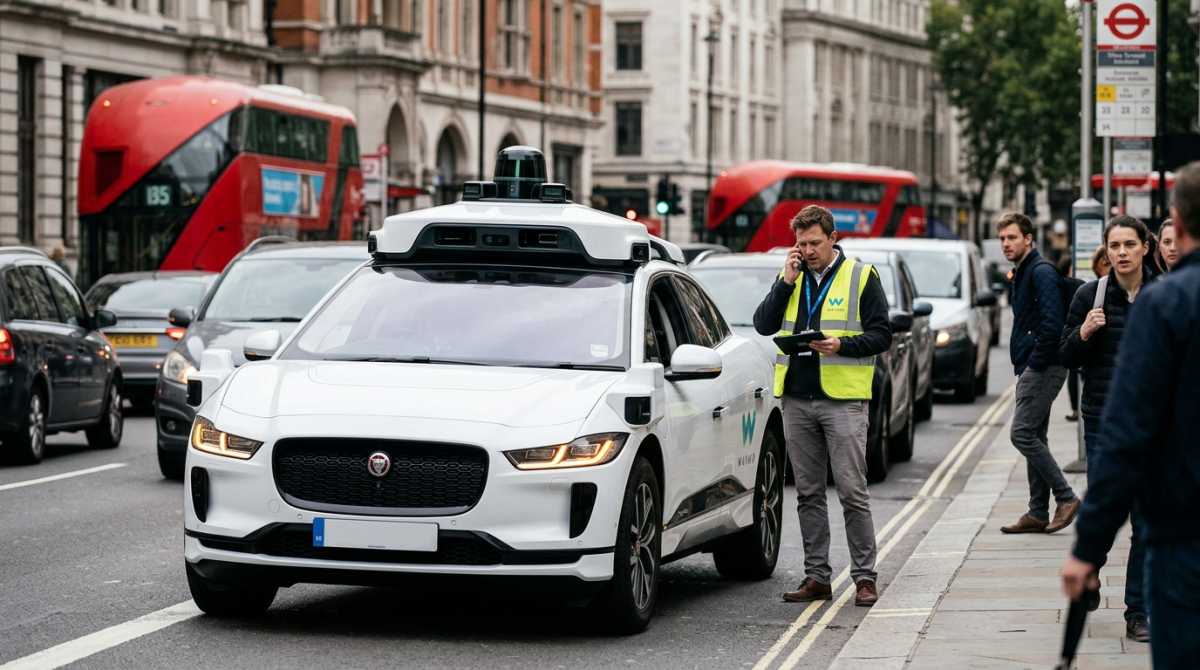
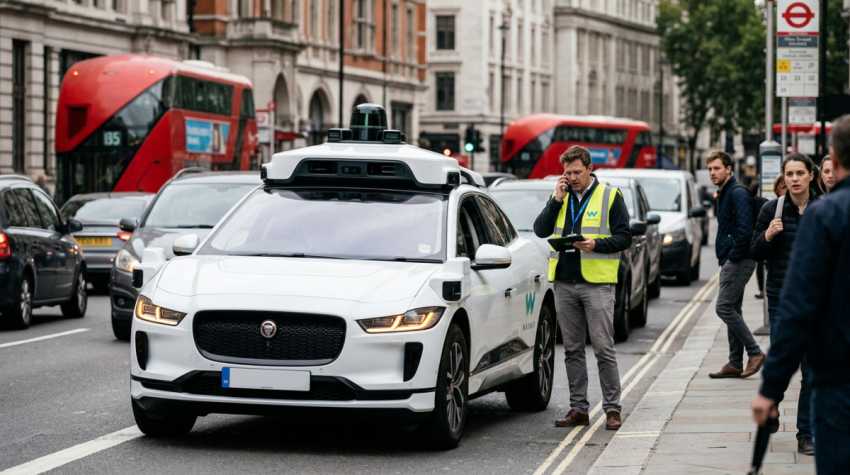
TL;DR: Waymo's self-driving Jaguar I-Pace cars are now testing on London's streets, but recent incidents, including one at a police crime scene, are raising serious questions about their 'common sense' AI. This comes despite Waymo's own data showing their vehicles are involved in 12 times fewer injury-causing crashes than human drivers.
Key Facts
- 12x: Waymo claims its driver technology is involved in 12 times fewer injury-causing crashes with pedestrians compared to human drivers over 96 million miles.
- 3,800: A recent US recall affected 3,800 Waymo vehicles after a robotaxi struggled with floodwater navigation, highlighting issues with extreme weather.
- Harlesden: One Waymo Jaguar I-Pace reportedly entered a taped-off police crime scene in Harlesden during recent London testing sessions.
- Shoreditch: Residents in Shoreditch reported a Waymo vehicle becoming stuck on a no-through road, having to reverse out while sounding a loud safety siren.
Self-driving cars from Google's sister company, Waymo, are currently mapping the streets of London, but a series of recent incidents is fuelling a major debate over their real-world safety and 'common sense' capabilities.
The company’s fleet of distinctive Jaguar I-Pace vehicles has been spotted extensively across the capital, from Harlesden to Shoreditch. While this marks a significant step for autonomous ride-hailing in the UK, local residents and technology experts are highlighting some concerning blind spots in the AI's performance.
How safe are Waymo cars compared to humans?
On paper, the safety statistics are impressive. Waymo's latest data shows its autonomous system has been involved in 12 times fewer injury-causing crashes involving pedestrians than human drivers over a staggering 96 million miles of operation. This is the kind of data that supporters point to as proof of concept.
However, the reality on the ground appears more complex. A recent and widely publicised driverless car recall in the US has cast a shadow over these figures. The recall of 3,800 vehicles was initiated after an incident in Texas where a robotaxi was reportedly swept away by floodwaters. This raises a critical question: can an algorithm truly handle the chaotic, unpredictable nature of a rainy Tuesday in London?
The 'common sense' problem for Robotaxis
Experts suggest the core issue lies in how current AI learns. Igal Raichelgauz, a leading voice from automotive tech firm Autobrains, argues that today’s systems rely too heavily on learning by example from pre-existing training data.
If a self-driving car encounters a truly unique scenario it hasn't 'seen' before, it may freeze or make a bizarre decision. This appears to be what happened during the Waymo London testing incidents. In one case, a vehicle in Harlesden reportedly blundered straight into a taped-off police crime scene. The AI didn't perceive a 'police barrier'; it simply saw a road it believed was clear to drive on.
What this means for London drivers and residents
For Londoners, the tests have brought mixed results. In Shoreditch, residents were reportedly woken by a Waymo vehicle that had wandered into a no-through road. It was forced to perform a slow reverse manoeuvre while blaring a safety siren, a clear disturbance for neighbours.
Another incident in Battersea Park highlighted the limits of AI in confrontational situations. Dashcam footage showed a pedestrian attacking one of the cars with a rock. In this tense moment, the human safety driver had to intervene, taking manual control and driving through a red light to escape the threat. It’s a stark reminder that while AI is good at following rules, it may lack the crucial survival instincts of a human driver.
So, are these robotaxis safe for the UK's capital? Waymo insists they are, pointing to the car's 360-degree view provided by advanced LiDAR, radar, and cameras that can see far more than the human eye. The debate around self-driving car safety in London continues to grow as the technology becomes more visible.
For now, every Waymo Jaguar I-Pace on UK roads has a trained human safety driver behind the wheel, ready to take over in an instant. The Waymo London testing incidents show that while the future of autonomous ride-hailing is approaching, we still have a long way to go before drivers can truly take their hands off the wheel for good.