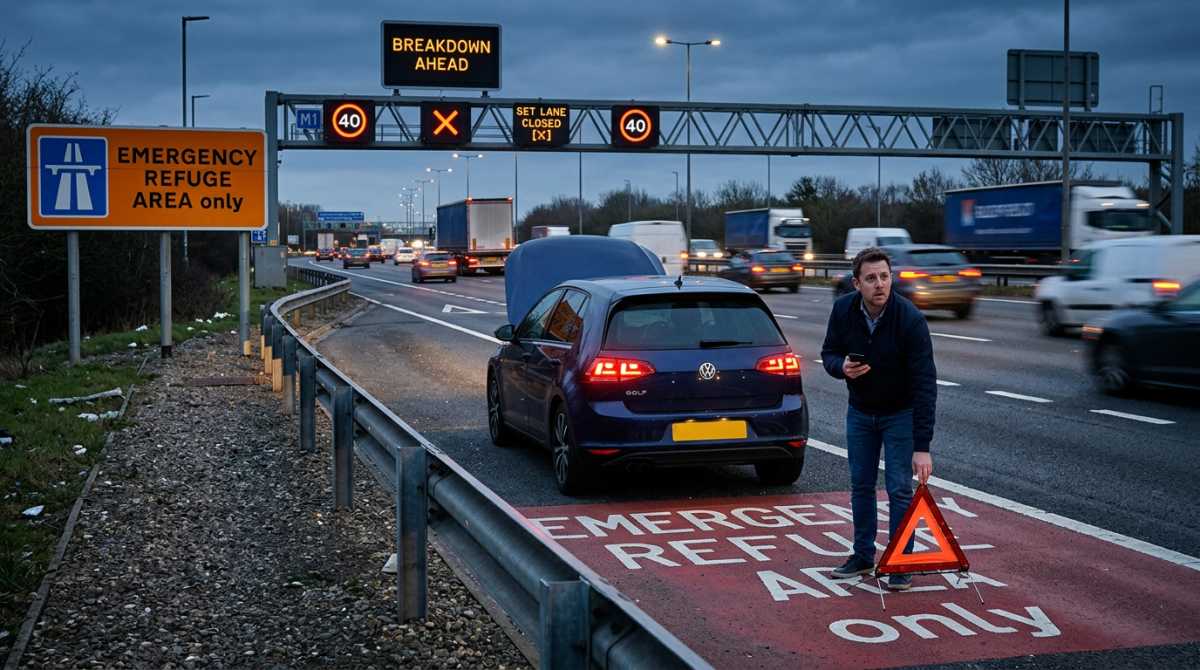
TL;DR: If your car breaks down on a motorway in the UK, immediately move left to the hard shoulder or an Emergency Refuge Area (ERA) if safe. Exit your vehicle via the left-hand door, stand behind the safety barrier upstream of your car, and call for help, prioritising 999 if you are in a live lane or danger. Always ensure your vehicle is motorway-ready to avoid common issues.
Key Facts:
- Over 30% of motorway breakdowns are due to preventable 'human' errors like tyre neglect or fuel miscalculations.
- The Highway Code Rule 276 advises drivers to exit their vehicle via the left-hand doors and stand behind the safety barrier if a breakdown occurs on a motorway.
- Emergency Refuge Areas (ERAs) on smart motorways are typically spaced every 0.75 to 1.5 miles and feature an SOS telephone for direct contact with National Highways.
- A 'Red X' signal above a motorway lane indicates it is closed, and ignoring it can result in a £100 fine and three points on your licence.
- Emergency recovery from National Highways for a hazardous vehicle can start at approximately £150, excluding storage fees, making annual breakdown cover a cost-effective choice.
Motorway breakdown relief: Your guide to safety and savings for UK drivers
No one wants to think about their car breaking down on a motorway, but for UK drivers, knowing exactly what to do can be a lifesaver. Here at Regit, we've helped thousands of motorists navigate these high-pressure situations. As the UK's motorway network evolves, with more smart motorways and advanced infrastructure, understanding the correct steps isn't just about convenience – it's about crucial safety. This guide offers practical, driver-first advice to handle a motorway breakdown, ensuring you stay safe and minimise stress.
Why is this so important? From our experience, the first 60 seconds of a breakdown often dictate the outcome. Whether you drive a petrol car or a modern EV, the fundamental risks of high-speed traffic remain. This guide breaks down what this means for you, the driver, offering clear, actionable steps for peace of mind.
Getting your vehicle to safety: The crucial 'Go Left' strategy
The moment you notice a problem – be it a sudden loss of power, a flat tyre, or a warning light flashing – your absolute priority is to get your vehicle out of the live lanes of traffic. National Highways has consistently promoted the "Go Left" campaign, and for good reason. It's the safest initial move you can make.
What to do if you can still drive
If your vehicle is still operational, use its momentum to reach the nearest exit or a service station. If that isn't an option, aim for an Emergency Refuge Area (ERA) if you're on a smart motorway, or the hard shoulder on a traditional motorway.
Expert Tip for UK Drivers: We've observed that many drivers hesitate, hoping a fault will clear. Don't wait. As soon as you suspect an issue, indicate, move into the left-hand lane, and pull over as far left as possible onto the hard shoulder or into an ERA. Once stopped, turn your wheels towards the verge. This simple action ensures that if your car is hit from behind, it's pushed away from the live lanes, not into them.
What if you stop in a live lane?
This is arguably the most dangerous scenario a driver can face. If your car loses power in a middle or right-hand lane and you cannot safely reach the left:
- 1. Switch on your hazard warning lights immediately.
- 2. Keep your seatbelt fastened.
- 3. Call 999 without delay. Do not attempt to call your breakdown provider first if you are stranded in a live lane; only the emergency services can close lanes to protect you and other road users.
Exiting your vehicle safely: Highway Code Rule 276 explained
Even once you're safely on the hard shoulder or in an ERA, the danger isn't over. Highway Code Rule 276 is clear: your actions must protect both yourself and other road users.
- Exit via the left-hand doors: Never open the driver's side door if it faces oncoming traffic. The slipstream from a passing HGV can be incredibly powerful, potentially ripping a door off its hinges or, worse, pulling you into the path of traffic.
- The 'Upstream' Rule: Move well away from the carriageway and position yourself behind the safety barrier. Crucially, stand upstream of your car. This means you should be positioned so that any approaching traffic reaches you before it reaches your vehicle. This way, if your car is struck, debris will fly away from you, not towards you.
- Wear high-visibility clothing: A hi-vis vest is a small investment that can make a huge difference. We strongly recommend keeping one in your glove compartment, not the boot, so it's instantly accessible without needing to retrieve it from the rear of the car.
Important warning for UK motorists regarding warning triangles:
While essential on A-roads, you must never use a warning triangle on a motorway. The risk of walking 45 metres behind your car on a motorway verge to place it is statistically far greater than any benefit the triangle might provide. Your personal safety is paramount.
Smart motorway breakdown vs. traditional motorway breakdown: What's the difference for drivers?
Smart motorways continue to be a hot topic among drivers. While they aim to improve traffic flow, the absence of a permanent hard shoulder means your options are slightly different, but still manageable.
Emergency Refuge Areas (ERAs)
ERAs are specifically designed safe havens on smart motorways. They are typically located every 0.75 to 1.5 miles and are clearly marked by distinctive blue signs featuring an orange SOS telephone symbol.
- Using the SOS Phone: This is always the preferred method over a mobile phone. The SOS phone directly connects you to National Highways control room, which automatically pinpoints your precise location, speeding up assistance.
- Rejoining the Motorway: Do not attempt to rejoin the motorway from an ERA without instruction. Use the SOS phone to inform the control room. They have the ability to 'close' lane one with a Red X signal, providing you with a safe space to accelerate and merge back into traffic.
The 'Red X' signal: Your legal obligation
If you see a Red X displayed above a lane, it means that lane is closed. Failing to comply is not only illegal – attracting a £100 fine and three penalty points on your driving licence – but it's also incredibly dangerous for any drivers or recovery workers who might be broken down ahead. As of 2026, automated cameras are highly effective at identifying and penalising Red X violators.
Pinpointing your location: Essential for speedy motorway recovery
When you call for assistance, simply saying "I'm on the M1" isn't enough to guarantee a swift response. Providing precise location data can significantly speed up your recovery and potentially save you money on hourly-rate recovery services.
- 1. Driver Location Signs: Look for the small blue or white marker posts situated on the verge. These provide the motorway number, the direction of travel (e.g., 'A' for northbound, 'B' for southbound), and a specific kilometre reading.
- 2. What3Words: Many UK recovery services, including major players like the RAC and AA, now utilise What3Words. This ingenious system divides the world into 3-metre squares, each with a unique three-word address. It's incredibly helpful for pinpointing your exact spot, especially in less descriptive areas.
- 3. Smartphone GPS: If you have mobile signal, dropping a pin on Google Maps or a similar navigation app can provide accurate coordinates to share with your breakdown provider.
Impact on used car prices and reliability: What it means for drivers
From a Regit perspective, frequent motorway breakdowns can have a wider impact than just disrupting your journey. Our analysis shows that vehicles with a history of roadside assistance call-outs, particularly those linked to poor maintenance (such as running out of fuel or neglected coolant issues), can see their resale value dip by 5-10%. This is a crucial consideration for any driver looking to sell their car in the future.
Good news for petrol car owners: Despite the ongoing shift towards electric vehicles, modern internal combustion engines (ICE) remain remarkably reliable for long-distance journeys, provided they are properly maintained. However, it's worth noting that nearly 30% of motorway stops are attributed to common 'human' errors, including inadequate tyre pressure and miscalculating fuel needs. These are easily avoidable issues that drivers can address with simple checks.
Motorway recovery costs compared: How much you could save
Breaking down on the motorway without adequate breakdown cover can be an unexpectedly costly mistake for UK drivers.
- National Highways Statutory Removal: If your vehicle is deemed a hazard by the police or National Highways, they have the authority to move it. Charges for a basic lift typically start from approximately £150, plus additional storage fees. These costs can quickly escalate.
- Private Recovery vs. Membership: Opting for a one-off 'emergency join' with a major breakdown provider can set you back upwards of £250. Compare this to an annual membership, which usually ranges from £60-£120. For the budget-conscious driver, the annual membership is a clear winner, offering significant savings and peace of mind.
Staying safe in winter and extreme weather: Preparedness for UK roads
Following recent severe winter weather across the UK, advice for breakdown safety has evolved. Short, urban trips in winter often prevent engines from reaching optimal operating temperatures, leading to moisture build-up that can trigger sensors on longer motorway runs.
If you experience a motorway breakdown in freezing conditions, the advice to exit your car and stand behind the barrier still stands, but ensure you are dressed appropriately for the weather. We strongly recommend assembling a 'motorway kit' for winter, including items like a foil blanket, a powerful torch, and a portable power bank for your phone. If it's genuinely too dangerous or cold to remain outside (e.g., during a blizzard), stay inside your vehicle with your seatbelt on and hazard lights flashing, and call for emergency assistance immediately.
Summary of key actions for UK drivers
- Get off the motorway at the next exit if it is safe and possible.
- Always 'Go Left' to the hard shoulder or an ERA if you cannot exit the motorway.
- Activate your hazard lights; switch on sidelights in low-light conditions or at night.
- Exit your vehicle via the left-hand doors and wait behind the safety barrier, positioned upstream of your car.
- Call 999 immediately if you are stuck in a live lane or feel you are in imminent danger.
- Never attempt minor repairs, such as changing a tyre, on the hard shoulder yourself. This is incredibly dangerous.
By following these expert-backed steps, you significantly reduce the risk of further incidents and ensure your safety. Stay safe, ensure you are visible, and always make sure your vehicle is 'motorway ready' before embarking on any long journey across the UK.