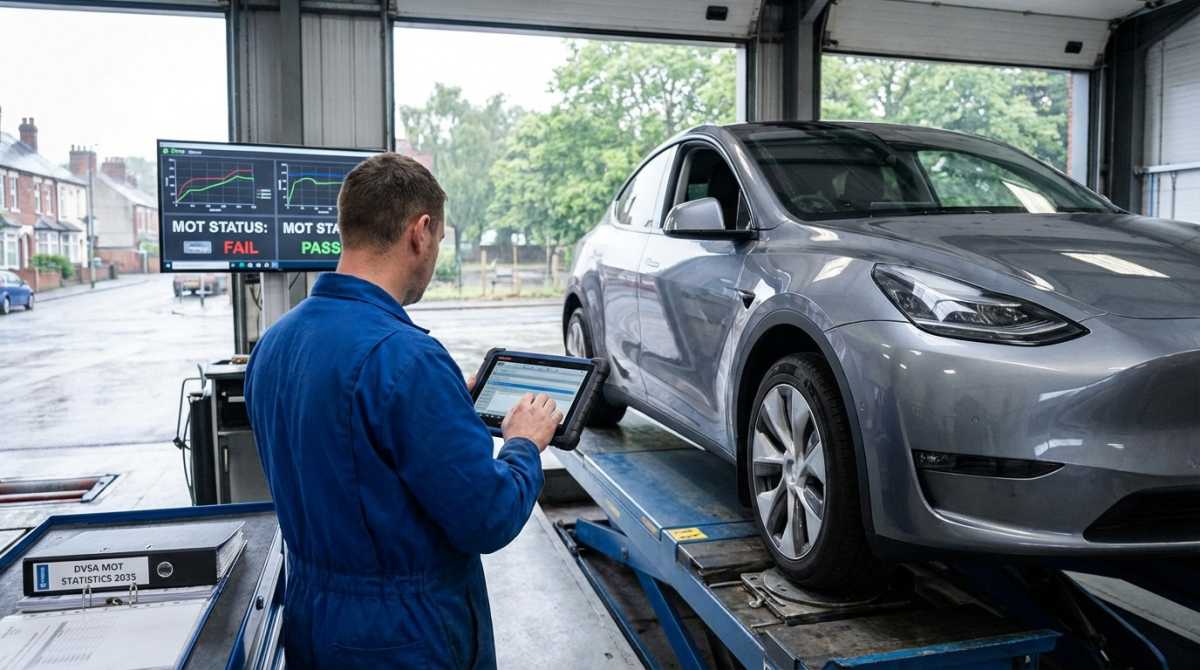
TL;DR: Electric cars are failing their first MOTs at surprisingly high rates, with some premium models exceeding a 17% failure rate. The primary cause is rapid and excessive tyre wear, a direct result of the heavy battery packs and instant torque characteristic of EVs.
Thinking your new electric car is free from maintenance worries? New data reveals a startling trend in EV MOT failure rates in the UK, with some premium models struggling to pass their very first test. If you've made the switch, this is something you can't afford to ignore.
Key Facts
- 17.2% is the first MOT failure rate for the Mercedes EQC, currently the highest among popular electric vehicle models in the UK.
- EVs are 40% more likely to fail their MOT on tyres compared to petrol or diesel cars, according to recent DVSA MOT statistics on electric vehicles.
- 14.8% of all Tesla Model Ys, one of the UK's best-selling electric cars, fail their initial MOT test at three years old.
- 1.6mm is the minimum legal tyre tread depth in the UK; driving with tyres below this limit results in an automatic MOT failure.
Which EVs Are Failing Their First MOT?
The car with the highest failure rate might surprise you. According to the latest figures from the DVSA, the luxurious Mercedes EQC faces significant MOT problems, with a staggering 17.2% failure rate on its first test. But this isn't an isolated issue. The hugely popular Tesla Model Y has a 14.8% failure rate, and other models like the BMW i4 and Tesla Model 3 aren't far behind. It’s a real wake-up call for owners who assumed electric motoring was a 'set and forget' affair.
THE 10 CARS WITH THE WORST FIRST MOT PASS RATES IN 2025
| Make & model | Number of MOTs (2025) | Number of passes | Number of fails | Fail rate (%) |
|---|---|---|---|---|
| Mercedes-Benz EQC (electric) | 4,179 | 3,462 | 717 | 17.2% |
| Ford Tourneo Custom | 3,141 | 2,621 | 520 | 16.6% |
| Vauxhall Insignia | 693 | 584 | 109 | 15.7% |
| Ford Tourneo Connect | 1,756 | 1,481 | 275 | 15.7% |
| Land Rover Discovery Sport | 3,704 | 3,144 | 560 | 15.1% |
| BMW i4 (electric) | 3,830 | 3,259 | 571 | 14.9% |
| Tesla Model Y (electric) | 19,282 | 16,423 | 2,859 | 14.8% |
| BMW X5 | 6,250 | 5,328 | 922 | 14.8% |
| Tesla Model 3 (electric) | 13,159 | 11,235 | 1,924 | 14.6% |
| Citroen E-C4 (electric) | 2,680 | 2,301 | 379 | 14.4% |
Source: DVSA data supplied to Carvertical for MOT pass tests conducted from 1 January - 31 December 2025
Why Are So Many EVs Failing? It's All About the Tyres
The primary reason for these high failure rates comes down to one critical component: the tyres. The combination of a heavy battery pack and the instant torque that EVs deliver puts immense strain on the rubber. This leads to a significant issue with EV tyre wear and MOT failure, with electric cars being 40% more likely to fail on tyres than their petrol or diesel counterparts. In fact, tyre defects are the single biggest contributor, accounting for nearly half of all EV MOT failure rates UK-wide. It's something many owners don't realise until that first test looms.
Is the Current MOT Test Fit for Purpose?
So, with all these new challenges, is the current test still relevant for modern electric cars? The government is beginning to ask the same question. There's growing discussion about evolving the electric vehicle roadworthiness assessment to better reflect the technology used in EVs. Future tests might focus more on battery health, software integrity, and electronic safety systems, moving beyond purely mechanical checks. This debate is highlighted in findings from groups like the Institute of the Motor Industry, whose EV report calls for an updated, EV-specific MOT test UK framework to be considered.
How to Avoid an MOT Failure for Your EV
For now, the advice for EV owners is simple. While you don't have oil changes to worry about, you absolutely must pay closer attention to your tyres. Regularly check your tread depth and ensure it remains well above the legal minimum of 1.6mm. Don't be surprised if you need to visit the tyre shop more frequently than you did with a petrol car. A little proactive maintenance can save you the headache and expense of a failed MOT and a potentially hefty bill for premium, reinforced EV-specific tyres.