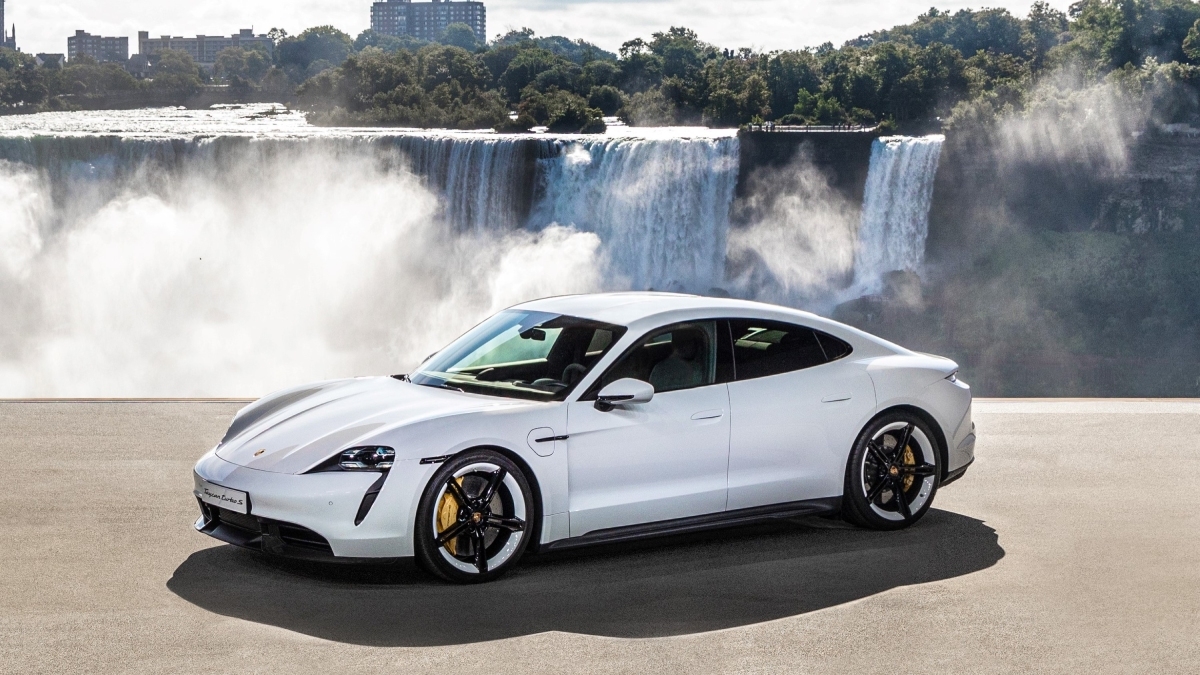
Porsche is reportedly preparing to discontinue the Taycan, its first series-production electric car, by the end of the decade as demand for the £88,400 model continues to weaken.
Sources close to the German carmaker have told WirtschaftsWoche that production of the Taycan could end no later than 2030. Porsche is understood to have decided against moving production from its Stuttgart plant to Leipzig, where there is greater manufacturing capacity.
The company had reportedly considered relocating the Taycan to Leipzig as one way of extending the model's life. Another option was to end production immediately.
Instead, Porsche is said to have agreed with its works council to phase out production over the next few years. The agreement has yet to be formally ratified.
The Taycan was launched in 2019 as Porsche's first fully electric production model. Its arrival marked a significant moment for the sports-car maker, which initially enjoyed strong demand for the electric saloon.
That momentum has since faded.
The Taycan is available in several versions and body styles. The standard model starts at £88,400 in the UK, while the Sport Turismo estate costs from £89,400. The more rugged-looking Cross Turismo starts at £99,400.
The Taycan can accelerate from 0-62mph in 4.8 seconds, produces 429bhp and has a top speed of 143mph.
Despite the reported plans to phase out the model, Porsche has continued to update it. In June, the company announced its 2027 model-year Taycan, introducing features including an E-Shift system designed to simulate gear changes, a more characterful Electric Sport Sound and AI integration.
Porsche also confirmed that the Taycan, Taycan 4 and Taycan 4S would receive the larger 105kWh Performance Battery Plus as standard. The battery supports ultra-rapid charging at up to 320kW.
The potential demise of the Taycan reflects the broader change in Porsche's electric-car strategy.
When the Taycan launched, Porsche's then-chairman Oliver Blume had set a target for electric cars to account for 80 per cent of the company's sales by 2030.
The company has since taken a more cautious approach to electrification. Porsche now plans to retain petrol-powered versions of the 911, Panamera and Cayenne into the 2030s, rather than moving as quickly towards an all-electric line-up.
The Taycan has also faced significant depreciation, which could have further weakened its appeal to buyers. Vin Assessment estimates that a Porsche Taycan loses around 57 per cent of its typical asking price over six model years.
The latest report follows comments from Porsche chief executive Michael Leiters last month. Speaking to the Frankfurter Allgemeine Zeitung, Leiters said the company was not planning to discontinue the Taycan 'in the short term'.
That wording leaves open the possibility of a longer-term phase-out, however, and the latest reports suggest production will continue at Stuttgart until the model reaches the end of its planned life.
Porsche is also making clear that it does not intend to electrify every part of its range.
At the company's annual general meeting in June, Leiters ruled out the prospect of a fully electric 911. Instead, Porsche's flagship sports car is expected to continue using hybrid technology for the next decade as the company balances tighter emissions requirements with continued demand for combustion-engined performance cars.
For Porsche, the Taycan's potential retirement would mark the end of an important chapter. The model helped establish the company's credentials in the EV market, but its declining demand highlights the difficulty luxury carmakers face in maintaining momentum as the industry shifts towards electric power.