Summary: UK drivers can save fuel by adopting smarter driving habits like checking tyre pressure, removing excess weight, smooth acceleration, early gear shifting, and using the 'Eco' button. Utilising the Fuel Finder Scheme and avoiding unnecessary idling also significantly reduces petrol costs.
Quick Facts:
- Proper tyre pressure can improve fuel efficiency by up to 3%.
- Removing just 50kg of unnecessary weight can cut fuel consumption by 1-2%.
- Driving smoothly can improve fuel economy by 15-20% compared to aggressive driving.
- Air conditioning can increase fuel consumption by 5-10% at lower speeds.
- The Fuel Finder Scheme can help drivers locate the cheapest local petrol stations.
With global oil prices teetering on that $100-a-barrel mark, British drivers are feeling the pinch at the pumps again. It’s a frustrating reality, but honestly, you don't have to just sit there and take it. By tapping into the government's Fuel Finder Scheme and picking up a few clever hypermiling habits, like actually checking your tyre pressures or ditching that dusty roof rack, you could slash your fuel spend by a massive third.
But does it actually work to change your habits? The data says a resounding yes. By adopting these 10 practical tips, UK drivers could save hundreds of pounds annually on petrol, turning rising prices into manageable costs.
Unlock savings: How the UK Fuel Finder Scheme works for you
There is a bit of good news for once. The Fuel Finder Scheme now legally forces UK petrol stations to report price changes within 30 minutes. Rachel Reeves mentioned this could save the average household about £40 a year. It’s a small win, but in this economy, every penny counts.
10 practical ways to save fuel & boost your MPG
1. Hunt for the best price
Don’t just roll into the nearest station because it’s convenient. Use those live tracking apps to see if the supermarket down the road is cheaper than the branded forecourt. Saving 3p a litre might seem trivial, but it adds up to a free tank over time.
2. Don't ignore your tyres
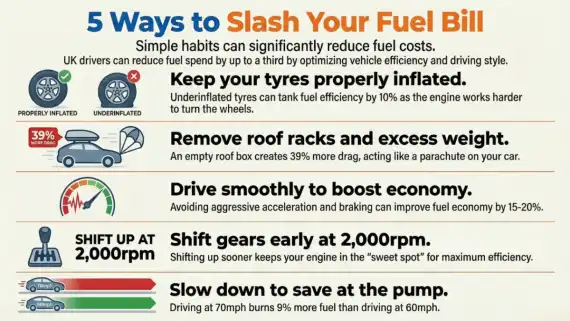
When was the last time you checked your air? Underinflated tyres are a silent budget killer. The RAC found that soft tyres can tank your efficiency by 10 per cent because the engine has to work harder just to turn the wheels.
3. Shed the dead weight
We’re all guilty of using the boot as a secondary wardrobe. Clear it out. Also, if you’ve got an empty roof box, take it off immediately. At motorway speeds, that plastic shell creates a staggering 39 per cent more drag. It’s essentially like driving with a parachute attached to your roof.
4. Smoothness is your best friend
Aggressive driving is expensive. Try to look further down the road so you can ease off the accelerator early for red lights. If you aren't constantly stomping on the brakes, you aren't wasting the energy you just paid for.
5. Shift gears sooner
If you're still driving a manual, listen to the engine. We’ve found that shifting up at around 2,000rpm keeps you in the sweet spot for efficiency. Most cars made in the last decade have a little arrow on the dash telling you when to shift – try actually following it.
6. Ease off the lead foot
Speed is the biggest fuel hog. The AA reckons that doing 70mph burns 9 per cent more fuel than doing 60mph. Is getting home five minutes earlier worth the extra fiver? Probably not.
7. Trust the 'Eco' button
That 'Eco' mode isn't just a gimmick. It dulls the throttle response so you don't accidentally floor it. Also, keep your stop-start system active. If you're stuck in London or Manchester traffic for more than ten seconds, having the engine off is a genuine lifesaver for your wallet.
8. The cruise control trap
Look, I love cruise control on a long, flat stretch of the M1. However, it’s rubbish on hills. A computer can’t see the top of a hill coming, so it keeps the power pinned for too long. You’re much better off using your own foot to manage the climb.
9. AC vs Windows
Air conditioning uses power, but open windows ruin your aerodynamics. The general rule of thumb? Use the windows for slow town driving, but keep them shut and use the AC once you’re on the motorway.
10. Link your journeys
Cold engines are incredibly thirsty. Instead of nipping out three times for different errands, do them all in one big loop. Once the engine is warm, it stays at peak efficiency, which is exactly how to save fuel UK-wide.
Thinking about switching your car for something a bit cheaper to run? Check out Regit's list of the most fuel-efficient cars.
Fuel-saving FAQs: Your questions answered
What time of day is best to fill up on petrol?
It’s often cheaper midweek, especially on Tuesdays or Wednesdays, because fuel prices can rise before weekends or holidays when demand increases. Early morning or late evening trips also help you avoid queues and idling time.
Does supermarket fuel last as long as branded petrol?
Yes, all UK fuels meet minimum quality standards. Supermarkets often offer cheaper prices because they buy in bulk. Premium fuels like Shell V-Power or BP Ultimate may slightly improve efficiency in newer engines, but the difference is usually small.
Do fuel loyalty cards or rewards schemes actually save money?
They can. Many supermarkets (like Tesco Clubcard or Nectar at Sainsbury’s) offer points or discounts per litre, which can add up to £30–£50 in annual savings if you fill up regularly.
Will switching to premium or “super unleaded” petrol improve my mpg?
Only if your car’s engine is designed for it. Most standard cars run perfectly well on regular E10 petrol. High-performance or turbocharged cars may benefit slightly, but for most drivers, the extra cost outweighs the gains.
How much fuel does idling waste while parked?
Leaving your engine running for just 10 minutes can waste up to a fifth of a litre of fuel, and that adds up fast. Turning off the engine is always more efficient if you're stationary for more than 10 seconds.
Does keeping my car serviced really help with fuel economy?
Yes. Regular servicing, especially oil changes, air filter replacements, and spark plug checks, keeps the engine running efficiently and can improve fuel economy by up to 10%.
Can changing my driving route reduce fuel costs?
Definitely. Using apps like Google Maps or Waze to find routes with fewer stops, steady speeds, and less traffic reduces fuel burn. Avoiding short, cold-start journeys also saves money.
Is electric or hybrid driving cheaper than petrol in the UK?
Generally yes. Even with energy costs fluctuating, electric vehicles (EVs) can cost 50–70% less per mile to run. Hybrids offer a middle ground if you’re not ready to go fully electric.
Do roof bars and bike racks affect fuel efficiency?
Yes, even without a box or bikes attached, roof bars create wind drag that can reduce mpg by as much as 10%. Remove them when not in use.
How do temperature and weather affect fuel economy?
Cold weather thickens engine oil and reduces tyre pressure, which makes your car less efficient. Warm weather improves mpg slightly, but using air conditioning can offset the benefit.