Quick Answer: Yes, you can check a vehicle's complete MOT history without the V5C log book by using only its registration number on Regit's free-to-use MOT history checker.
Key Facts
- Regit's free MOT History Checker: The free service requires only a vehicle's registration number for access.
- 2005: The online MOT history database contains records for all cars, motorcycles, and light goods vehicles tested in Great Britain from 2005 onwards.
- £25: It costs £25 to apply for a replacement V5C log book from the DVLA if you are the registered keeper and need one.
- 11-digit number: You need the 11-digit reference number from the V5C to download a digital PDF copy of an MOT certificate.
- 30%: Around 30% of vehicles fail their MOT at the first attempt, making past failure data a crucial indicator of a car's maintenance and potential future costs.
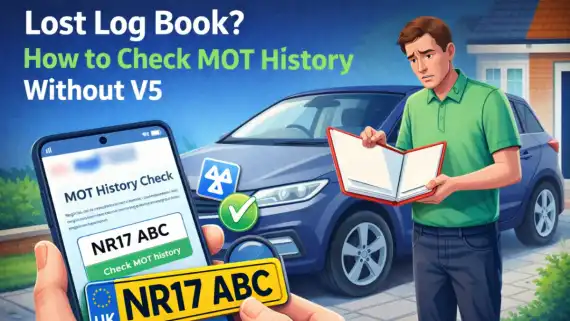
Checking a vehicle's MOT history is a critical step for any used car buyer or diligent owner. Many drivers believe this valuable information is locked away, accessible only with the V5C log book. The good news is, this is not the case. Your options just got better thanks to the digitisation of UK vehicle records.
This guide explains exactly how to perform a free MOT history check without a V5C, what the information means, and how to use it to your advantage.
What is a V5C log book?
A V5C, commonly known as the log book, is a multi-page red and blue document issued by the Driver and Vehicle Licensing Agency (DVLA). Its primary purpose is to register the official keeper of a vehicle. It is not proof of ownership.
The V5C contains key vehicle details, including the make, model, engine size, date of first registration, and the name and address of the registered keeper. It also contains an 11-digit reference number, which is used for specific online transactions, such as taking a private number plate off a vehicle or downloading an MOT certificate.
How to perform a free MOT History Check without a V5C
You do not need the V5C log book to see the complete MOT history. The process is free, official, and takes less than a minute. All you need is the vehicle's registration number.
Here is the step-by-step process:
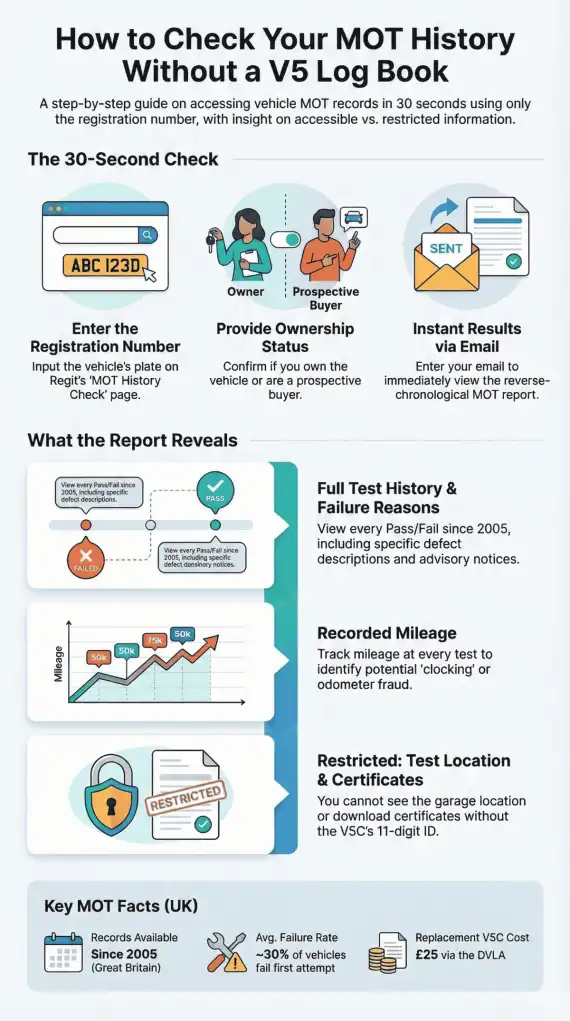
1. Navigate to Regit's Free MOT History check page titled 'MOT History Check'.
2. Enter the vehicle's registration number into the provided box.
3. Tell us whether you own the vehicle or are just interested.
4. Click the 'View MOT History' button.
5. Enter your email address.
6. The service will immediately display the vehicle's make, model, and specs, along with the full MOT history, presented in reverse chronological order (most recent test first).
Decoding the MOT history report
The data provided by the free check is comprehensive. It gives you a clear window into the vehicle's past health and maintenance.
What you CAN see with just a registration number:
- MOT Status and Expiry Date: The report immediately confirms if the vehicle has a valid MOT and shows the exact date it expires.
- Full Test History: Every MOT test result (Pass or Fail) is listed, dating back to 2005.
- Recorded Mileage: The mileage recorded at each MOT test is displayed. This is your primary tool for identifying potential 'clocking' or mileage fraud.
- Reasons for Failure: For any failed test, the report provides a detailed list of the specific defects that caused it, using official DVSA terminology (e.g., 'Brake pipe excessively corroded').
- Advisory Notices: These are items that were not severe enough to fail the MOT but were noted by the tester as needing attention soon. Examples include 'Nearside Front Tyre worn close to legal limit' or 'Slight oil leak'.
What this means for drivers is that you have a complete, official diary of the car's condition at every annual test, accessible from your phone or computer.
What you cannot see without the V5C
While the free check is powerful, two specific pieces of information are restricted and require the 11-digit reference number from the V5C log book.
- Test Location: You cannot see the name or location of the garage that performed the MOT test. This information is protected for privacy and commercial reasons.
- MOT Certificate Download: You cannot download or print an official A4 PDF copy of the MOT certificate. This function is reserved for the registered keeper to prevent fraudulent document creation.
Why the free MOT check is a buyer's most powerful tool
Using the free MOT check is the single most important first step when considering a used car. It allows you to 'pre-inspect' a vehicle before you even arrange a viewing.
A shiny exterior and a fresh valet can hide a multitude of problems. The MOT history, however, cannot lie. It provides an unbiased, factual account of the car's mechanical and structural condition over many years.
For example, seeing a consistent history of advisories for rust on the suspension or underbody is a major red flag, suggesting expensive repairs are imminent. Conversely, a car that passes year after year with minimal advisories indicates a well-maintained vehicle.
Expert analysis: How to spot red flags in an MOT History
An expert doesn't just look for a 'Pass'. They analyse the patterns within the report to build a picture of the vehicle's life.
- 'Dangerous' Defects: A 'Dangerous' fail means the car was deemed illegal to drive away from the test centre until the issue was fixed. Multiple dangerous fails in a car's history can signal a neglectful owner who runs the car into the ground between tests.
- Mileage Discrepancies: This is a classic sign of 'clocking'. If the mileage recorded in 2022 was 60,000 miles, but the 2023 test shows 55,000 miles, the odometer has likely been tampered with. The MOT history is your best defence against this fraud.
- Persistent Advisories: An advisory for an 'oil leak' or 'worn brake discs' that appears for two or three consecutive years is a bad sign. It shows the owner has ignored the tester's advice and is only doing the bare minimum to pass the MOT, leaving you to foot the bill for the eventual repair.
- Corrosion (Rust): Any mention of 'corrosion' or 'rust', even as an advisory, should be taken very seriously. Testers will note rust on brake pipes, suspension components, and structural areas like sills and subframes. These can be incredibly expensive and difficult to repair properly.
How to replace a lost or missing V5C log book
If you are the registered keeper and have lost your V5C, or you've just bought a car and need to apply for one, you must contact the DVLA. You will need the V5C to tax the vehicle, sell it, or transfer a private number plate.
The process is straightforward:
- Cost: £25.
- Method: You can apply for a duplicate log book online via the GOV.UK website if none of your details have changed. If you need to change your name or address, you must apply by post using a V62 form.
- Timeline: An online application typically results in the new V5C arriving within 5 working days. Postal applications can take up to 6 weeks.
Final summary: Your MOT history check options
Checking the MOT history without a V5C is not only possible but is now a standard, essential part of modern car ownership and buying. The free, instant access provided by the Regit's MOT history service offers incredible transparency and empowers drivers to make safer, more informed decisions.
Always use this digital tool to vet a car's past before you commit to a viewing. A clean MOT history is a strong indicator of a good car, but it's not a replacement for a physical inspection and test drive. Use the data to guide your purchase and avoid costly mistakes.