
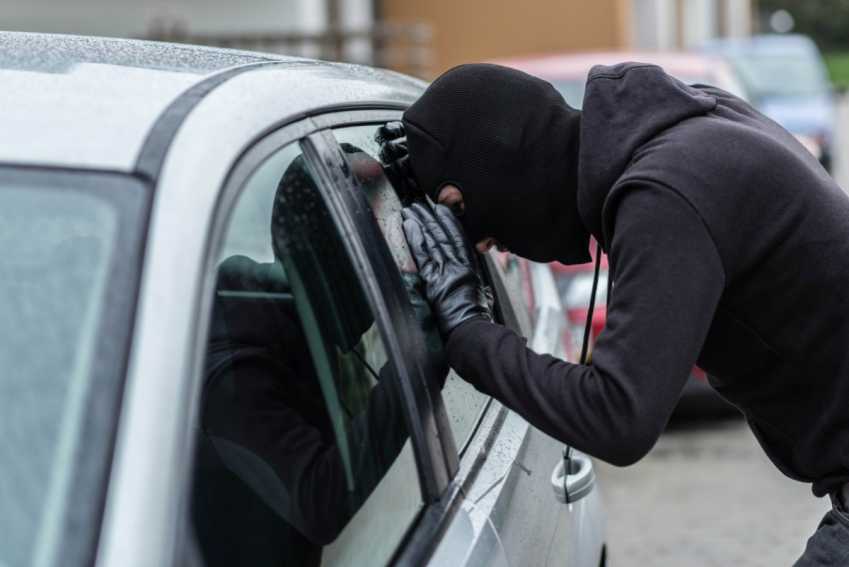
Apart from buying a home, our second most expensive outlay tends to be the purchase of a new car, and while it’s become much easier to drive away with a shiny new set of wheels thanks to attractive PCP and other finance deals, keeping it safe from prying eyes is paramount.
Car theft is becoming increasingly sophisticated
Sadly, the more security measures manufacturers fit to their vehicles, the more ways would-be thieves seem to counteract the systems, with the emphasis shifting away from hotwiring. These days they tend to tap into onboard computer technology, while key cloning has also become far more common practice.
According to police crime figures recorded by the Office for National Statistics, in the 12 months between April 2025 and March 2026, five in every 1,000 people were victims of vehicle crime, with a total of 312,250 offences recorded. This was down 11 per cent on the previous year, but is still too many and devastating for those involved.
The rise of keyless theft and signal manipulation
By far, the majority of vehicle thefts between 2024 and 2025 were achieved by thieves manipulating the signal from a remote locking device, an issue that has become more prevalent since carmakers replaced conventional keys with electronic fobs.
The impact of vehicle theft was brought up in the House of Commons last month by Liz Jarvis, Liberal Democrat MP for Eastleigh. She told us that the issue had been raised by a number of constituents during door-to-door visits.
She said: “One vehicle is stolen in England and Wales every four minutes. But this is also about the human impact of these crimes. I have heard from constituents, including NHS workers who have not been able to get to work or do the school run because their car vanished overnight. In one case, a couple told me that they saw a van pull up outside their property, and then someone get out and simply drive their car away.”
The growing market for car theft devices
The ease with which thieves can obtain the devices to aid the crimes was also outlined by Ms Jarvis, who explained: “To understand why this crisis is accelerating; we need to look at how these thefts are being carried out. The methods being used today bear little resemblance to the car thefts of a decade ago. The most common method now is relay theft, where criminals use a signal amplifier to capture a key fob signal from inside the owner’s home and then relay it to a device held next to the car. That tricks the vehicle into unlocking and starting without the key being present.
“What should concern us most is how accessible this technology has become. These are not improvised tools: devices targeting high-end vehicles can sell for more than £20,000, so there is a serious criminal market built around vehicle theft.
“As this technology has advanced, prices have fallen, with cheaper devices including low-cost models from China now appearing in the UK, and yet videos demonstrating exactly how to use those devices remain available online. I urge the Government to press platforms to remove that content. As things stand, we are allowing criminals to access step-by-step instructions on how to steal a car. The scale of the shift is reflected clearly in the data: in 2019 signal manipulation accounted for just 14 per cent of vehicle theft methods, but by 2024 the figure had risen to 58 per cent.”
Simple ways to make your car harder to steal
There are effective ways to protect our vehicles from these opportunist thieves. Of course, common sense is paramount, such as parking in well-lit areas, preferably with CCTV in place.
A keyless entry fob can be stored in a Faraday pouch or metal box to block any wireless hacking and cloning, while traditional chunky steering wheel locks are still a deterrent too.
Alternatively, Thatcham-approved trackers are becoming far more commonplace and can be a cost-effective way to protect a vehicle against theft. Having one of these devices fitted will often see a reduction in insurance costs too.
How vehicle trackers can help recover stolen cars
We caught up with one of the UK’s leading tracker fitting and monitoring companies to find out how it all works and just how successful their services can prove.
SmarTrack is a UK-based company that provides insurance-approved vehicle tracking, asset protection and stolen vehicle recovery systems. The other cog in this partnership is Global Telemetrics, which provides the 24/7, all-year-round monitoring platforms for vehicle security.
So far this year, the company has recovered more than £18.9m worth of vehicles for customers and last year that figure was £29.8m. Since it was formed more than 20 years ago, it has recovered more than £229m worth of vehicles.
Why professional tracker installation matters
Like all highly reputed tracking companies, fitting the device is of paramount importance. A SmarTrack spokesman explained: “In order to maintain Thatcham approval, all devices must be fitted by a Thatcham-approved and SmarTrack-authorised installation technician. The technician will take time to discreetly install each device in varying locations to minimise the risk of a device being found and subsequently removed in the event of a theft.”
Once a tracker has been securely fitted to a vehicle, the owner can monitor its movements via a smartphone app. If the vehicle is being moved without any owner approval, that’s when the alarm bells ring and the security company gets to work, with the Auto-crime Repatriation Investigation Team called into action.
This group of professionals has teams up and down the country with decades of experience in auto-crime and vehicle recovery, and they work very closely with the police for a speedy solution.
Inside the technology tracking down stolen vehicles
A spokesman for Global Telemetrics said: “As soon as a vehicle is reported as stolen or identified through driver detection as stolen, the customer is urged to obtain a crime reference number. Once we have this we liaise with the repatriation team who then liaise with the police themselves.
“The repatriation team will head to the vehicle using its tracker to pinpoint the location and they stay until the police can attend. We have had recoveries in as little as four minutes from being confirmed stolen.”
‘No Tag, No Start’: adding another layer of protection
The growing importance of tracking devices was reinforced by Meta Trak, a London-based company with more than 40 years’ experience in the vehicle security sector.
A Meta Trak director, who for security reasons asked to remain anonymous, explained: “Our layered approach to security is key in tackling advanced theft methods. Each tracking device is linked to the owner's ID Tag. As well as the tracking set-up, there can be an immobiliser that is also linked to the system. This can be configured so if the ID tag is not seen by the system during a vehicle start attempt or the vehicle is being tampered with, it will not start. It’s what we call our ‘No Tag, No Start’ feature.”
There are additional security measures too, including a Deadlock function that can also be activated via the owner’s app. When enabled, the vehicle will not start even if the keys and the ID tags are present.
Once a theft has been averted, the owner simply disables the Deadlock function in their app and can use spare keys to drive the vehicle. However, Meta Trak advises contacting the vehicle manufacturer to delete the stolen key and programme a new one, along with new ID Tags that can be purchased from Meta Trak.
Although Meta Trak does not have its own repatriation team, it has an excellent relationship with the police and will speak directly with them once a crime reference number has been supplied.
Why professional installation is vital
We also spoke to David Clelland, Director at Infiniti Tracking, a company that was founded 15 years ago and supplies and installs vehicle tracking systems for all types of vehicles throughout the UK. They offer one of the widest ranges of trackers available, with seven different brands, including some of the leading names in the UK market.
He said: “We supply and install the tracking hardware, but the ongoing monitoring and vehicle recovery service is generally provided by the individual tracking brand rather than Infiniti Tracking.
“A tracker is only as effective as its installation. Having it professionally installed by a Thatcham-approved engineer means it can be fitted correctly and, importantly, discreetly within the vehicle. Modern vehicles are becoming increasingly complex, particularly with the growth of electric vehicles and sophisticated electronic systems. A professional installer needs to understand the vehicle, know where the tracker can safely