If you’ve squinted your way home since the clocks went back on Sunday, you’re far from alone. The RAC surveyed 1,208 drivers just before the change, and 83% said they were worried about the glare from other vehicles’ headlights as darkness falls. Three-quarters of those affected think the problem is getting worse.
The survey also asked who drivers blame, and the answer was clear. Of those who get dazzled, 52% say larger, higher vehicles are the main culprits, against just 20% who blame ordinary hatchbacks, saloons and estates. Another 38% say it isn’t limited to one type of car.
How bad is headlight glare for drivers?
The RAC’s figures paint a worrying picture. Half of dazzled drivers say glare makes hazards harder to spot, 49% struggle to see road signs and markings, and 35% say they’re temporarily blinded by oncoming lights. One in seven admit they’ve nearly crashed as a result.
Glare is changing how people live, too. Some 21% of dazzled drivers plan to drive less now the clocks have changed, and 3% will stop driving at night altogether. Among those already cutting back, more than a quarter see friends less often, and 6% have cancelled medical appointments.
Are SUVs to blame for headlight glare?
There’s a real basis for drivers’ suspicions. A big SUV’s headlights sit higher than a hatchback’s, which puts them closer to the eye level of the driver coming the other way, and SUVs now make up the majority of new car sales.
A government-commissioned independent study, published late last year, confirmed that some brighter modern headlights are more likely to cause glare. Height and brightness aren’t the whole story, though. Volvo safety expert Thomas Broberg has argued that most glare comes from poorly aimed headlights, and that lights mounted higher on SUVs need to be angled further down to avoid dazzling others.
Age plays a part as well. Road safety consultant Rob Heard has said older drivers’ eyes can take up to nine seconds to recover from glare, compared with about a second for younger drivers.
What is the government doing about headlight glare?
January’s Road Safety Strategy committed the government to further UK research into glare, which the RAC says is expected to start shortly. Work also continues internationally, where the lighting rules for future cars are agreed.
The RAC wants that research to cover the cars already on the road, not just future models, and three-quarters of the drivers it surveyed agree. Its senior policy officer, Rod Dennis, said drivers would only be satisfied once they knew real changes were on the way. This week’s talk of a weight-based tax on heavy SUVs shows how large vehicles are coming under pressure from more than one direction.
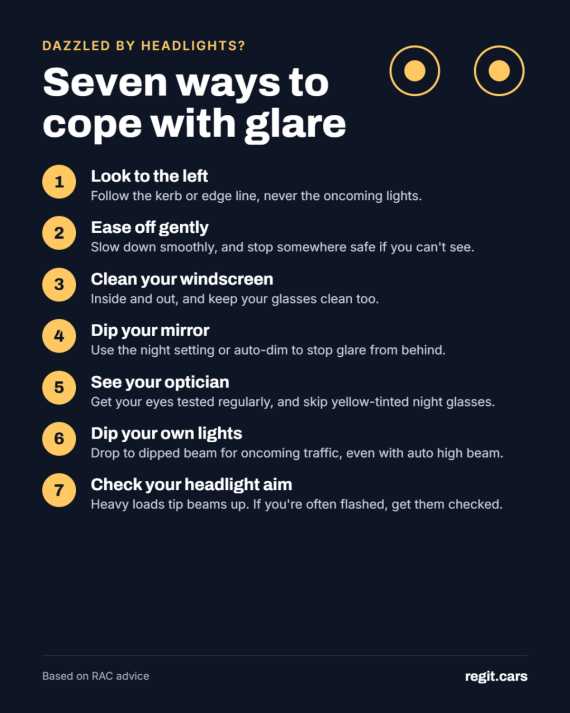
Seven ways to cope with headlight glare
1. Look to the left. Never stare into oncoming headlights. Follow the kerb or the white edge line on the left of the road until the car has passed, which keeps you on course without being blinded.
2. Ease off gently. If glare leaves you unable to see, slow down smoothly without braking hard, so the car behind doesn’t run into you. If it’s really bad, stop somewhere safe and legal until your eyes recover.
3. Clean your windscreen. The inside of the glass builds up a greasy film from the heater, and it scatters light from oncoming headlights. Clean both sides regularly, and keep your glasses clean too.
4. Dip your mirror. Flick your rear-view mirror to its night setting, or use auto-dimming if your car has it, so bright lights behind you don’t dazzle you.
5. See your optician. Regular eye tests matter more as you get older, so ask about lenses that reduce reflections. Avoid yellow-tinted “night driving” glasses, which make dark parts of the road harder to see.
6. Dip your own lights. Switch to dipped beam for oncoming traffic and on well-lit roads. If your car has automatic high beam, learn how to override it quickly in case it doesn’t react in time.
7. Check your headlight aim. A boot full of luggage or passengers in the back can tip your beams upwards. If other drivers often flash you, get your headlights checked at a garage, and make sure any replacement bulbs are the right type for your car.
Our verdict
Big SUVs are part of the problem, and the RAC’s figures show drivers know it. Higher-mounted lights shine closer to your eye level, and there are far more of them on the road than a decade ago.
They aren’t the whole story, though. Brightness, badly aimed lights and the rules governing them all play a part, and the fix has to cover cars already on the road, not just new ones. Until that comes, the seven tips above will make your evening drives safer, whatever you’re driving.
Headlight aim is part of every MOT, so if you’re not sure when yours was last checked, look up your car’s MOT history with Regit and see when the next test is due.