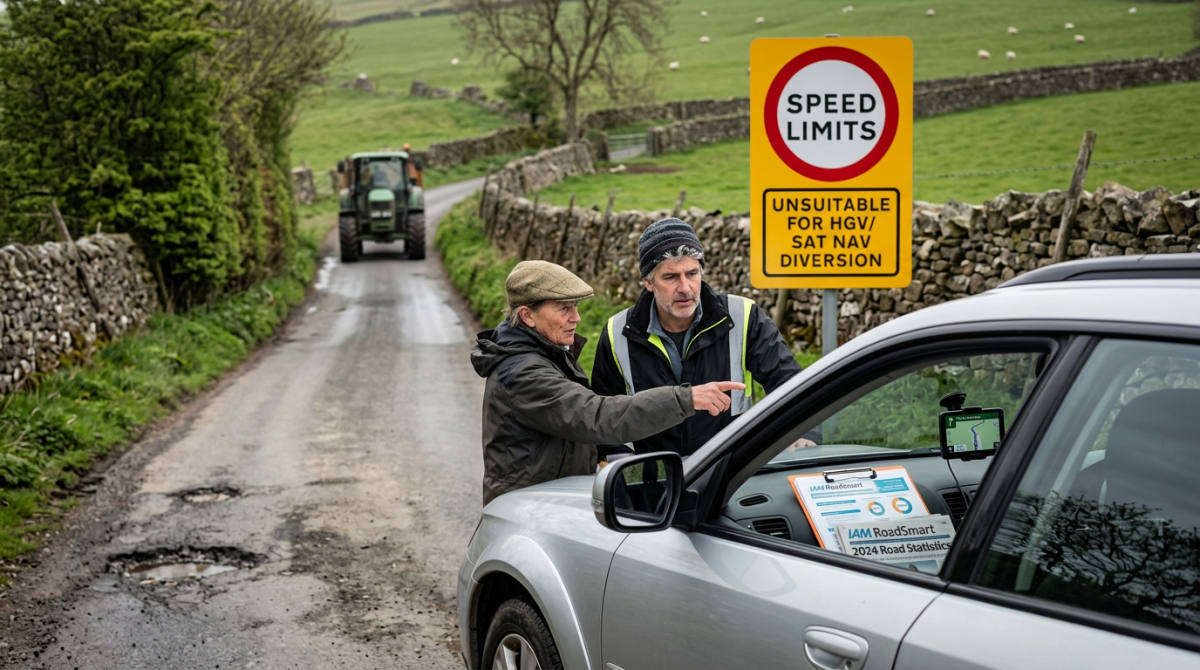
TL;DR: New Department for Transport data reveals rural roads account for 60% of UK road deaths, despite carrying less than half the traffic. This raises serious concerns about sat nav diversions onto country lanes, with IAM RoadSmart urging drivers to reconsider these shortcuts due to increased risks on unprepared routes.
Key Facts:
- 60% of UK road deaths occur on rural roads, despite these roads carrying less than 50% of the country's traffic.
- IAM RoadSmart highlights that sat navs often divert hundreds of drivers onto narrow country lanes not designed for high traffic volumes.
- The Department for Transport recently confirmed these alarming road death statistics for rural areas.
- Many drivers are regularly diverted off main A-roads onto rural lanes, often to save just a few minutes.
- The government scrapped smart motorway projects in 2023, potentially increasing pressure on rural road networks.
Rural road safety in the UK is a growing concern, with recent figures from the Department for Transport (DfT) highlighting a stark reality. Despite carrying less than half of Britain's overall traffic, rural roads are the site of 60% of all road deaths. This alarming statistic underscores the hidden dangers lurking on country lanes, often prompted by sat nav diversions.
Many UK drivers admit to regularly following their sat navs onto narrow, rural routes, hoping to shave precious minutes off their journey. But is that shortcut truly worth the gamble? The latest data suggests a resounding 'no' for safety-conscious drivers.
Motorways and major A-roads are engineered with safety in mind, featuring barriers, wider lanes, and improved sightlines designed to mitigate the impact of driver errors. Rural roads, however, present a stark contrast. They often feature sharp, unexpected bends, inconsistent surface quality, and the sudden appearance of agricultural vehicles or livestock. These factors combine to create a significantly higher risk environment.
IAM RoadSmart, a leading road safety charity, is now strongly advising drivers to exercise caution before blindly trusting their GPS. Nicholas Lyes, Policy Director at IAM RoadSmart, points out a critical issue: when a sat nav suggests a detour, it doesn't just send one driver down a narrow track. It can direct hundreds, or even thousands, of vehicles onto lanes simply not built for such traffic volumes.
This problem has potentially worsened since the government's decision to scrap smart motorway projects in 2023. Without the planned additional capacity on the main arterial routes, the rural road network is feeling an increased squeeze, pushing more traffic onto less suitable roads.
When navigating these country lanes, drivers should never treat the 60 mph speed limit as a target. It's frequently far too fast for single-track roads with blind corners and limited visibility. Staying vigilant for cyclists, pedestrians, and horse riders who could be just around the next bend is paramount. For many, sticking to the main A-roads, even if it means a slightly longer journey, remains the safer and more sensible option for UK drivers.