Bristol Clean Air Zone (CAZ): Charges, Map & Exemptions
- Find out if your car is exempt from ULEZ charges
- Check Clean Air Zone (CAZ), Low Emission Zone (LEZ) and Zero Emission Zone (ZEZ) charges
- Find low and zero emission vehicles

Driving into Bristol? Use Regit's Bristol Clean Air Zone checker to find out if your vehicle meets the required emissions standards and whether you need to pay a daily charge.
The Bristol Clean Air Zone (CAZ) was introduced to improve air quality by reducing emissions from the most polluting vehicles. If your car, van or other vehicle does not meet the required standards, you may need to pay a daily charge when driving within the zone. If you live in other areas of the UK and are affected by ULEZ or CAZ, you can check if your car is exempt from the charges here.
What Is the Bristol CAZ?
The Bristol Clean Air Zone is an area where older, more polluting vehicles may need to pay a daily charge to drive through. The zone was introduced on 28 November 2022 as part of Bristol City Council's plan to reduce nitrogen dioxide pollution and improve air quality across the city.
Unlike some clean air schemes, Bristol's CAZ does not ban vehicles from entering. Instead, vehicles that do not meet the required emissions standards must pay a charge, while compliant vehicles can travel through the zone without paying.
Bristol operates a Class D Clean Air Zone, meaning it can apply to a wider range of vehicle types - including private cars, taxis, vans, buses, coaches and HGVs. This is an important difference from Class C zones such as Bath, where most private cars are not charged.
Is it the same as ULEZ?
No. The Bristol Clean Air Zone is not the same as London's ULEZ (Ultra Low Emission Zone). Both schemes aim to reduce air pollution by encouraging cleaner vehicles, but they use different rules, boundaries and charging systems.
The main difference is that Bristol's CAZ covers a specific area of the city and charges vehicles based on whether they meet the required Euro emissions standards. London's ULEZ operates across a much larger area and has different charging rules.
If you are travelling between UK cities, it is important to check each zone separately, as a vehicle that is compliant in one area may not always have the same requirements elsewhere.
Is it a congestion charge?
The Bristol Clean Air Zone is not a congestion charge.
A congestion charge is designed to reduce traffic levels, while a Clean Air Zone focuses on reducing harmful vehicle emissions. You will only need to pay the Bristol CAZ charge if your vehicle does not meet the required emissions standards and you drive within the zone. Compliant vehicles are not charged.
Does the charge run 24 hours a day?
The Bristol Clean Air Zone operates 24 hours a day, every day of the year, including weekends and bank holidays.
If your vehicle is not compliant, you will need to pay the daily charge for each day you drive within the zone.
Zone Map - Boundaries, Roads and Postcodes
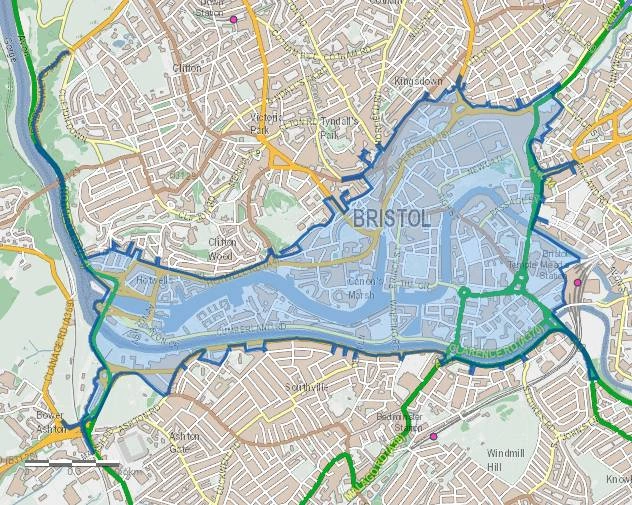
The Bristol CAZ covers an area around Bristol city centre, including many of the main roads and routes used to access the centre. Broadly, it is bounded by the A4044 to the north, the A370 to the south, Station Approach to the east and the A3029 to the west.
The zone is enforced using automatic number plate recognition (ANPR) cameras, which check vehicles entering, leaving and travelling within the area.
Before travelling, it is worth checking the Bristol CAZ map and your vehicle's compliance status, especially if you are unfamiliar with the city.
Which postcodes fall inside the CAZ?
The Bristol Clean Air Zone covers parts of central Bristol, including areas within the following postcode districts:
- BS1
- BS2
- BS3 (parts)
- BS4 (parts)
- BS5 (parts)
Not every road within these postcode areas is included, so postcode alone should not be used as the only way to check whether you will enter the zone.
The safest way to confirm your route is to check the official Bristol CAZ map and use a vehicle checker before travelling.
How Much Does It Cost? - 2026 Charges
The Bristol Clean Air Zone charge depends on the type of vehicle you drive and whether it meets the required emissions standards. Most newer vehicles are already compliant and can enter the zone without paying. However, if your vehicle does not meet the minimum emission standards, you will need to pay a daily charge every time you drive within the zone.
The charge applies 24 hours a day, 365 days a year, including weekends and bank holidays. You only pay once per day, even if you enter and leave the zone multiple times on the same day.
Daily charge by vehicle type
The Bristol CAZ charges are based on vehicle category:
| Vehicle Type | Daily Charge |
| Cars (petrol and diesel) | £9 |
| Taxis | £9 |
| Vans and light goods vehicles (under 3.5 tonnes) | £9 |
| Heavy goods vehicles (HGVs) | £100 |
| Buses | £100 |
| Coaches | £100 |
If you are unsure whether your vehicle will be charged, use the Regit Bristol Clean Air Zone checker before travelling. This will confirm whether your vehicle meets the required emissions standards and whether a payment is needed.
How does it compare to other UK Clean Air Zones?
Bristol is one of several UK cities that have introduced Clean Air Zones to reduce pollution levels.
Unlike some other schemes, Bristol's CAZ is a Class D Clean Air Zone, meaning it can apply to a wider range of vehicles, including private cars, taxis, vans, buses, coaches and HGVs.
For comparison:
- Birmingham Clean Air Zone: charges non-compliant vehicles entering the city centre, including cars, vans, taxis, buses and HGVs.
- Bath Clean Air Zone: mainly affects higher-emission commercial vehicles rather than most private cars.
- London ULEZ: operates differently and has its own emissions rules and charging system.
Each Clean Air Zone has different boundaries, charges and vehicle requirements, so it is important to check your vehicle before travelling to a different city.
Vehicle Checker - Is Your Car Compliant?
Before driving into Bristol, use Regit's CAZ Vehicle Checker to find out whether your car, van or other vehicle meets the required emissions standards.
The quickest way to avoid unexpected charges is to check your registration number before your journey.
How to use the official CAZ checker tool
Using Regit's Bristol Clean Air Zone Checker is simple:
- Enter your vehicle registration number.
- Confirm your vehicle details.
- Check whether your vehicle meets Bristol's emissions requirements.
- Find out whether you need to pay a daily charge.
The checker looks at your vehicle's emissions data to determine whether it is compliant. If your vehicle is shown as non-compliant, you can plan your journey, pay the charge if required, or consider upgrading to a cleaner vehicle.
Euro emission standards explained
Clean Air Zones use Euro emission standards to measure how much pollution vehicles produce. Generally:
- Petrol cars: Euro 4 or newer are usually compliant.
- Diesel cars: Euro 6 or newer are usually compliant.
- Vans and commercial vehicles: requirements vary depending on vehicle type.
- Zero-emission vehicles: electric and hydrogen vehicles are not charged.
As a guide, petrol vehicles registered from around 2006 onwards and diesel vehicles from around late 2015 onwards are more likely to meet Bristol's requirements, although the exact compliance depends on the vehicle's recorded emissions data.
Are motorcycles exempt?
Motorcycles and mopeds are generally exempt from the Bristol Clean Air Zone charge.
However, it is still worth checking your vehicle before travelling, especially if you use a less common vehicle type or have made modifications.
Exemptions - Which Vehicles Don't Pay?
Not every vehicle entering Bristol's Clean Air Zone has to pay the daily charge.
Some vehicles are exempt because they produce little or no emissions, while others qualify under national Clean Air Zone exemption rules or local Bristol City Council schemes. If you think your vehicle may be exempt, it's always worth checking before you travel, as not all exemptions are applied automatically.
Electric and zero-emission vehicles
Fully electric vehicles (EVs) and hydrogen fuel cell vehicles can travel within the Bristol Clean Air Zone without paying a daily charge. These vehicles produce zero tailpipe emissions, so they meet the Clean Air Zone's emissions requirements automatically.
Hybrid vehicles are not automatically exempt. Whether a hybrid is charged depends on the fuel it uses and whether it meets the required Euro emissions standard. For example, a newer plug-in hybrid petrol car may be compliant, while an older diesel hybrid may still be charged.
The easiest way to confirm whether your vehicle is compliant is to use the Regit Bristol CAZ checker before you travel.
Disabled tax class and Blue Badge holders
Vehicles registered with the Disabled or Disabled Passenger Vehicle tax class are exempt from the Bristol Clean Air Zone charge under the national Clean Air Zone rules.
However, having a Blue Badge does not automatically exempt a vehicle. If the vehicle is not registered in an eligible disabled tax class and does not meet the required emissions standards, the daily CAZ charge may still apply.
Bristol City Council also offers separate exemption arrangements for some Blue Badge holders and disabled travellers in specific circumstances. Drivers should check their vehicle status and any exemption eligibility before entering the zone.
Temporary exemptions, grace periods and retrofits
Bristol City Council introduced a number of temporary exemptions and sunset periods when the Clean Air Zone first launched to help residents, businesses and organisations adapt to the new rules.
Most of these temporary exemptions have now ended, but some specialist vehicles and approved cases may still qualify for exemptions under national legislation.
Certain vehicles that have been upgraded through the Clean Vehicle Retrofit Accreditation Scheme (CVRAS) can also become compliant. This mainly applies to larger commercial vehicles such as buses, coaches and HGVs that have had approved emissions reduction technology professionally installed.
If your vehicle has been retrofitted, make sure the upgrade has been officially certified and recorded before driving into the zone. Until the records have been updated, your vehicle may still appear as non-compliant.
Is there a vehicle upgrade grant available?
To help reduce the impact of the Clean Air Zone, Bristol City Council introduced financial support schemes for eligible residents, businesses and organisations that needed to replace or upgrade non-compliant vehicles.
Previous support has included grants, interest-free loans and funding towards:
- Replacing older petrol or diesel vehicles.
- Upgrading to cleaner, CAZ-compliant vehicles.
- Purchasing electric vehicles.
- Retrofitting eligible commercial vehicles.
- Supporting licensed taxi and private hire drivers with cleaner vehicles.
Most funding schemes were introduced around the launch of the Clean Air Zone and have now closed. However, new funding opportunities may become available in the future, particularly through local or government-backed clean air initiatives.
If you're looking to upgrade your vehicle, it's worth checking the latest Bristol City Council guidance to see whether any grants or support schemes are currently available.
How to Pay the Charge
If your vehicle does not meet the required emissions standards, you'll need to pay the Bristol Clean Air Zone charge for each day you drive within the zone.
The easiest way to pay is online through Bristol City Council. Before making a payment, it's worth using the Regit Bristol CAZ checker to confirm whether your vehicle is compliant, as many vehicles can travel through the zone without paying.
Pay online - step-by-step
Paying the Bristol CAZ charge is straightforward:
- Check whether your vehicle is charged using the Regit Bristol CAZ checker.
- Visit the Bristol City Council online payment portal.
- Enter your vehicle registration number.
- Select the date you travelled or plan to travel.
- Pay using a debit or credit card.
- Keep your payment confirmation for your records.
You only need to pay once per day, even if you enter and leave the zone multiple times on the same day. However, if your journey continues past midnight, you'll need to pay for each day separately.
Payment deadline - how long do you have after driving?
You can pay the Bristol Clean Air Zone charge:
- Up to 6 days before your journey.
- On the day you travel.
- Up to 6 days after driving within the zone.
If you miss this payment window, you may receive a Penalty Charge Notice (PCN), so it's best to pay as soon as possible if your vehicle is liable for the charge.
Can you legally reduce or avoid the charge?
There are a few legitimate ways to avoid paying the Bristol CAZ charge:
- Drive a vehicle that meets the required emissions standards.
- Use a fully electric or hydrogen-powered vehicle.
- Check whether your vehicle qualifies for an exemption.
- Plan a route that stays outside the Clean Air Zone.
- Walk, cycle or use public transport where practical.
Avoiding the charge by entering the zone without paying could result in a Penalty Charge Notice.
Operating Hours - When Does the Charge Apply?
Unlike some road charging schemes that only operate during certain hours, the Bristol Clean Air Zone is in force all day, every day.
If your vehicle is non-compliant, the daily charge applies whenever you drive within the zone.
Active days, times and dates
The Bristol Clean Air Zone operates:
- 24 hours a day
- 7 days a week
- 365 days a year
The charging period runs from midnight to midnight. If you drive in the zone before and after midnight, you'll need to pay for both days.
Does it apply on bank holidays?
Yes. The Bristol Clean Air Zone remains in operation on:
- Bank holidays
- Public holidays
- Weekends
- Christmas and New Year
There are no seasonal or holiday exemptions, so it's always worth checking your vehicle before travelling.
Penalties - What Happens If You Don't Pay?
If you drive a non-compliant vehicle in the Bristol Clean Air Zone and don't pay the daily charge within the payment window, Bristol City Council can issue a Penalty Charge Notice (PCN).
The penalty is issued in addition to the requirement to pay the outstanding daily CAZ charge where applicable.
How much is the Penalty Charge Notice (PCN)?
If you fail to pay the Clean Air Zone charge:
- The standard Penalty Charge Notice is £120.
- If you pay within 14 days, the penalty is reduced to £60.
- The outstanding Clean Air Zone charge may also still need to be paid.
Paying the daily charge before the deadline is the easiest way to avoid additional costs.
How to appeal a CAZ penalty
If you believe a Penalty Charge Notice has been issued incorrectly, you have the right to challenge it.
You can appeal if, for example:
- Your vehicle was exempt.
- The charge had already been paid.
- The vehicle was incorrectly identified.
- There were other exceptional circumstances.
Appeals can be submitted online or by post through Bristol City Council. In most cases, you have 28 days from the date of service shown on the PCN to make your appeal. Once an appeal is submitted, the penalty is normally placed on hold while it is being considered.
Check City Clean Air & Low Emission Zones
From Birmingham to Edinburgh, more cities are introducing Clean Air and Low Emission Zones. Use Regit to see if your car is compliant, understand the charges, and plan your journeys with confidence.








Frequently Asked Questions
Is this the same as the Bristol congestion charge?
No, Bristol does not have a congestion charge. The Bristol Clean Air Zone is designed to improve air quality by charging the most polluting vehicles, not to reduce traffic levels. If your vehicle meets the required emissions standards, you can drive within the zone without paying.
Is Bristol Airport inside the zone?
No, Bristol Airport is outside the Bristol Clean Air Zone. If you're travelling to the airport, you won't pay the CAZ charge unless your route takes you through the Clean Air Zone before reaching the airport.
How can I reach the city centre without entering the zone?
Depending on where you're travelling from, it may be possible to avoid the Bristol Clean Air Zone by planning an alternative route around the city.
Before setting off, check the Bristol CAZ map alongside your sat nav, as some routes into the city centre will pass through the charging zone.
Are motorcycles exempt?
Yes, motorcycles and mopeds are not charged in the Bristol Clean Air Zone.
How do I check if my vehicle will be charged?
The quickest way is to use the Regit Bristol Clean Air Zone Checker. Simply enter your vehicle registration number to instantly find out whether your vehicle is CAZ compliant and if you'll need to pay the daily charge. Checking before you travel can help you avoid unnecessary charges and Penalty Charge Notices.