Newcastle & Gateshead Clean Air Zone (CAZ)
- Find out if your car is exempt from ULEZ charges
- Check Clean Air Zone (CAZ), Low Emission Zone (LEZ) and Zero Emission Zone (ZEZ) charges
- Find low and zero emission vehicles
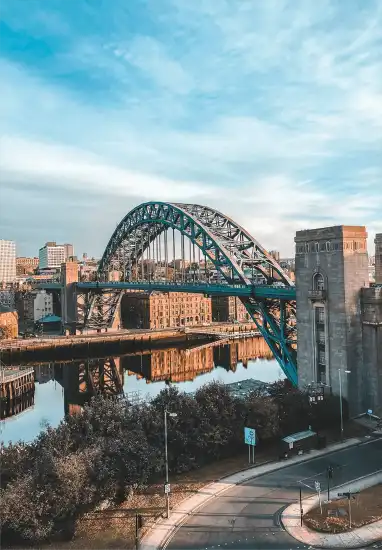
The Newcastle and Gateshead Clean Air Zone (CAZ) was introduced on 30 January 2023 to improve air quality across parts of Newcastle city centre and Gateshead. It operates 24 hours a day, 7 days a week, all year round, and only higher-emitting vehicles in specific classes are charged.
If you're driving into the zone, use Regit's Newcastle CAZ Checker before travel to see whether your vehicle meets the required emissions standards and whether a daily charge applies. If you live in other areas of the UK and are affected by ULEZ or CAZ, you can check if your car is exempt from the charges here.
What Is the Newcastle and Gateshead Clean Air Zone?
The Newcastle and Gateshead Clean Air Zone (CAZ) is a council-led scheme designed to improve air quality by reducing harmful vehicle emissions across parts of Newcastle city centre and Gateshead. It came into effect on 30 January 2023 and operates 24 hours a day, seven days a week, all year round.
It is a Class C CAZ, which means private cars and motorcycles are not currently charged, while certain taxis, vans, minibuses, buses, coaches and HGVs may need to pay if they do not meet the required standards.
The charge applies once per vehicle, per day, even if you enter and leave the zone multiple times. Drivers should always check their vehicle and route before travelling, especially if they regularly cross between Newcastle and Gateshead.
Does the Newcastle Clean Air Zone include Gateshead?
Despite often being referred to as the Newcastle Clean Air Zone, the scheme officially covers parts of both Newcastle and Gateshead. The zone includes much of Newcastle city centre and key routes across the River Tyne, including the Tyne crossings such as the Swing Bridge, High Level Bridge and Redheugh Bridge.
Because the Clean Air Zone spans both local authority areas, drivers travelling between Newcastle and Gateshead may enter the zone without realising it.
Is the Newcastle CAZ the same as a congestion charge?
The Newcastle and Gateshead CAZ is not a congestion charge. It targets higher-polluting vehicles that do not meet emissions standards, rather than charging most vehicles simply for entering the area.
Newcastle and Gateshead Clean Air Zone Map - Where Is the Zone?
The Newcastle and Gateshead Clean Air Zone (CAZ) covers much of Newcastle city centre and parts of Gateshead, including several major routes across the River Tyne. If you're driving into central Newcastle or travelling between Newcastle and Gateshead, it's important to know where the zone begins, as charges apply to non-compliant commercial vehicles that enter the boundary.
The easiest way to avoid surprises is to check the official CAZ map and use Regit's free CAZ Checker before you travel. Road signs are placed at entry points to warn drivers when they are entering the zone.
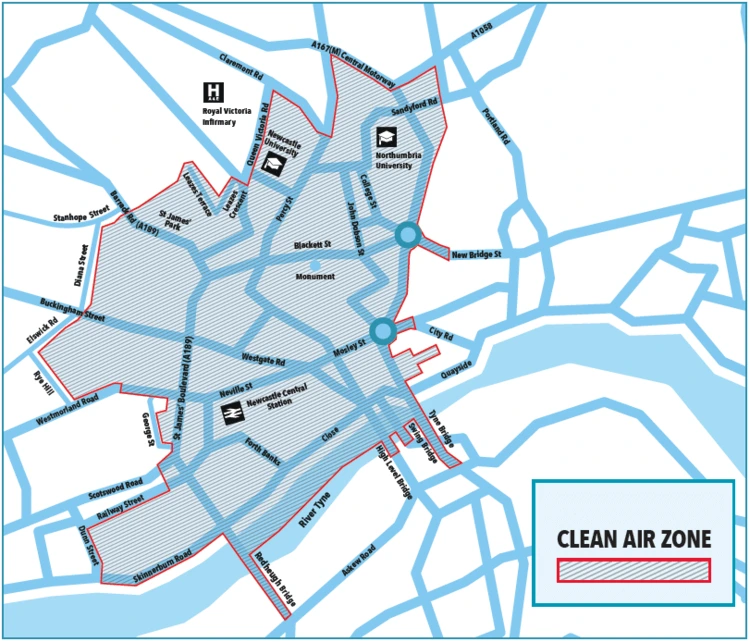
Identify the Clean Air Zone boundary
The Clean Air Zone boundary covers most of Newcastle city centre and extends across the River Tyne into parts of Gateshead. It has been designed to target areas where air pollution levels have historically exceeded legal limits.
Drivers entering the zone from any direction will see official Clean Air Zone signs before crossing the boundary. If your vehicle is subject to CAZ charges, entering the zone at any point during the day will trigger a single daily charge, regardless of how many times you drive in and out.
Where is Gateshead and why is it part of the Newcastle CAZ?
Gateshead sits immediately south of Newcastle upon Tyne, separated by the River Tyne. Thousands of vehicles cross between the two locations every day for work, business and leisure.
Because air pollution affects both sides of the river, Newcastle City Council and Gateshead Council introduced a joint Clean Air Zone to improve air quality across the wider urban area. Although many people refer to it simply as the "Newcastle Clean Air Zone", the scheme officially covers parts of both local authority areas.
Newcastle city centre streets and areas inside the zone
The Clean Air Zone includes much of Newcastle city centre, covering many of the city's busiest roads and surrounding areas. If you're travelling to destinations such as the Quayside, Central Station, the business district or nearby shopping areas, your route may pass through the CAZ.
Rather than relying on street names alone, it's best to check your planned route before travelling, as the boundary does not cover every road in the city centre and can vary depending on your direction of travel.
The four Tyne bridges inside the CAZ boundary
The Clean Air Zone includes four key crossings over the River Tyne:
- Tyne Bridge
- Redheugh Bridge
- Swing Bridge
- High Level Bridge
These bridges connect Newcastle and Gateshead and are all located within the CAZ boundary. If you're driving a non-compliant commercial vehicle across any of these bridges, you'll enter the Clean Air Zone and may need to pay the daily charge. Private cars and motorcycles are not charged for using these crossings under the current Newcastle and Gateshead Clean Air Zone rules.
Newcastle CAZ Vehicle Checker - Is My Vehicle Compliant?
The easiest way to find out whether you will be charged in the Newcastle and Gateshead Clean Air Zone (CAZ) is to use Regit's Newcastle CAZ Compliance Checker. By entering your registration number, you can quickly see whether your vehicle meets the required emissions standards and if a daily charge applies.
This is especially useful for businesses, taxi operators, van drivers and anyone unsure about their Euro standard. It also helps avoid unexpected charges and penalty notices.
Which vehicles must pay the Newcastle Clean Air Zone charge?
Charges apply to non-compliant commercial vehicles that enter the Clean Air Zone. This includes:
- Taxis and private hire vehicles
- Vans and light goods vehicles
- Minibuses
- Buses and coaches
- HGVs
These vehicles are charged a daily fee if they enter the zone without meeting the required emissions standards. Private cars and motorcycles are not charged under the current Class C rules.
Which vehicles are exempt from the Newcastle and Gateshead CAZ?
Some vehicles are exempt from charges even if they enter the Clean Air Zone. This includes:
- Private cars and motorcycles
- Vehicles that meet the required emissions standards
- Emergency service vehicles (such as ambulances and fire engines)
- Vehicles used by disabled drivers (Blue Badge holders, in certain circumstances)
- Military vehicles
- Certain historic vehicles
Exemptions may vary depending on vehicle type and usage, so it is still important to confirm eligibility using the Newcastle and Gateshead Council website.
What emission standard do vehicles need? Euro 4 and Euro 6 explained
Vehicle compliance in the Newcastle CAZ is based on European emissions standards, known as "Euro standards". These standards determine how much pollution a vehicle is allowed to produce. In general, petrol vehicles usually need to meet Euro 4 standards or higher, and diesel vehicles usually need to meet Euro 6 standards or higher, to be compliant. Always check by registration because compliance can vary by exact model and date of manufacture.
| Type of Vehicle | Minimum emission standard | Approximate vehicle registration date required to meet standard |
| Taxi, private hire vehicle |
Diesel: Euro 6 Petrol: Euro 4 |
Diesel: after September 2015 Petrol: generally after 2005, but vehicles that meet this standard have been available since 2001 |
| Light goods vehicle |
Diesel: Euro 6 Petrol: Euro 4 |
Diesel: after September 2016 Petrol: after January 2006 |
| Heavy goods vehicle, bus, coach | Euro VI | After 2014 |
Newcastle Clean Air Zone Charges: How Much Does It Cost?
The Newcastle and Gateshead Clean Air Zone (CAZ) daily charges only apply to vehicles that do not meet the required emissions standards and fall within the chargeable classes. Private cars and motorcycles are not charged under the current rules.
Current daily charges are:
- £12.50 per day for taxis, private hire vehicles, vans and minibuses
- £50 per day for buses, coaches and HGVs
The charge applies 24 hours a day, 7 days a week, and is enforced automatically using ANPR cameras. One daily charge covers all entries into the zone on that day.
How to pay the Newcastle and Gateshead Clean Air Zone charge
If your vehicle is not compliant, you must pay the Clean Air Zone charge for each day you enter the zone. Payment can be made:
- Online via the official government Clean Air Zone payment service
- By telephone using the designated CAZ payment line
Payment can usually be made up to 6 days before travel, on the day, or up to 6 days after entering the zone. It is the driver or registered keeper's responsibility to ensure payment is made on time, as you will not automatically receive a reminder. If the charge is not paid within the deadline, a Penalty Charge Notice (PCN) may be issued.
Grants and financial support for non-compliant vehicles
Financial support was introduced to help affected drivers and businesses upgrade to cleaner vehicles. Newcastle and Gateshead councils confirmed that the grants scheme was to close in January 2026, so any remaining eligibility should be checked against the latest council guidance.
The support was aimed mainly at non-compliant taxis, vans, HGVs and other chargeable vehicles. Private cars and motorcycles were not eligible because they are not charged under the CAZ rules.
What is the penalty for not paying the Newcastle Clean Air Zone charge?
If you enter the Clean Air Zone in a non-compliant vehicle and do not pay the daily charge within the required time frame, you may receive a Penalty Charge Notice (PCN). The standard penalty is typically:
- A £120 fine per offence, in addition to the unpaid CAZ charge
- Reduced by 50% if paid within 14 days of issue
If the penalty is not paid or challenged within the required timeframe, the charge can increase and be escalated further through enforcement action, including additional fees and recovery processes. To avoid penalties, it's important to check your vehicle compliance in advance and ensure payment is made within the allowed window after entering the zone.
Newcastle CAZ vs ULEZ: The Difference
The Newcastle and Gateshead CAZ is not the same as London's ULEZ. Both schemes aim to reduce emissions, but the Newcastle zone is a Class C Clean Air Zone focused mainly on higher-polluting commercial vehicles, while ULEZ applies much more broadly.
The most notable difference is that in Newcastle, private cars and motorcycles are not currently charged.
Check City Clean Air & Low Emission Zones
From Birmingham to Edinburgh, more cities are introducing Clean Air and Low Emission Zones. Use Regit to see if your car is compliant, understand the charges, and plan your journeys with confidence.




Frequently Asked Questions
What time does the CAZ charge apply?
The Newcastle and Gateshead Clean Air Zone operates 24 hours a day, 7 days a week, all year round, so the charge applies for that full day if a non-compliant vehicle enters the zone.
How is the Newcastle and Gateshead Clean Air Zone enforced?
The zone is enforced using ANPR cameras at entry points. These cameras identify vehicles automatically and match them against emissions and compliance data.
Do electric and hybrid vehicles have to pay the Newcastle CAZ charge?
Electric vehicles are not charged because they produce zero tailpipe emissions. Hybrid vehicles are not automatically exempt and should be checked individually using Regit's Newcastle CAZ Checker before travel.
Can I pay the Newcastle CAZ charge retrospectively after driving through?
Yes. Payment can usually be made up to 6 days after entering the zone, as well as before or on the day of travel. If payment is missed within this window, a penalty charge may apply.
When did the Newcastle and Gateshead Clean Air Zone launch?
The CAZ launched on 30 January 2023, with charges applying to non-compliant commercial vehicles entering the zone.
Does the Newcastle CAZ charge rental and hire vehicles?
If you are renting a standard private car in Newcastle, you will not be charged to drive in the Clean Air Zone. Charges only apply to older, non-compliant commercial vehicles such as vans, taxis and HGVs. Rental companies usually provide compliant vehicles, but it is still worth checking before you travel.
Does the zone cover the Gateshead side of the river?
Yes. The zone covers parts of both Newcastle and Gateshead, including major routes across the River Tyne.